KUCHING: The completion of the Miri–Marudi– Mulu and Long Terawan–Long Lama–Long Panai road network by 2029 will open up vast economic opportunities in the Baram area, transforming what was once an isolated region into a connected growth corridor.
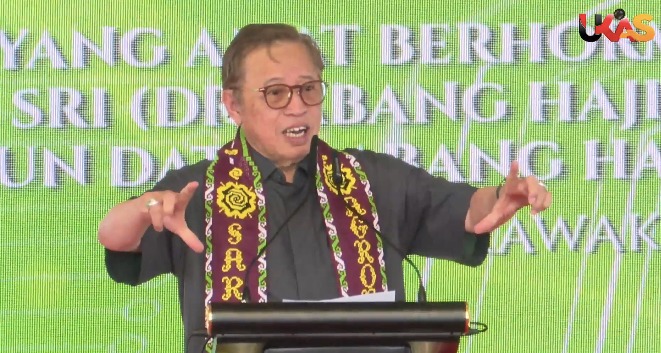
Premier Datuk Patinggi Tan Sri Abang Johari Tun Openg said the road development will form a loop linking Miri to Mulu, cutting travel time and paving the way for new industries and investments.
He said improved connectivity would not only ease movement but also unlock the area’s economic potential, particularly in agriculture.
“I see that the land there is highly suitable for coffee cultivation. Perhaps one day, we could even develop ‘Baram coffee’ as a local product,” he said during the Gabungan Parti Sarawak (GPS) convention on Sunday (Apr 19).
Abang Johari said Baram’s development is part of a broader strategy to ensure rural areas are no longer left behind, with infrastructure expansion extending to Limbang and Lawas by 2030.
He said Sarawak’s long-term planning has focused on reducing dependence on fossil fuels while improving rural connectivity and resilience.
“When diesel prices rise, people panic. If prices increase threefold, it creates uncertainty globally. That is why we acted early.
“Previously, many said hydrogen was expensive because the technology was not mature. But today, it can be produced at a much lower cost, and when compared to diesel, it is actually cheaper,” he said.
Abang Johari also highlighted Sarawak’s early transition to renewable energy in rural areas, noting that diesel generators have gradually been replaced with solar power under the Sarawak Alternative Rural Electrification Scheme (SARES).
He said areas such as Telang Usan are now powered by solar energy, ensuring uninterrupted electricity supply even as fuel prices rise.
“If we had continued relying on diesel, many longhouses would still be in darkness at night. But today, they remain well-lit, and households can use electricity without disruption,” he said.
At the same time, Abang Johari said the construction of bridges in areas such as Daro, Igan and Betong has reduced dependence on diesel-powered ferries, easing the financial burden on rural communities.
“As diesel prices increase, ferry costs also rise. But with bridges in place, people are less affected. That is why during the recent festive season, there were fewer complaints,” he said.