“Extraordinary claims require extraordinary evidence.” – Carl Sagan
A HERBAL capsule looks simple. It may contain a brown or green powder and promise benefits such as better immunity, healthier skin, or improved wellbeing. Yet before a medicinal plant can become a safe and reliable product, it must pass through a long journey. It may begin in a forest, a village garden, or a conversation with an elder before moving through identification, ethical collection, laboratory testing, safety evaluation, formulation, and quality control.
The capsule is only the final chapter. The science begins much earlier.
Many medicinal-plant studies start with traditional knowledge passed down within communities over generations. A plant may be prepared as a drink, poultice, bath, or food, and used for fever, wounds, stomach discomfort, or fatigue.
Such knowledge helps researchers identify plants that may deserve closer investigation, for example, in Sarawak. However, traditional use is not automatically the same as scientific proof.
Researchers still need to determine which part of the plant is used, how it is prepared, how much is taken, and whether it is safe. Traditional knowledge provides the first clue. Science must investigate what follows.
The first scientific step is correct plant identification. Common names can be confusing because one name may refer to several species, while the same plant may have different names in different communities. Some plants may also look similar but contain different chemical compounds.
Researchers therefore examine botanical features and may use DNA-based methods to confirm identity. A reference specimen is usually preserved so future researchers can verify exactly which plant was studied. If the plant is wrongly identified, every result that follows may become meaningless.
Ethical collection is equally important. Medicinal plants are not simply free laboratory materials. Some are linked to community knowledge and specific territories, while others may be rare or vulnerable to overharvesting.
Researchers must consider where the plant comes from, who holds the associated knowledge, and whether consent and permissions have been obtained. Communities should not be treated merely as sources of information, but as knowledge partners.
Once the correct plant has been collected responsibly, it is cleaned, dried, and ground. Researchers then use suitable extraction methods to separate groups of natural compounds.
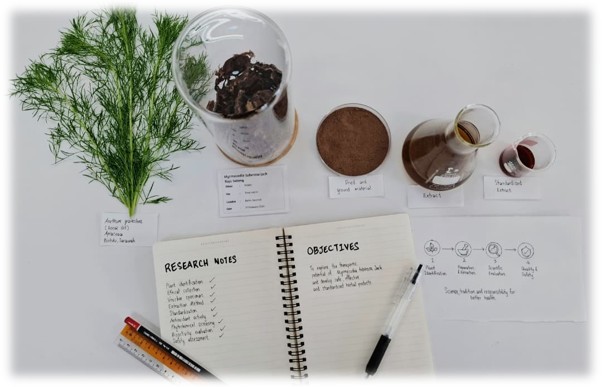
The method makes a difference. A traditional water preparation may produce a different chemical mixture from an extract made with alcohol or another solvent. Drying temperature, storage, and processing time can also affect the final composition.
The extract may then be tested for antioxidant, antimicrobial, or anti-inflammatory effects. These experiments help researchers identify promising candidates and understand possible biological mechanisms.
However, laboratory activity is only an early step. An extract that acts against bacteria in a laboratory dish may not work in the human body. A substance that protects cells under controlled conditions may behave differently after digestion and metabolism. The human body is far more complex than a test tube.
This is why terms such as “potential”, “promising”, and “preliminary” matter. They are not signs of weak science, but of responsible communication.
Safety must also be investigated. The word “natural” is often associated with safety, but this can be misleading. Some plant chemicals may be beneficial at one dose but harmful at another. Safety testing may examine whether an extract damages cells or organs, causes allergic reactions, or interacts with medicines.
The part of the plant matters too. A fruit may be edible while its seed, root, or concentrated extract requires greater caution. Pregnant women, children, older adults, and people with chronic illnesses may also face different risks.
Even when a plant shows promise, turning it into a product creates another challenge: consistency. Plants are living organisms, and their chemical composition may change according to soil, rainfall, temperature, harvesting season, and storage. Without standardisation, one bottle could be stronger than another.
Formulation is more than simply filling a capsule. A plant extract may be active in the laboratory but difficult for the body to absorb. It may also break down during storage. Its stability, shelf life, packaging, and recommended dose must therefore be evaluated.
Terms such as “micronised”, “hydrolysed”, or “high absorption” may sound impressive, but they should be supported by evidence. Marketing language should never move faster than the science.
Sustainability must also be considered. When a plant product becomes popular, wild populations may be harvested faster than they can regenerate. Responsible development should therefore include cultivation, propagation, and sustainable harvesting.
For Sarawak, this is especially important. Our biodiversity is a source of knowledge and future innovation, but it is also a living heritage that must be protected.
Consumers do not need to become scientists, but they can ask better questions. What plant species is used? Which part is included? Is the amount clearly stated? Are the claims based on human studies, laboratory findings, or marketing language? Has the product been assessed by the relevant authorities?
Consumers should also be cautious when a product claims to cure many unrelated conditions, promises immediate results, or uses scientific terms without explaining the evidence.
The journey from medicinal plant to herbal capsule is not simply a matter of drying leaves and placing powder into a container. It involves traditional knowledge, botanical accuracy, ethical responsibility, scientific evidence, safety, standardisation, formulation, and sustainable sourcing.
Behind every responsible herbal product should be more than an attractive label. There should be evidence, transparency, and respect – for science, consumers, communities, and the biodiversity from which the product began.
The views expressed here are those of the writer and do not necessarily represent the views of Sarawak Tribune. The writer can be reached at ab_fauziah@upm.edu.my.