
Photos: Ghazali Bujang
KUCHING: Despite its strong and often unpleasant smell, belacan (shrimp paste) remains an indispensable ingredient in many Sarawakian kitchens.
For many households, belacan is more than just a cooking ingredient.
It is a key component in a variety of local dishes and sambal recipes, making it a staple that few Sarawakians can do without.
Its presence in everyday cooking highlights its cultural importance, where it is valued not only for its strong flavour but also for its role in defining traditional Sarawakian cuisine passed down through generations.
Beyond its local significance, belacan has also quietly made its way into international markets.
While its strong aroma may be off-putting to some, the product has successfully penetrated overseas demand thanks to its unique flavour profile, which continues to attract both curiosity and appreciation from foreign consumers.

Belacan producer Jajol Bujang, who hails from Bako, said he first started the belacan business together with his late wife, marking the beginning of what has now become nearly 40 years of involvement in the traditional shrimp paste industry.
The 74-year-old shared that his journey in the trade began on a small scale before gradually growing into a steady supply network that now reaches both local and external markets.
“I have sold my homemade belacan to tourists from China and Western countries. They came here directly to buy it.
“Besides that, we also supply this food product to shops around Kuching and even in West Malaysia,” he told Sarawak Tribune.
The continued interest from both local and foreign buyers shows that traditional products still hold strong value in today’s modern food industry, where authenticity and heritage remain important selling points.
He said that the daily routine involved in producing belacan, which is a labour-intensive process requiring time, skill, and careful attention.
The entire process takes about a day to complete before the final product is packaged and prepared for distribution.
He said the first step involves catching bubok (geragau shrimp), which serves as the primary raw ingredient in the production of belacan.
Once harvested, the shrimp are processed using a special machine for grinding, ensuring they are prepared for the next stage of production.
“After that, we dry it under the sun until it is completely dry before placing it into moulds.
“Next comes the packaging process, and the belacan is ready to be delivered to shops for sale,” he said.
Although the process may appear straightforward, he stressed that producing high-quality belacan depends heavily on environmental conditions, particularly weather.
He said unpredictable weather remains one of the biggest challenges faced by producers, especially since the drying stage requires strong and consistent sunlight.
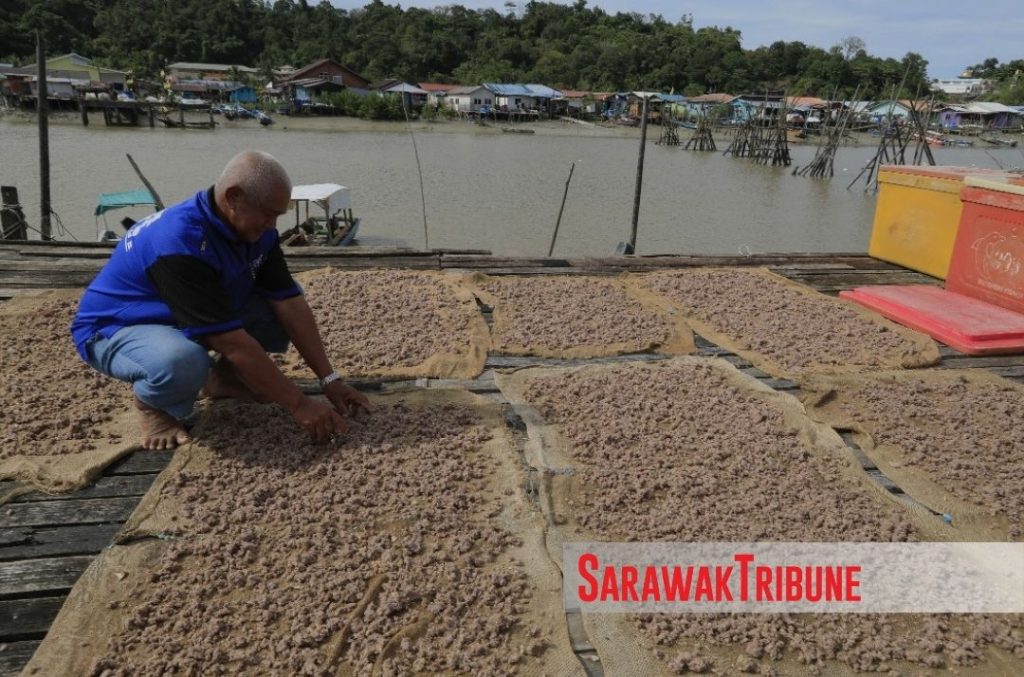
“We need very hot weather to properly dry the shrimp. If it is not fully dried, the belacan will spoil,” he said.
According to him, even slight changes in weather conditions can affect production schedules, sometimes delaying the entire process and impacting output.
Despite these challenges, producers continue to maintain traditional methods that have been used for decades, preserving both quality and authenticity in the final product.
Meanwhile, fisherman Jobni Ini, 59, spoke of his 35 years of experience catching bubok in the Bako River, a practice he has been involved in since he was 14 years old.
For him, the process of catching bubok is deeply tied to experience and understanding of natural conditions rather than fixed schedules or timing.
According to him, there is no fixed time for catching the tiny shrimp, as it largely depends on the weather conditions of the day.

“Whether the tide is high or low, we can catch up to 210 kilograms of bubok when the weather is hot. However, catches become unpredictable during the rainy season,” he said.
Over the years, he has learned to adapt to these changes, adjusting his routine based on environmental conditions and seasonal patterns.
Elaborating, Jobni revealed that the bubok he catches is not intended for commercial sale in its raw form but is instead used for his own belacan production.
“I also make belacan, so I go down to the river to catch bubok, which is the main ingredient in producing the product,” he added.
His dual role as both fisherman and producer reflects the close relationship between local livelihoods and traditional food production in Sarawak, where raw materials are often sourced and processed within the same community.