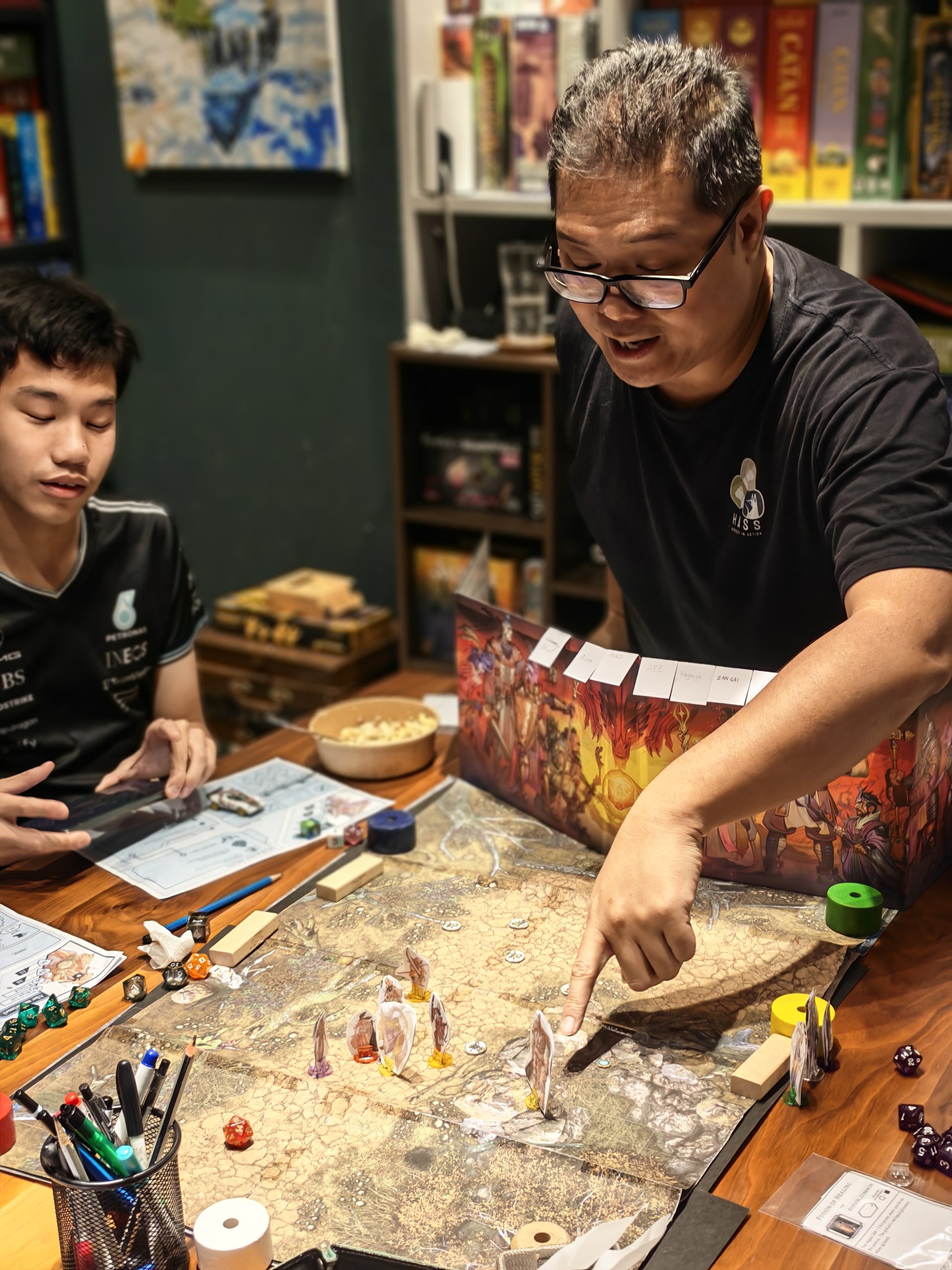
It’s always exciting to see a game of Dungeons and Dragons (D&D) — it’s like watching a story come alive, with the game master (GM) navigating uncharted waters according to his imagination, while the players decide their fate based on the roll of a die. Playing it requires imagination and charisma.

Though the adventures on the board may be unpredictable, the possibilities are limitless. Altogether, Tabletop Role-Playing Games (TTRPGs) bring about friendships through the hardships set by the GM. And that’s just what D&D is all about.
One moment, players could find themselves exploring an unfamiliar kingdom, while the next, they might be negotiating with a mysterious stranger, fighting a fearsome creature or searching for a way out of a dangerous situation.
There is no fixed script to follow, nor is there a guaranteed outcome. Instead, the story unfolds through the imagination and decisions of everyone around the table.
American veteran and former history teacher Chris Carter, who now resides in Kuching, said that the attraction of the game has never been limited to the adventures themselves.
Having been involved in TTRPGs since the 1970s, he sees them as a way for people to exercise their imagination, build friendships and discover parts of themselves that might otherwise remain unexpressed.
“TTRPGs are, at their core, social, cooperative storytelling. Unlike conventional board games, where players generally follow a set of rules towards a winning condition, TTRPGs allow participants to shape their own adventures,” he explained.
The game, he added, involves one person taking on the role of the GM, creating the setting, characters and circumstances surrounding the story. The remaining players each develop their own characters, taking on different personalities, abilities and backgrounds as they navigate the imaginary world.
“The GM then describes what happens, while players decide how their characters respond. Whether it is crossing a rickety bridge, confronting an enemy or finding an alternative solution to a problem, their actions determine how the adventure progresses,” he said.
Played with dice, the outcome and possibility of success or failure are determined by the game’s rules and the numbers rolled. However, the mechanics are only part of the experience.
“The mechanics are not the game. The cooperatively constructed story is the game. It is why people play,” Chris noted.
A game without a fixed ending
What makes D&D particularly interesting is that players are not restricted to a predetermined storyline. Although the GM may prepare an overarching adventure, the players are free to make their own decisions, sometimes taking the story in directions that were never anticipated.
A campaign, which refers to a series of connected gaming sessions, can continue for months or even years, depending on the players’ commitment.
For Chris, this freedom is what sets TTRPGs apart from conventional board games and video games.
While board games generally have defined objectives and winning conditions, D&D places greater emphasis on cooperation and the journey itself.
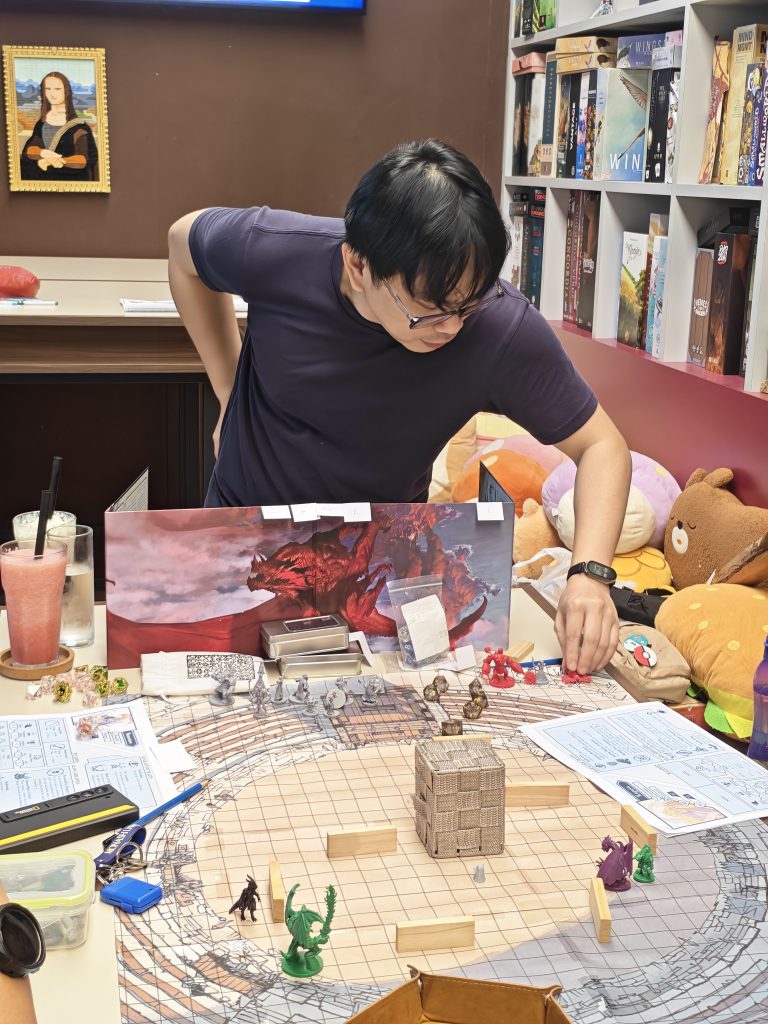
Players work together rather than against one another, drawing on their individual characters’ abilities to overcome challenges. The GM, meanwhile, is not simply a storyteller who knows how everything will end.
Instead, the GM must constantly improvise, responding to the players’ decisions and adapting the story as it develops.
“Whenever the players interact with non-player characters or interact with the world around them, they are actually interacting with the GM,” he explained.
This means that no two gaming sessions necessarily unfold in the same way, even when they begin with the same adventure.
To someone unfamiliar with the hobby, the amount of imagination involved might seem daunting. Yet, Chris believes that it is precisely what gives the experience its appeal.
“Without these elements, there is no game. Hard stop,” he said, referring to imagination, storytelling and improvisation.
An old friendship renewed
Chris’ interest in TTRPGs began when he was still a tweenager. He recalled playing Chainmail with his best friend, an experience that eventually led him to D&D. It immediately caught his attention, bringing together two things he enjoyed: playing games and using his imagination.
His first formal adventure was Keep on the Borderlands, a professionally produced adventure that he still remembers fondly.
The excitement among his group of friends was such that they even improvised their own gaming equipment.
“We were so excited to play that we ‘borrowed’ my mother’s spare tea cups to use as shakers, and wrote numbers on little cardboard chits in order to simulate having dice,” he recalled.
What began as a childhood interest continued into his military service in the 1980s.
However, as college, marriage, career and fatherhood came along, Chris gradually put the hobby aside to focus on other responsibilities. It was only after retiring that he found his way back to role-playing.
Describing the experience as renewing an old friendship, he said the years away had not diminished his interest. Instead, his life experiences had made the hobby even more meaningful.
Chris shared that returning to the table was not simply about revisiting a game he enjoyed as a young person, but also about rediscovering an activity that allowed him to connect with others through shared stories.
Finding confidence around the table
Beyond entertainment, Chris believes TTRPGs can also help people develop confidence, communication and problem-solving skills.
Since players are encouraged to make decisions, contribute ideas and interact with others, the experience provides an environment where they can gradually become more comfortable expressing themselves.
Having been playing for decades, Chris has noticed how players grow in confidence as they become more willing to participate and take chances with their characters.
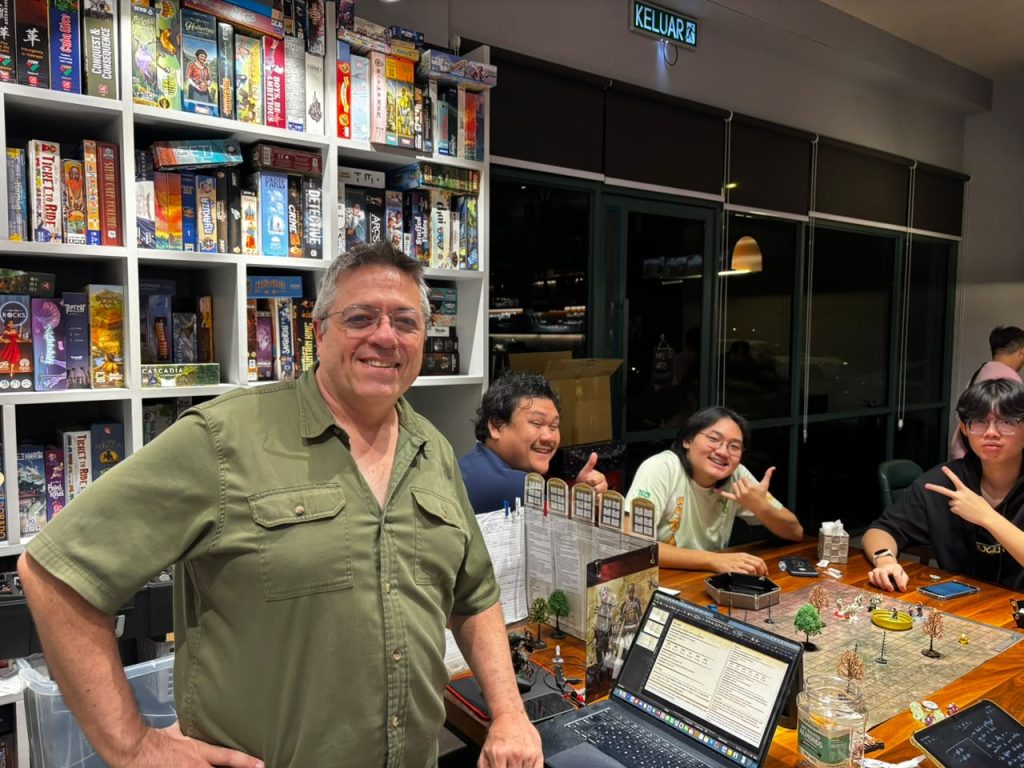
“Furthermore, players can and do find their voices in TTRPGs,” he said.
He added that the cooperative nature of the game creates a supportive environment where participants can express themselves without fear of being rebuked.
For some, taking on a fictional character may even provide an opportunity to explore aspects of their personalities that they might not normally show in everyday situations. Chris believes that although people carry different responsibilities and expectations in their daily lives, role-playing allows them to step outside those familiar identities.
“We all play roles in our lives, roles not entirely of our own choosing. Father, mother, sister, brother … The list is long. I have found that the more people role-play, the more people reveal themselves. Their best selves. The heroes that reside in all of us,” he said, adding that taking on a character can give players room to express themselves in different ways.
Keeping the community alive
In Kuching, Chris believes interest in TTRPGs is growing, with people from different age groups finding their way into the hobby. He has played with participants ranging from middle-school students to retirees, although most of his interactions within the local community have been with people in their 20s, 30s and 40s.
“Most people in this group are college educated and working professionally, which reveals to me that we may be missing a significant portion of the population,” he observed.
Chris revealed that this also presents an opportunity to introduce the hobby to a wider group of people, beyond those who are already familiar with tabletop gaming. He noted that interest in the city had been present for some time, but many enthusiasts previously lacked a stable and consistent venue where they could explore it.
With Bone Daddy at The Podium, Kuching, hosting meetings, there is now a regular place for enthusiasts to gather, play and build connections with others who share the same interest.
While online gaming platforms have made it easier for people to connect virtually, Chris remains convinced that face-to-face interaction offers something that cannot be replicated through a screen.
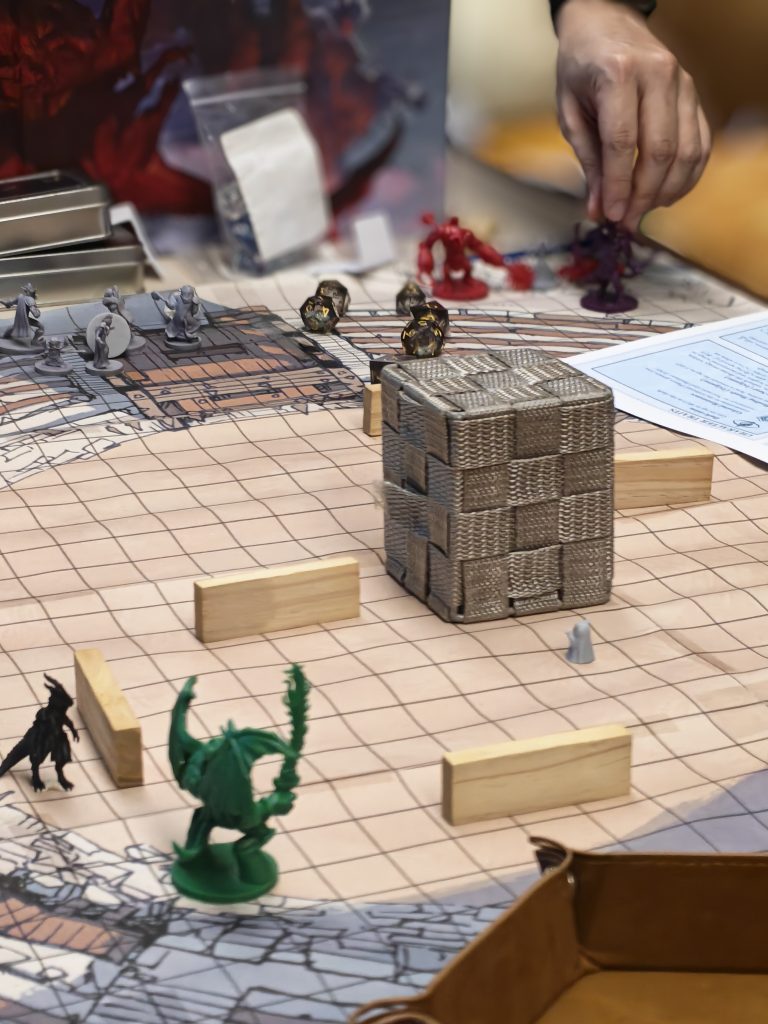
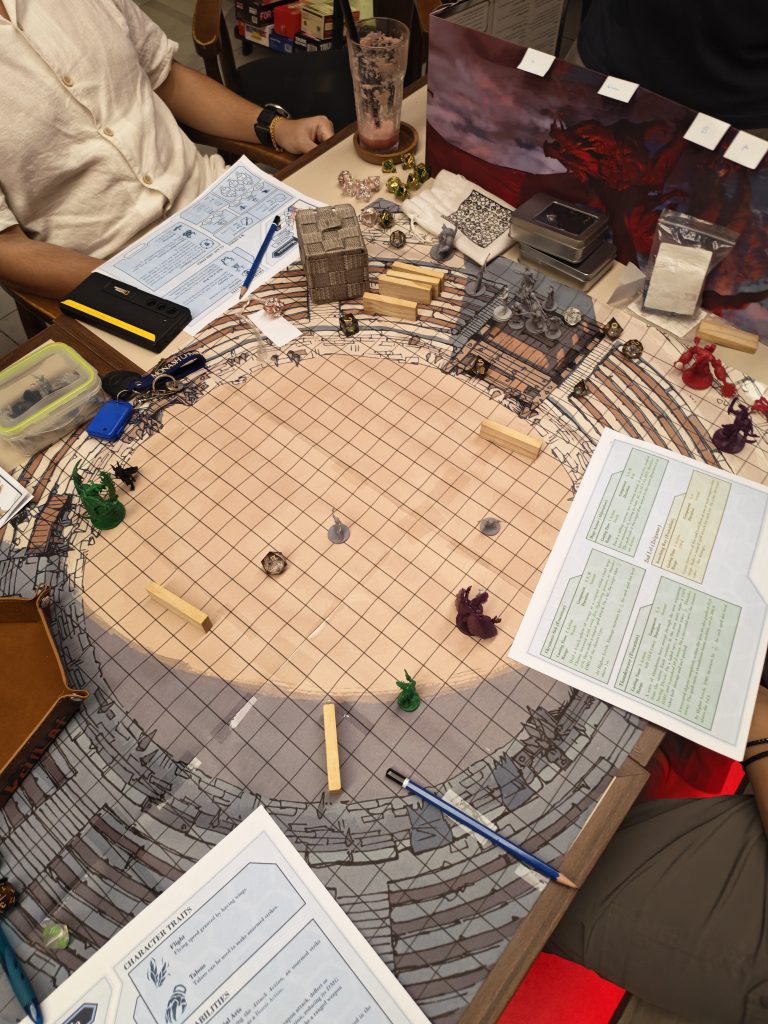
He refers to this as the “Adam Effect”, explaining that while online interaction is better than having no interaction at all, meeting in person is far more rewarding.
“Online play is better than not playing, but face-to-face playing is so much more rewarding,” he added.
Drawing a comparison with people who maintain relationships over video calls, Chris pointed out that virtual interactions often leave people wanting more meaningful time together.
“Those of us who live far apart from loved ones know the thrill of spending time on video calls, yet each interaction builds the desire in us to return, to spend real time with real people, face to face and heart to heart,” he said.
He likens the experience to the campfires of prehistoric societies, where people gathered to share stories, strengthen their sense of community and find comfort in one another. Perhaps this is why, despite the changing entertainment landscape, the appeal of sitting around a table with a group of friends remains.
The characters may be fictional, the adventures imagined and the outcomes determined by a roll of the dice, but the friendships formed along the way are very real.
For Chris, the value of the hobby ultimately lies in bringing people together.
“We need the campfire to share, to swap stories, to hold back the darkness and fears of the night. Find a TTRPG. Light the fire. Share.”