Part 2
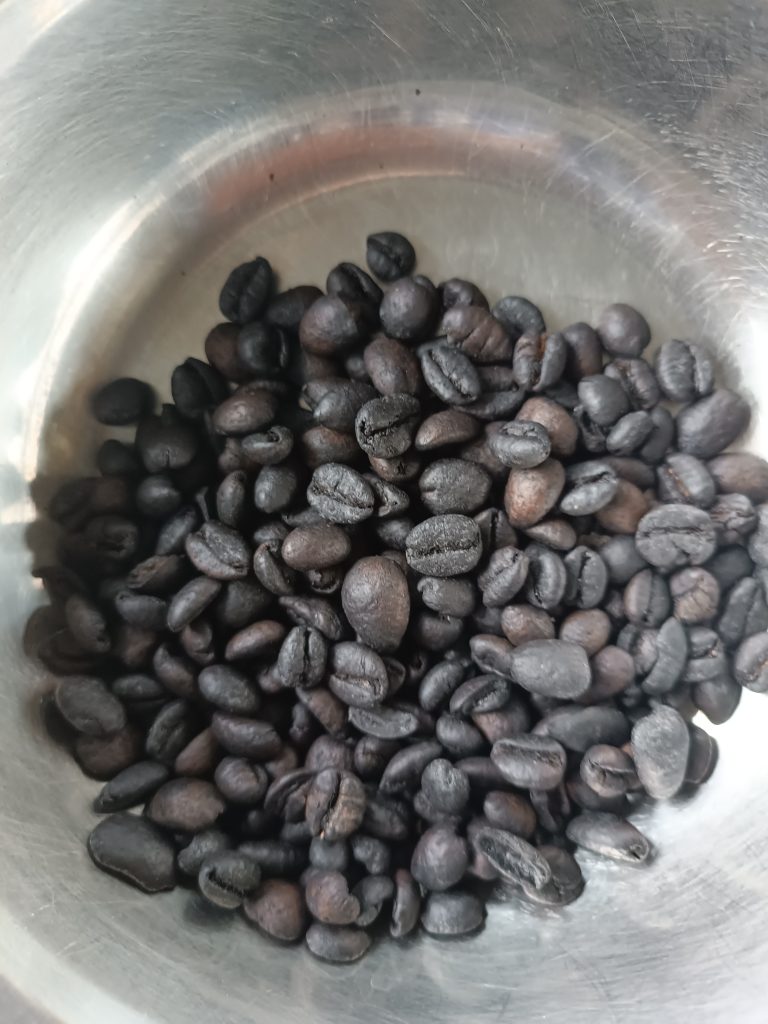
THE coffee beans crackle rhythmically inside the roaster, their colour deepening with every turn as fragrant oils awaken under the heat.
Warm steam curls into the air, carrying a rich aroma of toasted nuts, caramel and ripe tropical fruit that fills the room.
Moments later, the freshly brewed coffee is poured into waiting cups. The first sip is smooth yet bold, revealing layers of sweetness and gentle smokiness that linger on the palate.
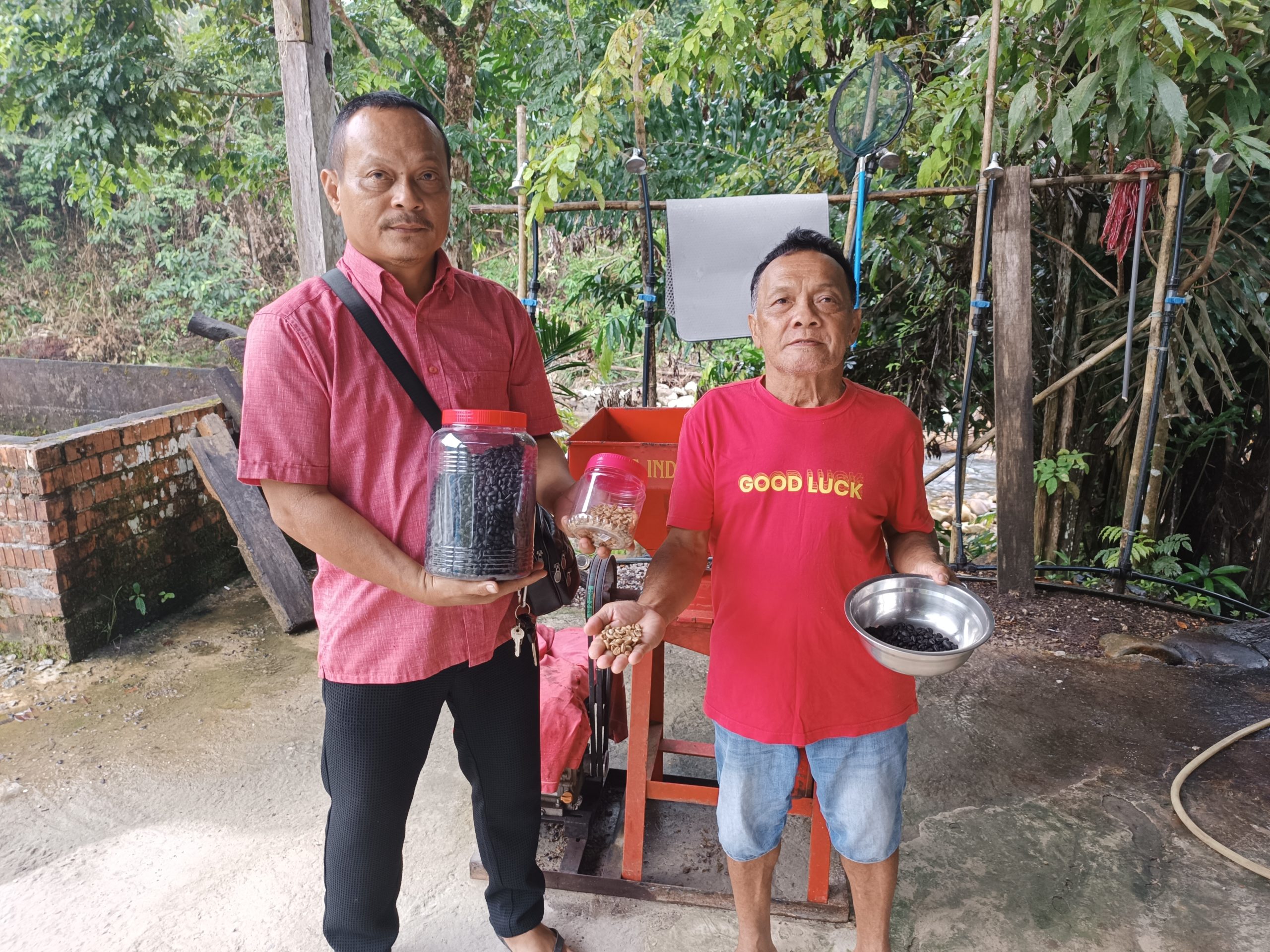
Few would guess that this remarkable brew, capable of rivaling premium coffees, began life on a small hillside in Kampung Tringgus Bong in Krokong, Bau, about 57.2 km from Kuching.
The journey of one bean
Every cup of Liberica coffee begins with a single bean.
By the time that bean reaches your lips, it has travelled a journey measured not only in kilometres, but in seasons, patience and faith. It has witnessed the hopes of a farming family, survived months under the tropical sun or even endured the heat of the roaster and finally surrendered its aroma to a waiting cup.
Selected from healthy, ripe cherries, the bean was carefully nurtured into a seedling. Every morning, the seeds were watered, watched over and waited. Yet beneath the optimism lingered uncertainty.
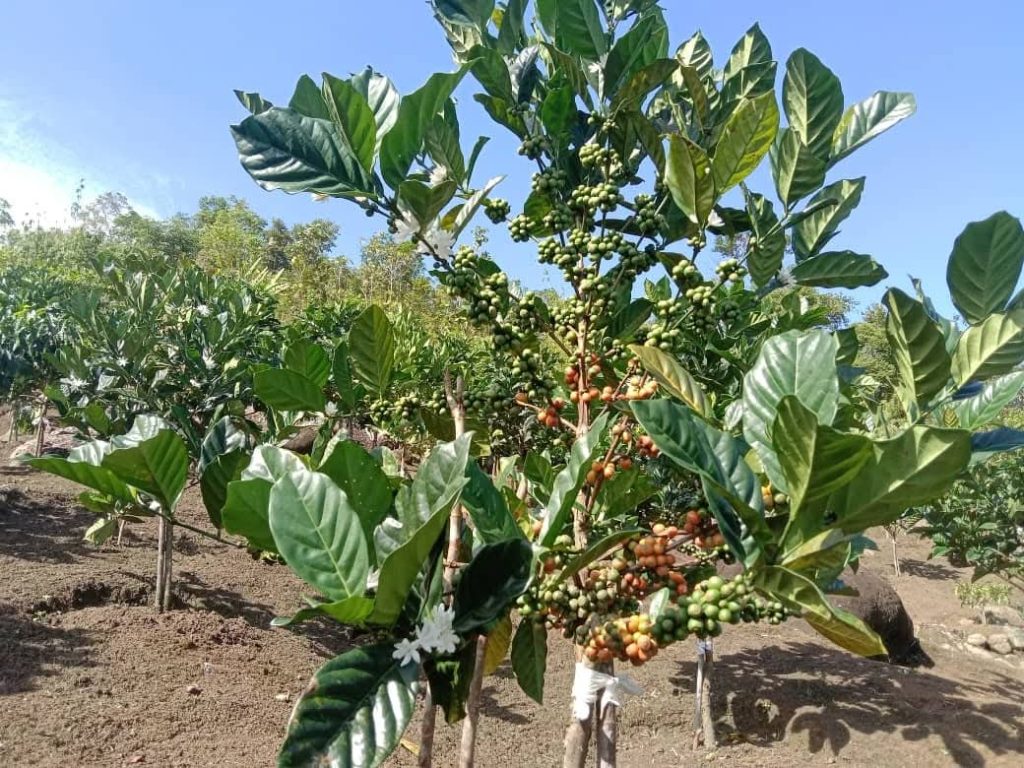
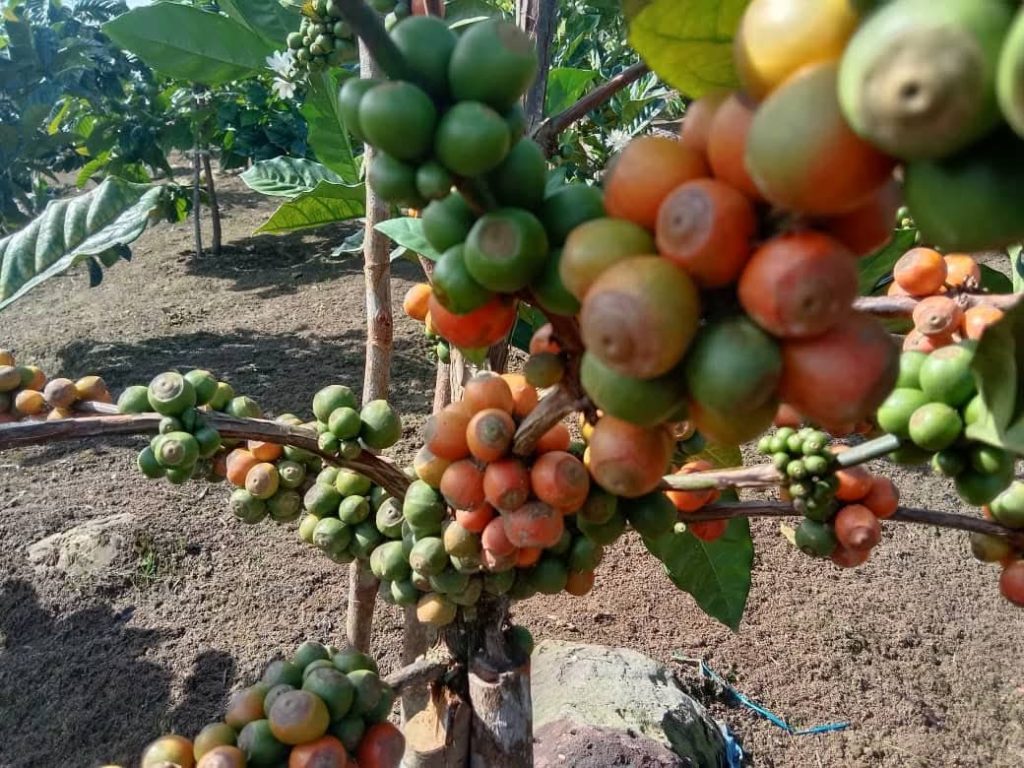
Inside that nursery, the first seedlings represented far more than young coffee trees. They embodied hope — a belief that the village’s future could be rewritten.
Months later, the seedlings left the nursery.
Transported to the farmers and carried carefully to the rolling hills overlooking Kampung Tringgus Bong, each one was planted into freshly dug earth.
Farmers pressed the soil gently around the fragile stems as rain clouds drifted overhead, providing nature’s first blessing.
Coffee demanded patience unlike any crop many villagers had grown before. At least two years would pass before the first meaningful harvest. For families accustomed to quicker returns, it was a leap of faith.
“We knew coffee takes time,” Tringgus Bong village chief and one of the participants Midia Sitat says. “There was no guarantee it would work.”
Yet every seedling planted became an act of courage. Every row of Liberica trees became a quiet declaration that the community was willing to invest in tomorrow rather than settle for yesterday.
Then came the season they had waited for.
Branches once lined with glossy green leaves now bent beneath clusters of brilliant crimson cherries. The hillsides that had once held uncertainty now glowed with colour.
Farmers picked ripe cherries and carried baskets between the rows. Some neighbours exchanged stories as they meet each other, laughter replacing the doubts that once surrounded the project.
For many, the first harvest marked more than the arrival of coffee cherries. It was proof that faith had borne fruit.
“This was the day we knew we had made the right decision,” the Kpg Tinggus Bong coffee pilot project head Baon Apung, 62, said with quiet pride.
The freshly harvested cherries soon began another transformation.
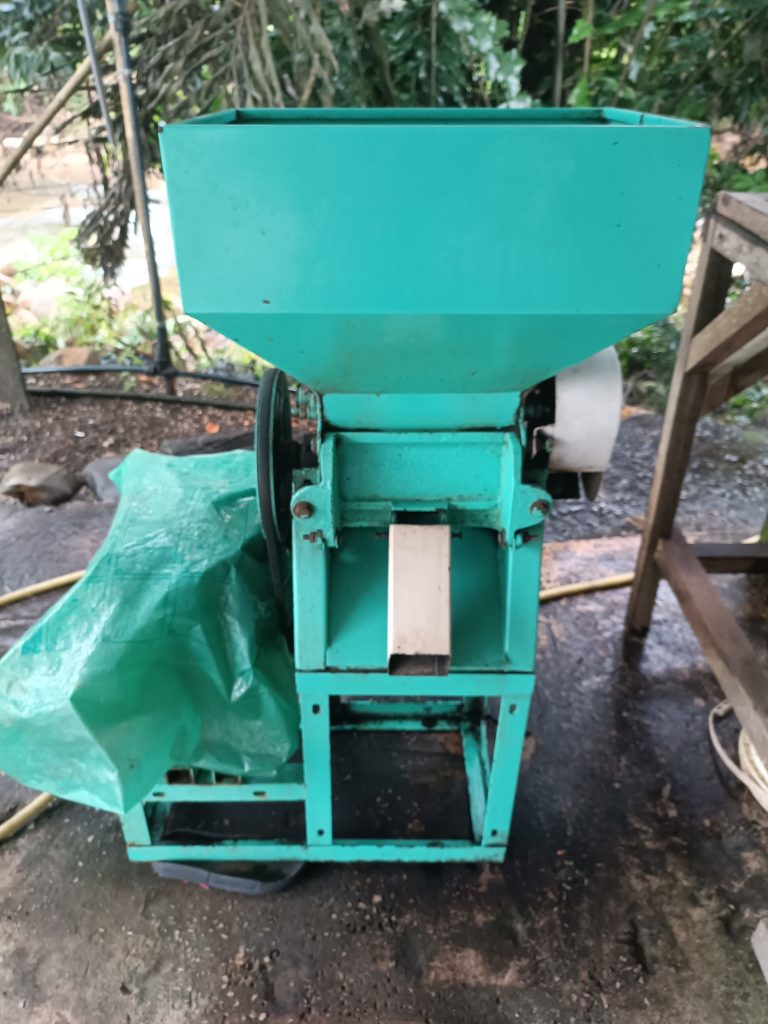
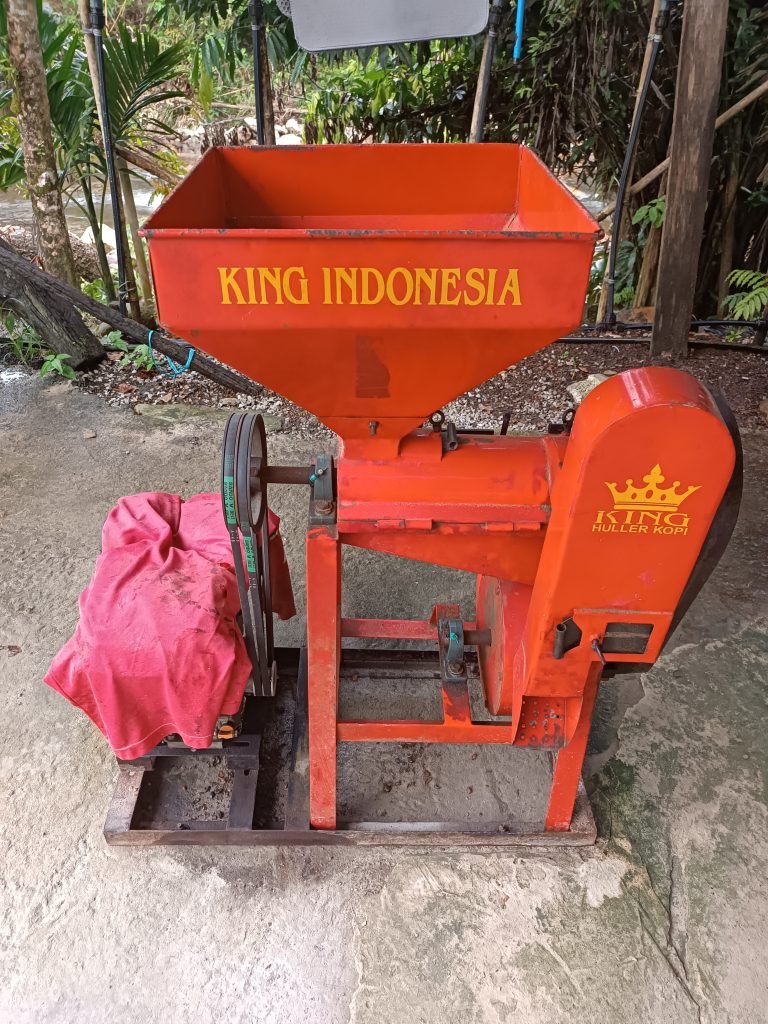
Their outer skins were removed before the beans were washed in clear pipe water or water flowing through the village. The sticky mucilage that clung to each bean was gently cleaned away. Every step demanded care and precision because quality, the farmers had learned, is never an accident.
The beans were then spread beneath the Sarawak sun.
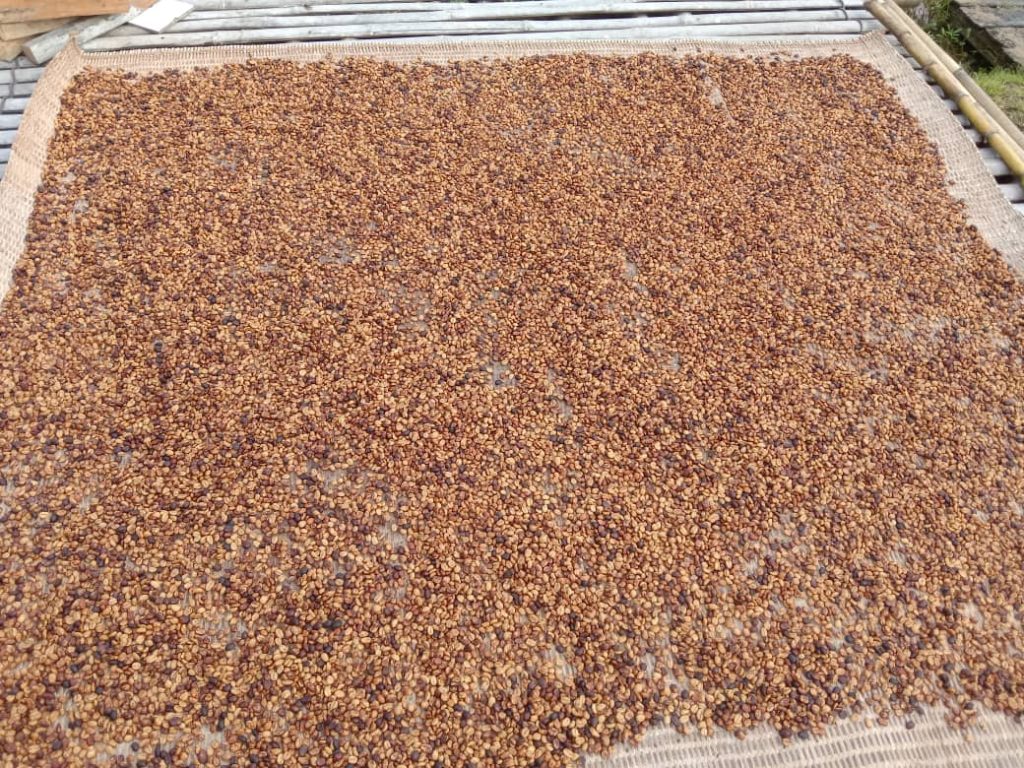
Day after day they rested on drying verandah or tanju — an open, unroofed outer veranda used for drying crops — turned repeatedly by careful hands to ensure even drying. At dusk they were covered against moisture before being uncovered again with the morning light.
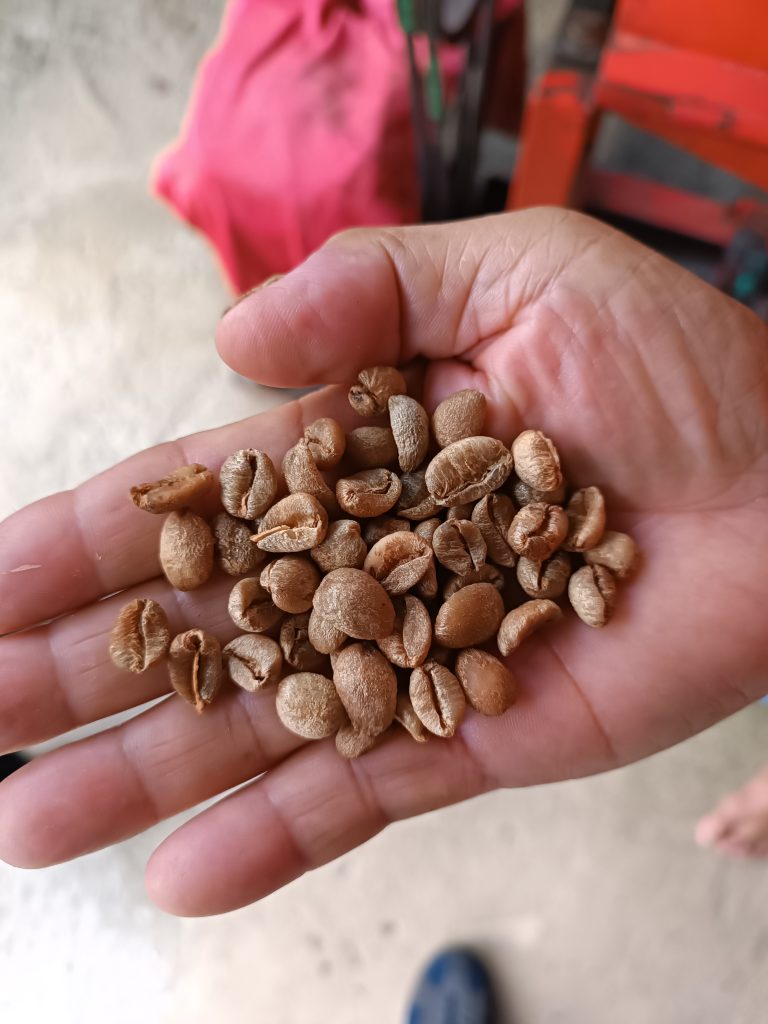
Only after weeks of careful drying did the pale green beans enter the roaster or are sold.
Months of careful cultivation, harvesting and processing culminated in this single moment.
But what rose with the aroma was something even richer. It was the story of a village, located at the edge of Krokong area, neighbour to the fellow Bidayuh villages in Upper Padawan.
When a customer lifts that cup in a café, they taste far more than coffee. Hidden within every sip are two years of waiting, the uncertainty of farmers who dared to try something new, the steady hands that nurtured every tree and the determination of a community that refused to let doubt define its future.
For the bean, the journey ends at the table. For Kampung Tringgus Bong, it is only the beginning.
Because this is more than a cup of coffee. It is the story of a village that transformed its future, one bean at a time.
Counting the transformation
From a small pilot project involving 22 participants, coffee cultivation in Tringgus Bong has emerged as a promising source of household income and opportunity for the community.
The project covers 44 acres, with 8,800 coffee trees planted and current production reaching about 880kg a month. Each participating household, having planted 308 trees, earns around RM2,000 to RM2,500 monthly from the crop, while initial start-up costs were supported by the Sarawak government through the Agricultural Facilitation Fund (AFF).
“Some farmers have since expanded their farms using their own resources, increasing the number of trees beyond the pilot project, earning more than the others,” said Midia.
To support further growth, Serembu assemblyman Datuk Miro Simuh has approved RM1.2 million under his GKCDA fund to build a farm road connecting the farms, making it easier to transport harvested coffee. The project is expected to be awarded this year.
Miro said coffee cultivation has actually expanded in Serembu beyond the successful Tringgus Bong pilot.
Today, coffee is grown across the Tringgus area, including Kampung Tringgus Bong, Kampung Tringgus Rabak Rotan and Kampung Tringgus Matan Nguan. Planting has also spread to Kpg Kaman, Kpg Gumbang, Pkg Padang Pan in Krokong and Kpg Podam in Serembu.
“Altogether, about 80,000 coffee trees have been planted in Serembu. In three years, we expect production to reach 700 to 1,000 tonnes of coffee beans annually, giving Bau the potential to become a major coffee production hub,” he said.
The next chapter
As the pilot Liberica coffee project in Kampung Tringgus Bong enters its next phase, the challenge is no longer whether coffee can grow in Bau, but whether the community can build a sustainable rural economy around it.
The opportunities are significant. Beyond selling coffee cherries and green beans, villagers can tap into higher-value activities such as roasting, packaging and producing specialty coffee, cold brews, coffee-infused snacks and souvenirs.
A distinctive “ringgus Liberica” brand could command premium prices by highlighting its unique origin story, indigenous farming practices and community-led development.
Coffee also opens new possibilities for tourism. Visitors increasingly seek authentic rural experiences, creating demand for coffee trails, guided plantation walks, farm stays, harvesting experiences and local cafés serving freshly brewed Liberica.
Combined with Bau’s existing attractions including caves, limestone landscapes and Bidayuh cultural heritage, coffee can become another compelling reason for tourists to extend their stay, strengthening Bau’s position as a coffee destination in Sarawak.
The expansion could also inspire a new generation of rural entrepreneurs. Young people may find opportunities in coffee processing, café businesses, digital marketing, agritourism, e-commerce and content creation, making agriculture a more attractive career than traditional farming alone.
However, scaling up will require careful planning. Maintaining consistent quality, securing sufficient processing facilities, building market access and protecting product standards are essential if the coffee is to compete beyond local markets.
Farmers will also need continuous technical training, access to financing and strong cooperative management to ensure equitable returns.
Climate variability, labour shortages and fluctuating coffee prices remain long-term risks. Expanding too quickly without guaranteed buyers could also expose farmers to financial uncertainty.
Ultimately, the future of Kampung Tringgus Bong’s Liberica industry will depend not only on producing more coffee, but on creating an integrated ecosystem where farming, tourism, entrepreneurship and branding reinforce one another. If managed well, the village could emerge as a model for community-driven rural transformation in Sarawak.
A legacy in the making
Five years ago, when the first Liberica seedlings arrived in Kampung Tringgus Bong, the future was uncertain.
Some villagers wondered whether the project would survive. Others questioned why they should abandon crops that had sustained generations. The hillside was largely quiet, its potential hidden beneath shrubs and secondary growth. The few who planted the seedlings did so with more hope than certainty.
Today, the same people speak a different language, not only of harvests and income, but of opportunity.
Families who once depended on irregular earnings now discuss coffee quality, processing techniques and market demand. Parents see the crop as a way to provide better education for their children. Young villagers, who once believed success could only be found outside their community, are beginning to imagine careers in coffee entrepreneurship, tourism and value-added products without leaving home.
What has changed most is not simply their livelihood, but their identity.
The villagers no longer see themselves merely as smallholders growing another crop. They have become pioneers of Sarawak’s emerging Liberica movement, custodians of a story that links their land, culture and resilience. Coffee has given them more than an alternative source of income — it has given them confidence that rural communities can shape their own future.
Challenges remain. Markets must be expanded, quality maintained and the next generation persuaded that agriculture can be both profitable and meaningful. Yet the foundation has been laid.
As the afternoon sun settles over Kampung Tringgus Bong, the hillside looks very different from the one that greeted visitors five years ago.

Rows of thriving Liberica trees stretch across the slopes. The sound of laughter replaces uncertainty as families and visitors move among the branches, touring the farm land and picking ripe cherries together. Children help carry baskets while elders share stories beneath the shade of the coffee trees with the visitors.
The harvest is no longer measured only in kilogrammes of cherries.
It is measured in renewed hope, restored dignity and a village that dared to believe a small seedling could grow into a new future.
And on this hillside in Kpg Tringgus Bong, that future has already begun.