In the quiet coastal village of Pasir Pandak, art, memory, and conservation converge through the Frugal Artist-in-Residence (FAiR) project – a collaboration between Malaysian and UK institutions that transforms local stories and environmental concerns into creative expressions of hope and renewal.
Reviving a Coastal Heritage through Arts and Conservation

PASIR PANDAK has always been more than just a village by the sea; it is a place where memories, nature and, now, art intertwine. I was first introduced to this hidden gem by the late batik artist Felix Ang, who affectionately called it his “little Hawaii”.
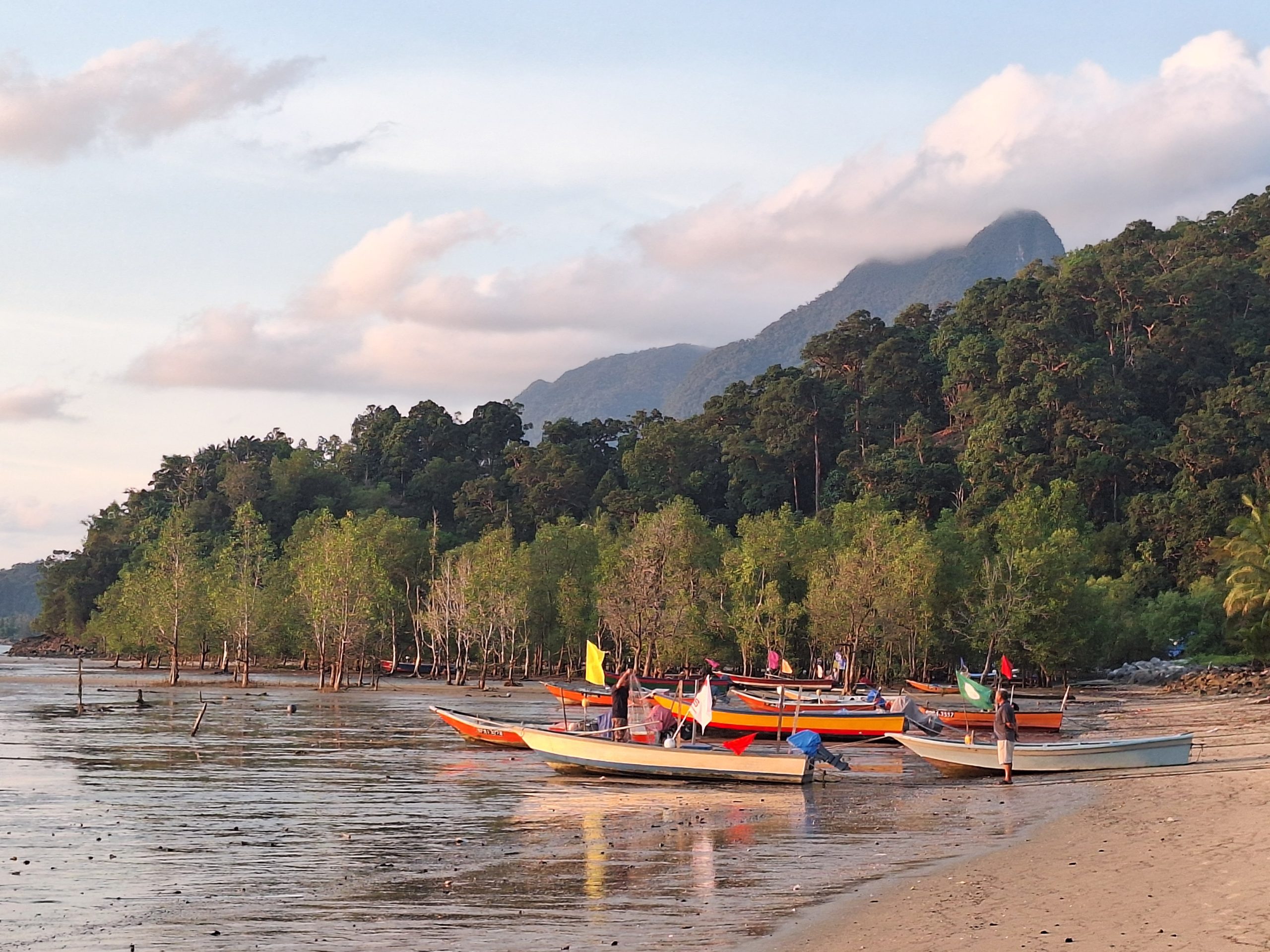
With its swaying coconut palms and the silhouette of Mount Santubong in the distance, Pasir Pandak captured the quiet beauty of Sarawak’s coastline long before tourism and development began to reshape it.
More than two decades ago, reaching Pasir Pandak meant driving along a narrow mud road lined with rare tropical plants. Kampung houses stood in bright hues, with colourful batik sarongs fluttering on clotheslines.
At the heart of the village, near a modest mosque shaded by a tall mango tree, the air carried the scent of the South China Sea.
During durian season, villagers would greet visitors with baskets of fruit – fragrant, rich and unforgettable. By mid-afternoon, a van from Kuching would arrive to collect the fishermen’s daily catch, while we lingered to buy prawns and fish fresh from the boats.
As the sun set, the villagers would cook our meal in their homes and serve it to us on the beach. The sight of the orange sun dipping below the horizon, while along the shore colourful fishing boats rested – some tilted slightly, their hulls streaked with salt and sun-faded paint – remains one of my most cherished memories.
Those were the days when Pasir Pandak was untouched, quiet and deeply human – a place where nature, tradition and community existed in harmony.


The Present: Art as a Bridge to Conservation
Fast-forward to today, and Pasir Pandak remains a cherished coastal community – but one now facing the realities of development and environmental change.
My recent visit to RESONANCE – Echoes of Nature, an exhibition at Think & Tink, reminded me how the village continues to evolve while staying true to its roots.
The Frugal Artist-in-Residence (FAiR) Project
The Frugal Artist-in-Residence (FAiR) is a year-long collaborative project between Universiti Malaysia Sarawak (UNIMAS) and the University of Coventry (UK), funded by United Kingdom Research and Innovation (UKRI).
The initiative is led locally by Dr Jacey Minoi (UNIMAS) and internationally by Professor Sylvester Arnab (University of Coventry), with Angelina Bong serving as the local Artist-in-Residence.
FAiR integrates art, community engagement and frugal innovation to promote environmental awareness, cultural preservation and sustainable living.
The project began with immersive field visits to Kampung Pasir Pandak, where the team learned about the community’s heritage, culture and needs.
The first major milestone was the Beach STEAM Festival, which brought together villagers, artists and students for repurposed-art workshops, art-doodling jams, cyanotype activities and educational sessions introducing marine endangered species.
These creative experiences encouraged participants to reconnect with nature through art and imagination.


Later, leaf-printing and cyanotype workshops with local women promoted accessible art-making methods that could be transformed into digital merchandise designs, opening new avenues for community-based income.
Angelina later designed a mural celebrating environmental conservation while reflecting the cultural identity and spirit of Pasir Pandak.
Building upon this work, a large-scale installation made from recycled plastic bottles was created in collaboration with lead artist James Robinson (UK), UNIMAS students, Angelina, and the local community.
The installation embodies the transformation of waste into art and stands as a symbol of collective care for the environment. Among the forms that emerge are endangered marine species and the crocodile – a creature increasingly seen near the village as its natural habitat disappears.
The base of the installation extends from Angelina’s earlier mural, weaving the two works together as a continuous reflection on renewal, coexistence and resilience.
All these creative processes – from community research and workshops to mural painting and sculpture building – have been documented and celebrated in a newly launched book capturing the entire FAiR journey and its social and artistic impact.
The book was launched on October 22 at Think & Tink, the venue of the RESONANCE exhibition.


The Culmination of FAiR
The culmination of the project – encompassing artworks, installations, workshop outcomes and the book publication – is currently on exhibition at Think & Tink until October 31.
For Angelina Bong, the FAiR experience represents one of her most meaningful artistic journeys – a collaboration that brought together people from diverse walks of life to create art rooted in sustainability, empowerment and hope. The exhibition is also anticipated to be showcased in the United Kingdom next year.
Other members of the FAiR team include Dr Aazani Mujahid, Noorhaslina Senin, Dr Leonard Lim Lik Pueh and Hana, all from UNIMAS, alongside UK collaborators Alex Masters and Dr Petros Lameras.
Together, their collective efforts underscore the growing importance of interdisciplinary collaboration in addressing today’s environmental and social challenges.
Reflection: Memory, Meaning and Belonging
In an era of rapid development and climate uncertainty, projects like FAiR illuminate the power of community-led creativity in fostering environmental awareness.
They remind us that caring for the environment is not only a matter of science or policy – it is also a question of memory, meaning and belonging.
Pasir Pandak’s transformation from a quiet fishing kampung into a centre of artistic environmental advocacy reveals how local knowledge, creativity and shared history can converge to shape a more sustainable future.
Through art and collaboration, this coastal community continues to honour its past while painting a hopeful vision for generations to come.