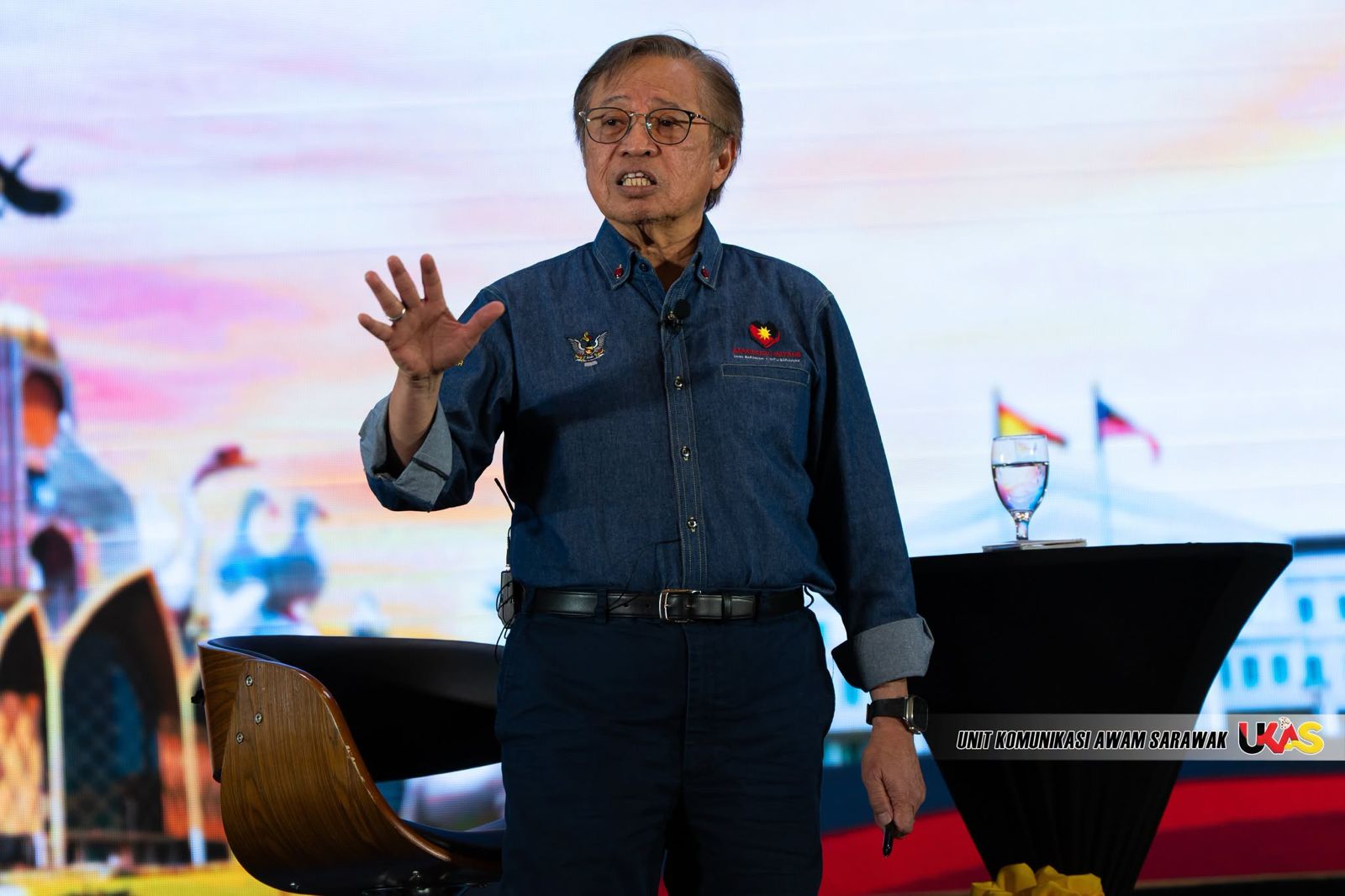
This is an abridged text from the Sarawak Day 2026 townhall dialogue with Premier Datuk Patinggi Tan Sri Abang Johari Tun Openg yesterday (July 22).
The townhall dialogue was moderated by Deputy Minister in the Premier’s Department (Corporate Affairs, Information, and UKAS) Datuk Abdullah Saidol and took place at University Technology Sarawak (UTS) in Sibu.
ABDULLAH: Sixty-three years ago, on 22 July 1963, Sarawak embarked on a historic journey. Although we only have about an hour together this townhall, I have received many questions from the audience.
Let’s begin with something a little light-hearted. Among all the questions submitted, the one that appeared most frequently was: what do you usually have for breakfast?
PREMIER: Actually, my first breakfast is prayer. In Islam, one of the most encouraged times to make doa is after Subuh prayers.
Every morning I pray that Sarawak will continue to be peaceful and prosperous, that our people will enjoy good health and happiness, and that Allah will continue to bless our state with abundance. That is my first breakfast.
Only after that do I have my actual breakfast. Usually, I have toast and soft-boiled eggs. People say it gives you energy. Whether that’s scientifically true, I don’t know—you’ll have to ask the doctors. But so far, Alhamdulillah, I still have plenty of energy. After all, I even came here riding a scooter.
These days, I usually have breakfast alone because my wife has passed away, but my children are around.
On a more serious note, we should all take care of our health. Maintain a healthy Body Mass Index (BMI), watch our body weight and be mindful of what we eat. So my mornings begin quietly—with prayer first, followed by breakfast.
ABDULLAH: Datuk Patinggi, let’s move on to the main reason we are gathered here today. Sixty-three years ago, you were just 13 years old. Over the past 63 years, you have personally witnessed Sarawak’s journey of growth and transformation.
For more than four decades, you have also played a direct role in shaping that journey. You entered politics at the age of 27 in 1977, became an elected representative in 1981 at the age of 31, and have continued serving the people ever since.
Given your experience throughout Sarawak’s remarkable journey over these 63 years, what reflections would you like to share with us?
PREMIER: First of all, allow me to wish all Sarawakians a very happy Sarawak Day. Our journey has indeed been a long one.
On 22 July 1963, the administration of Sarawak was returned to the people of Sarawak, under the leadership of our first Chief Minister, Tan Sri Datuk Amar Stephen Kalong Ningkan. There is one important distinction that everyone, especially our younger generation, should understand.
Sarawak attained self-government on 22 July 1963. Malaysia, however, was only officially formed later, on 16 September 1963. Originally, Malaysia was supposed to be formed on 31 August 1963, but several developments delayed its establishment.
At that time, Indonesia opposed the formation of Malaysia, leading to what became known as Konfrontasi, or the Indonesian Confrontation. Concurrently, Sarawak was also facing the communist insurgency. There was another issue involving Sabah, where the Philippines continued to lay claim to the territory. All these developments complicated the formation of Malaysia.
Because of those circumstances, the United Nations (UN) sent a mission to Sarawak and Sabah to ascertain whether the people genuinely supported the formation of Malaysia. Only after the findings confirmed the wishes of the people was Malaysia officially established on 16 September 1963. That is why we celebrate 31 August as Merdeka Day and 16 September as Malaysia Day.
The Malaysia Agreement 1963 (MA63) and all the relevant constitutional documents were deposited with the UN, making them internationally recognised agreements that all parties are expected to honour.
However, self-government did not immediately mean everything became easy. We were still a very young administration. Our leaders had only just assumed responsibility for governing Sarawak. During the transition period, many British officers remained in the civil service. For example, our State Secretary at the time was G.A.T. Shaw, a British officer who continued serving the government while advising both the Cabinet and the Chief Minister.
There was also an important programme known as Borneonisation. Its purpose was to gradually transfer administrative responsibilities from British colonial officers to qualified Sarawakians. That transition was another major challenge.
So, Sarawak entered self-government during a period of significant political and regional instability. Domestically, our leaders were still learning how to govern and politics was also rather unstable. Eventually, following the 1969 General Election, a Barisan Nasional (BN) government was formed under the leadership of the late Tun Abdul Razak at the federal level.
Gradually, Sarawak also began enjoying greater political stability. Even so, the road remained challenging. It was only around 1981, when the late Tun Pehin Sri Abdul Taib Mahmud introduced what he called development politics, that Sarawak entered a new phase. Political confrontation became less dominant, while greater emphasis was placed on development.
During that period, several important institutions were established. Among them was the Sarawak Economic Development Corporation (SEDC). Equally significant was the role played by Yayasan Sarawak. Through Yayasan Sarawak, many young Sarawakians received scholarships to pursue higher education in Peninsular Malaysia. After completing their studies, they returned home to contribute to Sarawak’s development. Many of today’s leaders are products of Yayasan Sarawak. In fact, if I’m not mistaken, you are one of them too.
That is one of the greatest outcomes of self-government. It fulfilled the aspirations embodied in the Nine Cardinal Principles, which had envisioned that Sarawak would eventually be governed by its own people. Alhamdulillah, today we have our own universities, institutions of higher learning and a generation of Sarawakians capable of leading the state’s development.
ABDULLAH: Datuk Patinggi, Sarawak Day was only officially gazetted as a public holiday 10 years ago. Since then, there has been increasing public discussion about Sarawak’s rights, the MA63 and greater state autonomy.
Many of the young people seated here tonight learned history through different school syllabuses, and sometimes the various dates and historical events can become confusing.
Why is it so important for young Sarawakians to understand our history and to continue safeguarding Sarawak’s rights?
PREMIER: As I mentioned earlier, throughout our journey, many of the powers originally granted to Sarawak under the Federal Constitution gradually became diluted over time. I must acknowledge the late Tok Nan, Pehin Sri Adenan Satem. He was the leader who realised that many of Sarawak’s constitutional rights were no longer being fully respected. He was the first to openly raise these issues.
I still remember him asking: “Why is it that we produce oil and gas, yet we receive so little in return?” He also made a statement that many Sarawakians still remember today. He said: “If the oil is in Kelantan, I don’t really mind. But when the oil and gas belong to Sarawak, I care.”
Those words reflected the sentiments of many Sarawakians. We should be able to enjoy the benefits that were originally intended under the MA63. That was one of the reasons Tok Nan declared 22 July as Sarawak Day in 2016.
When I succeeded him in 2017, I simply continued the struggle that he had already begun. Our objective remains the same—to safeguard Sarawak’s constitutional rights while ensuring that development continues to benefit our people.
ABDULLAH: Datuk Patinggi, since you were sworn in as the sixth Chief Minister in January 2017, Sarawak has undergone significant transformation. We saw the introduction of the Digital Economy agenda, the formation of Gabungan Parti Sarawak (GPS), the implementation of the State Sales Tax (SST) on petroleum products, and then the unprecedented challenges brought by the COVID-19 pandemic.
Despite the pandemic and a sharp decline in revenue at the time, Sarawak not only recovered but has since doubled its annual revenue to around RM14 billion.
Looking back, what was your thinking during those challenging years, and what strategy enabled Sarawak to emerge stronger than before?
PREMIER: Long before I became Chief Minister, I had already developed an interest in where technology was heading. At one point, I came across a book discussing what was then known as the virtual world, or Second Life. The book explained how digital technology would eventually create an entirely new environment beyond the physical world. At that time, many young people were already familiar with virtual environments through computer games.
As I read further, I realised this was no longer science fiction. Even organisations such as NASA had already begun exploring and applying similar technologies. That convinced me that digital technology would fundamentally change the way governments function, businesses operate and societies develop.
Soon after becoming Chief Minister, I discussed the matter with our former State Secretary, Tan Sri Datuk Amar Mohd Morshidi Abdul Ghani. I asked him: “Why shouldn’t Sarawak begin preparing for this transformation?”
If the world was changing, Sarawak could not afford to be left behind. We needed to understand these new technologies properly. That was why we invited experts from around the world. One of them was Don Tapscott, who is internationally recognised for his work on digital transformation, blockchain technology and cryptocurrency.
Many people asked me at the time: “Why Don Tapscott?” My answer was simple. We wanted to learn directly from the best. From there, we began changing the way the government works. Instead of relying purely on conventional administration, we moved towards data-driven governance.
Every policy should be based on accurate information. Without good data, we cannot make good decisions. Without proper statistics, long-term planning becomes little more than guesswork. For me, statistics are the foundation of economic planning. That became the starting point of Sarawak’s Digital Economy agenda.
I must admit that when Don Tapscott first came to Sarawak, people were skeptical including some senior government officers. Some wondered whether these ideas were practical. Some questioned whether blockchain or digital government would ever become relevant. Those were perfectly reasonable questions.
Then COVID-19 happened. Suddenly people could no longer meet physically. Families were separated, businesses were forced to close and everything changed almost overnight. That experience demonstrated exactly why digital transformation mattered.
The pandemic forced us to ask ourselves one important question: How do we rebuild Sarawak’s economy after COVID-19? That was the beginning of what eventually became the Post COVID-19 Development Strategy 2030, or PCDS 2030.
Another important development also took place. Although Barisan Nasional lost power at the federal level after the 2018 General Election, Sarawak still won 23 parliamentary seats. We then asked ourselves: “Should Sarawak continue depending on political developments elsewhere?” Our answer was no.
We decided that Sarawak must determine its own future. That was why we left Barisan Nasional and established GPS. From there emerged the principle of “Sarawak First.” Our priority became safeguarding Sarawak’s interests, strengthening our economy and preparing future generations with the knowledge and skills they would need to compete globally. Only then could Sarawak become a truly prosperous state.
However, having a long-term development strategy alone was not enough. Development requires financial resources, so I revisited the Malaysia Agreement 1963 and the Federal Constitution. I wanted to understand exactly what rights had originally been granted to Sarawak.
Together with our Attorney General at that time, Datuk Seri Talat Mahmood Abdul Rashid, we carefully examined the Constitution. I told him, “I’m not a lawyer. Please study it carefully.”
After reviewing the relevant constitutional provisions, he confirmed that the Constitution clearly gives Sarawak the authority to impose a State Sales Tax. Once I received that confirmation, I instructed the government to implement the SST on petroleum products.
I remembered what Tok Nan had always said about Sarawak’s oil and gas resources. It was not an easy decision because Petroliam Nasional Berhad (PETRONAS) disagreed. They argued that the Petroleum Development Act 1974 gave them the authority. I simply asked one question: “Which has higher legal authority—the Federal Constitution or an Act of Parliament?”
Eventually, the matter was brought before the courts. The courts upheld Sarawak’s constitutional position. As a result, state revenue increased significantly.
From the very beginning, I believed that any additional revenue earned by Sarawak should be returned to the people. That is why we invested heavily in roads, bridges, education, healthcare and infrastructure.
Sarawakian children must be able to compete anywhere in the world. They should never feel inferior to anyone else. That is also why we introduced free tertiary education. This year alone, we have allocated approximately RM250 million for that initiative.
Our revenue has increased from around RM7 billion to RM14 billion. But let me assure everyone here tonight— that is not the end of our journey. There is still much more that we plan to achieve.
ABDULLAH: Datuk Patinggi, since the introduction of the Post COVID-19 Development Strategy 2030 (PCDS 2030), Sarawak has rolled out numerous initiatives spanning the economy, infrastructure, education, welfare, environmental sustainability and the reclamation of the state’s rights.
From revenue diversification and major infrastructure projects to free tertiary education, welfare programmes and the growth of new industries, all these efforts are aimed at building a more prosperous Sarawak.
As you have said, the journey is far from over. How can all Sarawakians continue moving forward together, ensure no one is left behind, and what message would you like to leave for the younger generation who will shape Sarawak’s future?
PREMIER: I think the first thing we need to change is our mindset. For many years, people believed that after completing their studies, the ideal career was to work for the government. That has been the traditional way of thinking.
But the economy of the future will be very different. The prosperity of a nation depends on the strength of its economy and its ability to create new opportunities.
If we look back through history, the Industrial Revolution began with the invention of the steam engine. Later, steam was replaced by fossil fuels, allowing industries to expand rapidly and transforming economies around the world. Today, however, we are entering another major transition.
This time, the greatest challenge facing humanity is climate change. Scientists have warned that if global temperatures rise beyond 1.5 degrees Celsius, the consequences will be severe. Food security will become an increasingly serious concern. For that reason, the world is gradually moving away from hydrocarbon-based energy towards cleaner and more sustainable sources of energy.
I believe that between 2030 and 2050, the global economy will undergo another major transformation. Countries will increasingly depend on clean energy that is environmentally sustainable. The important question is: Where does Sarawak fit into this new global economy?
Sarawak is blessed with one of the oldest tropical rainforests in the world. Science tells us that forests naturally absorb carbon dioxide. That means Sarawak has a significant role to play in addressing climate change. Our forests function as a carbon sink. If the rest of the world benefits from our forests absorbing carbon, then surely there must also be value attached to preserving them. That is why carbon trading has emerged as an entirely new economic opportunity. It enables us to conserve our forests while generating new sources of revenue.
Secondly, Sarawak produces clean energy. We are blessed with abundant rivers. By harnessing the natural flow of water through hydroelectric dams, we are able to generate renewable electricity. That was one of the reasons I decided to bring Bakun Hydroelectric Dam back under Sarawak’s control after becoming Chief Minister. Since then, we have continued expanding our hydroelectric capacity through projects such as Murum and Batang Ai.
Thirdly, Sarawak receives sunshine throughout the year. Solar technology has advanced tremendously. Today, solar panels can even be installed above reservoirs or agricultural land, allowing farming activities to continue underneath while simultaneously generating electricity.
We also possess abundant biomass. Agricultural waste and forestry by-products can now be converted into biochar, replacing conventional coal in many industrial applications.
In addition, Sarawak has natural gas. Natural gas remains an important low-carbon transition fuel as the world gradually shifts towards cleaner energy.
Sarawak possesses all these resources. The real challenge now is ensuring that our people have the knowledge and expertise to take advantage of these opportunities. That is precisely why our free tertiary education policy places strong emphasis on disciplines such as cyber security, data analytics, chemistry, engineering and aerospace.
As the economy continues evolving, entirely new industries will emerge. Our young people must be ready to seize those opportunities and become the leaders of tomorrow.
The economy of the future will not be driven by renewable energy alone.It will also be driven by knowledge. That is why I always encourage our young people to cultivate the habit of reading.
One of the books I often recommend is The Hydrogen Revolution: Blueprint for the Future of Clean Energy by Marco Alverà. It provides a good understanding of many of the technologies that will shape the future economy. Among the technologies discussed are Proton Exchange Membrane (PEM) technology and new methods of producing hydrogen from natural gas through chemical processes, commonly referred to as blue hydrogen. These technologies are laying the foundation for a completely new economy.
Around the world, countries are working towards reducing carbon emissions and achieving net-zero carbon. Sarawak possesses both the natural resources and the strategic advantages to become part of that global transition. If this is the direction in which the world is heading, then Sarawakians themselves must become entrepreneurs and innovators in these emerging industries.
This transformation will also be supported by advances in digital technology, particularly Artificial Intelligence (AI). Today, AI relies heavily on what are known as Large Language Models (LLMs). If our young people master these technologies, they will not merely become employees—they can become creators of entirely new industries.
Look at some of the world’s most successful entrepreneurs: Steve Jobs, Bill Gates and Jack Ma. None of them inherited the industries they eventually built. They created them through knowledge, innovation and technology. I remember when I first heard the name Alibaba because of its name, I thought it had something to do with the Middle East. So I searched for it and realised it was actually a Chinese technology company. Today, it is one of the largest companies in the world.
Look also at Jensen Huang, the founder of NVIDIA. His family migrated from Taiwan to the United States. He studied engineering, worked hard and eventually built one of the world’s most valuable technology companies.
If they can achieve that, why can’t Sarawakians? That is precisely why we introduced free tertiary education. We want our young people to take advantage of this opportunity to master future technologies. Perhaps one day, one of you seated here will become the next Steve Jobs. Perhaps one of you will establish the next globally recognised technology company.
Some people may say that is too ambitious. I disagree. Nothing is impossible if we prepare ourselves properly.
Who would have imagined, years ago, that Sarawak would one day own its own airline? Who would have imagined that AirBorneo would fly to Kuala Lumpur? Who would have imagined that passengers would be served Sarawak food on board?
Years ago, many people would have dismissed those ideas as impossible. Yet today they are becoming reality. Sarawak is no longer viewed as a remote or isolated place. We have moved well beyond those outdated perceptions.
Today, Sarawakians are capable of competing with anyone in the world. I genuinely believe Sarawak can achieve even greater success, provided we continue to have good leadership and good governance. That is why GPS remains committed to producing a new generation of entrepreneurs.Our policies are centred on creating opportunities for the people.
Look at the infrastructure we have today. We now have Batang Lupar Bridge, one of the longest river bridges in Malaysia. I recently met visitors who were amazed by the size of the Batang Lupar Bridge. I then reminded them that Sarawak also has Batang Lassa Bridge, another of the country’s longest river crossings.
These projects are not merely bridges. They are transforming our rural economy. Communities that were once isolated are now connected. Development is reaching areas that previously took hours, or even days, to access.
We are also planning the long-term development of towns such as Kapit. Our vision is for Kapit to become an environmentally sustainable town. That is why we have sent officers overseas to study development models in Bergen, Norway, whose geography shares certain similarities with parts of Sarawak. We are learning from the best examples available so that we can build towns that are modern, environmentally sustainable and suitable for future generations. That is the Sarawak we are trying to build.
Unfortunately, I am no longer young. One day, I will have to hand over this responsibility to the next generation. That is why I place so much hope in the young people gathered here. It is you who will continue this journey. It is you who will determine where Sarawak goes over the next 30 or 40 years. I hope you will continue building upon what we have started and take Sarawak even further than my generation ever could.
ABDULLAH: Datuk Patinggi, anyone who has listened to your speeches over the years would notice your passion whenever you talk about digital technology, hydrogen, renewable energy and the future economy. Sometimes we even joke that you must have a laboratory at home because of how excited you become discussing these topics.
At the same time, despite speaking about technology and economic development, you always end your speeches by reminding people about sincerity, faith, gratitude and serving others.
Why is it so important for you to emphasise these values, and why do you believe spiritual principles should continue to guide Sarawak’s development?
PREMIER: Because one day, every one of us will be held accountable. When our time in this world comes to an end, we will all return to Allah SWT. In Islam, when a person passes away, what remains are not wealth, position or influence, but the deeds that he or she has performed throughout life. That is why every responsibility entrusted to us must be carried out with sincerity.
When I first entered politics at the age of 27, I actually declined. I felt I was still too young. But my late mother advised me to accept the responsibility. As a son, I obeyed my mother. Alhamdulillah, I have remained in politics and public service until today.
Politics is never easy. Sometimes you are praised. Sometimes you are criticised. Sometimes you succeed. Sometimes you experience setbacks. There will always be challenges. But throughout all of that, we must remain patient.
Leadership is a trust (amanah) from Allah SWT. Many people ask me: “How did you become Chief Minister?” and “How did you become Premier?”
My answer is always the same. Allah SWT entrusted me with this responsibility. If Allah SWT had not willed it, I would not be standing here today. Because of that, one day I too will have to answer for how I carried out that trust.
That is why our intentions must always remain sincere. Whatever we do must be done for the benefit of the people because what truly matters is whether our work has brought benefit to others. If we sincerely help people, Allah SWT will reward us.
That is why everything we do—whether building roads, improving education, strengthening healthcare or implementing welfare programmes—must always begin with sincere intentions.
ABDULLAH: Datuk Patinggi, we have seen in international sports that success is not always determined by size or resources. Often, it is values, discipline, resilience and confidence that make the difference.
As Sarawak continues to chart its future, what advice would you like to leave for the younger generation? How can they continue building on today’s achievements and take Sarawak even further in the years ahead?
PREMIER: I believe that reflects the journey of every human being. The first thing we do when we enter this world is cry. From there, we begin life’s journey. We learn to walk, go to school, continue our studies, start working and, for some, achieve success, while others face challenges. In the end, however, every one of us will leave this world.
When that day comes, what do we actually take with us? Not our wealth, our homes or our possessions. For Muslims, we are wrapped only in a white cloth before we are buried. Then, we will be accountable for how we lived our lives.
I remember speaking at a university where a student asked me, “Datuk Patinggi, what advice would you give to young people?” My answer was simple: Aim for Paradise.
What does that mean? It means living with sincere intentions. Everything begins with niat (intention). Whatever we do, our purpose should be to help others. Human beings only need enough to live. The true value of life is not measured by how much wealth we accumulate, but by how much good we do for others.
If we sincerely help people, Allah SWT will reward us. That is why my colleagues and I remain committed to improving the lives of Sarawakians. Everything we do must begin with good intentions. Allah SWT is always with us. As long as we remain sincere, patient and honest, He will continue to guide us. That is the most important message I wish to leave with all of you.
ABDULLAH: Thank you very much, Datuk Patinggi.