From hesitation to flight, a first-time ride on the Melanau tibou reveals a tradition shaped by courage, rhythm and connection — suspended between fear, thrill and the pull of letting go.
Between Fear and Flight: My First Tibou Experience
At the top of the ladder, everything suddenly feels very quiet.
You can hear people below — laughter, voices, someone calling out — but the ground feels further away than it should.
The wooden steps beneath your feet are steady, yet your thoughts are not. And for a brief second, one question slips in, uninvited:
Why did I say yes to this?
I remember standing there during the 2024 Kaul Mukah Festival, somewhere between the fifth and sixth steps of the tangga tibou — roughly two to three metres above the ground. It was the smaller version, the Tibou Umik, with only eight or nine steps, meant for first-timers. Manageable, they said.
It did not feel manageable.
The tibou stood not far from the Pantai Kala Dana shoreline in Mukah, where the scent of salt lingered in the air, the sea breeze drifted steadily in, and the sand shifted slightly underfoot.
Around me, the festival carried on — voices, movement, life. But up there, everything narrowed to one thing: the rattan swing (wai tibou) in front of me.
And then I stepped off.
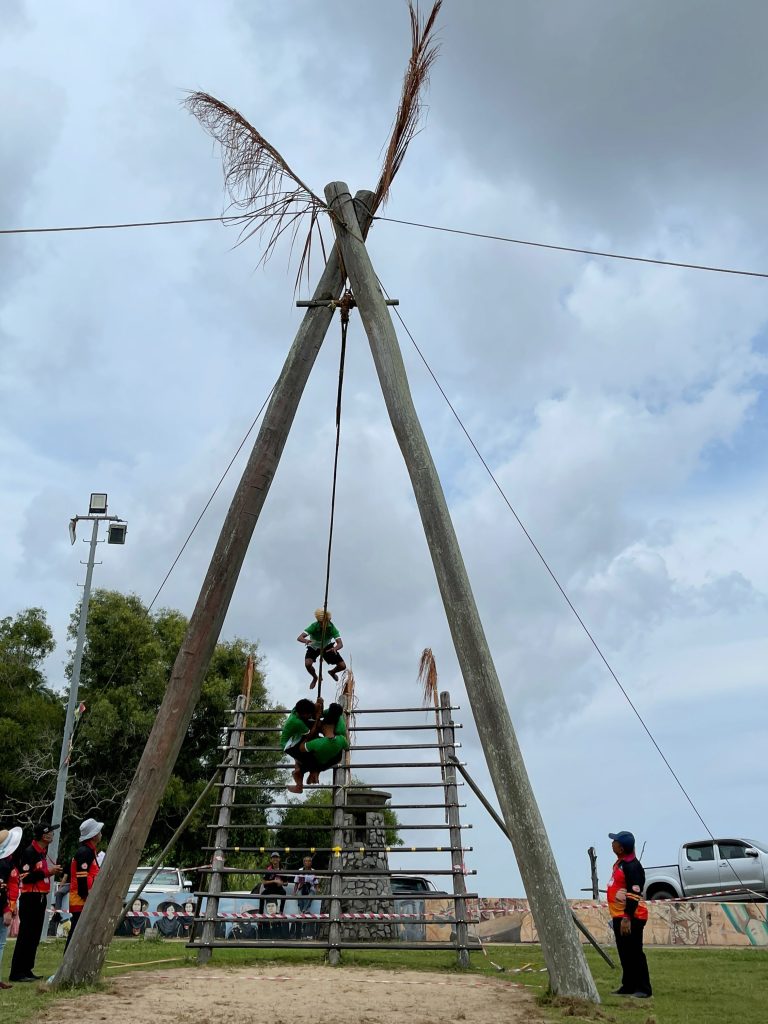
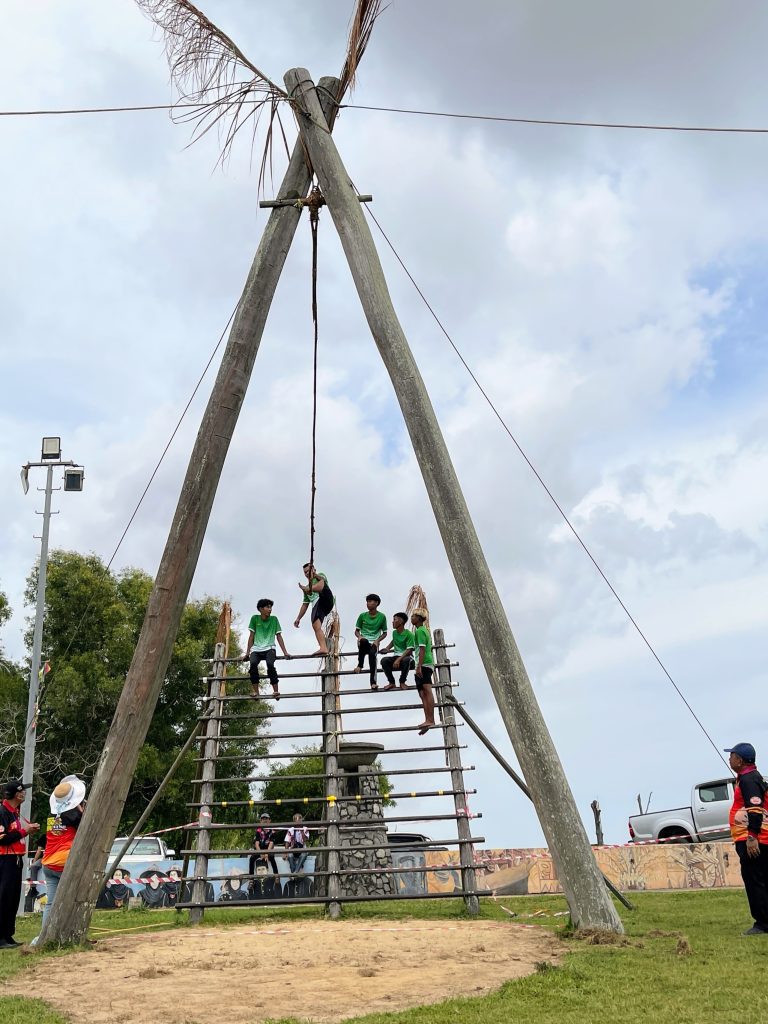
The first swing is not something you can prepare for. Your body moves before your mind catches up, and suddenly your heart feels as though it has leapt ahead of you — suspended somewhere between thrill and fear.
I remember screaming — loud, instinctive, almost involuntary — not out of panic, but because it was my first time, and I had nowhere else to channel that surge of excitement and nerves.
My hands tightened instinctively around the woven rattan, gripping harder than I realised, because somewhere in that fleeting moment, a quiet thought remained: what if I fall?
Beneath it all, the rattan creaked softly — a dry, rhythmic sound rising and falling with each swing — while voices from below cheered and laughed, urging me on.
But I didn’t fall.
Instead, the swing carried me forward, then back, then forward again — the rhythm settling, the fear loosening its hold. And just like that, something shifted. What began as hesitation softened into something lighter. Freer.
When my feet finally touched the ground again, there was a strange mix of relief… and pride. It was unexpected — not just the experience itself, but the fact that I had actually done it.
Later, when I told my Melanau friends about it, many admitted they had never dared to try it themselves. Somehow, that made the moment linger a little longer.
More than just a swing
Perhaps that is what the tibou has always been — not just a game, but a quiet invitation to confront fear in full view of a watching crowd, and still choose to leap.
To call it a swing would be to miss the point entirely.
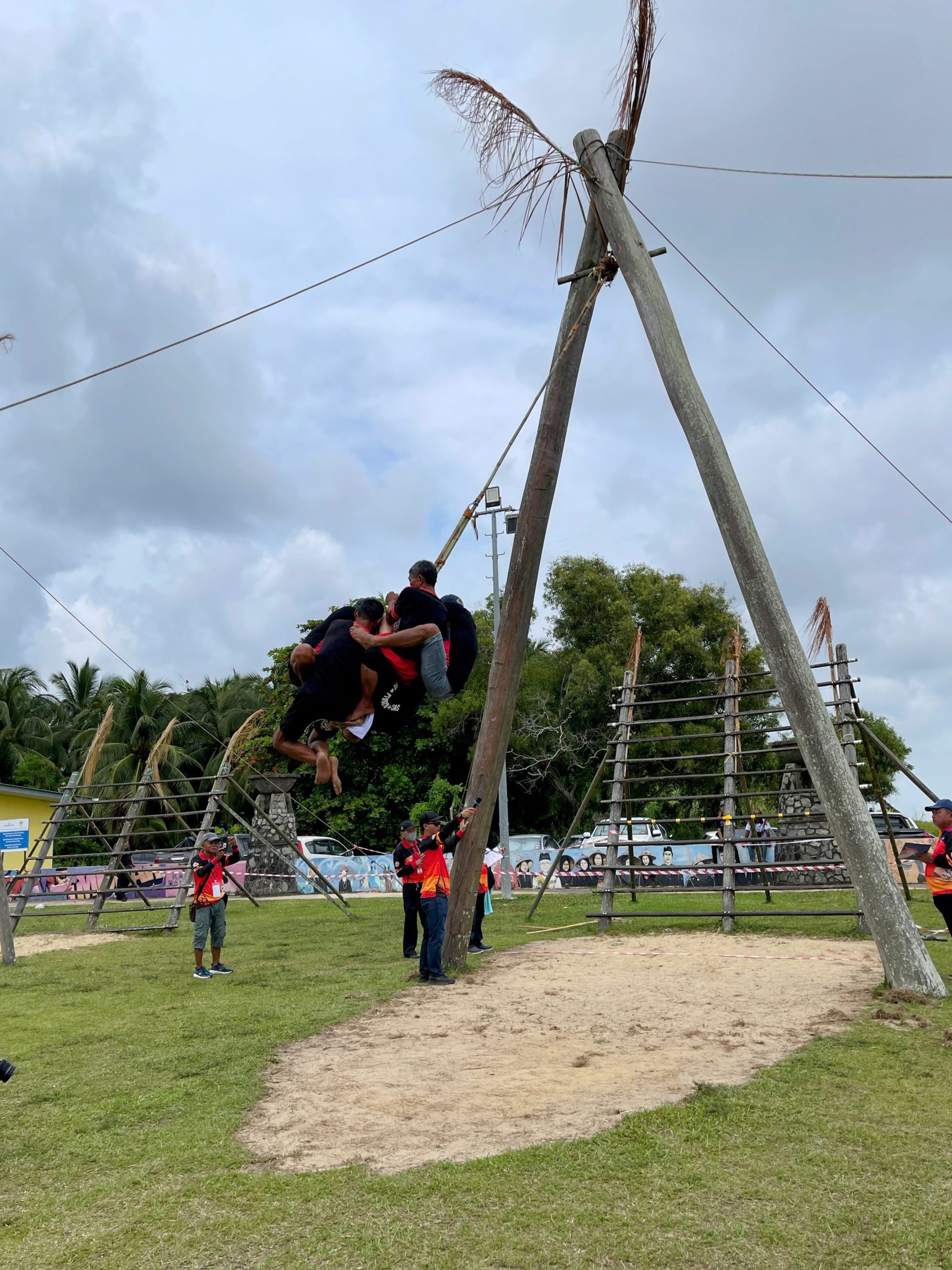
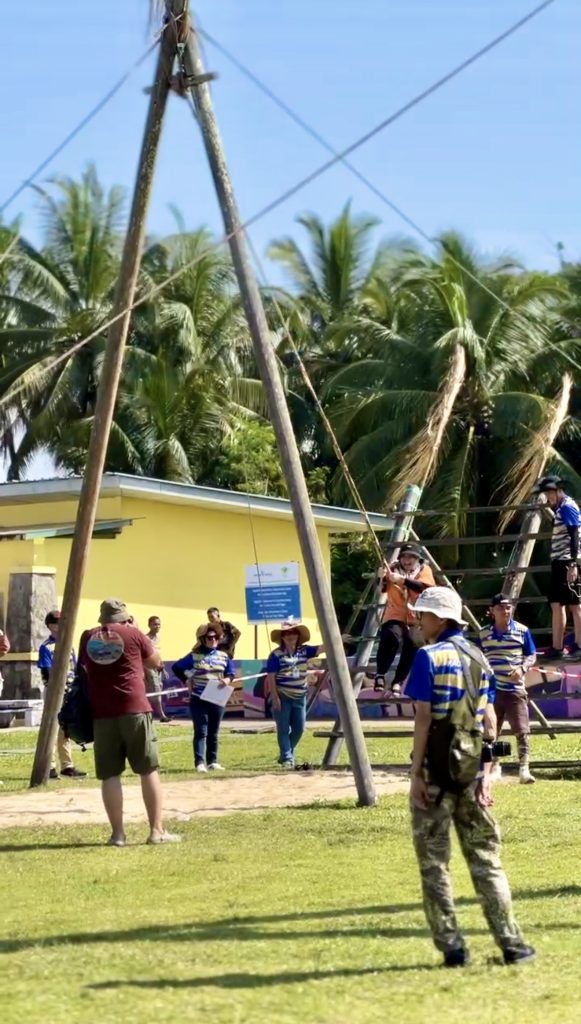
The tibou rises tall against the coastal sky, built from two long poles — traditionally belian wood — secured at the top to form an A-shaped structure. In the past, these were bound tightly with rattan; today, bolts and aluminium cables reinforce what was once held together entirely by hand.
Stability comes from the jat tibou — four supporting ties that anchor the structure — while the aleang tibou, a horizontal beam, completes its frame.
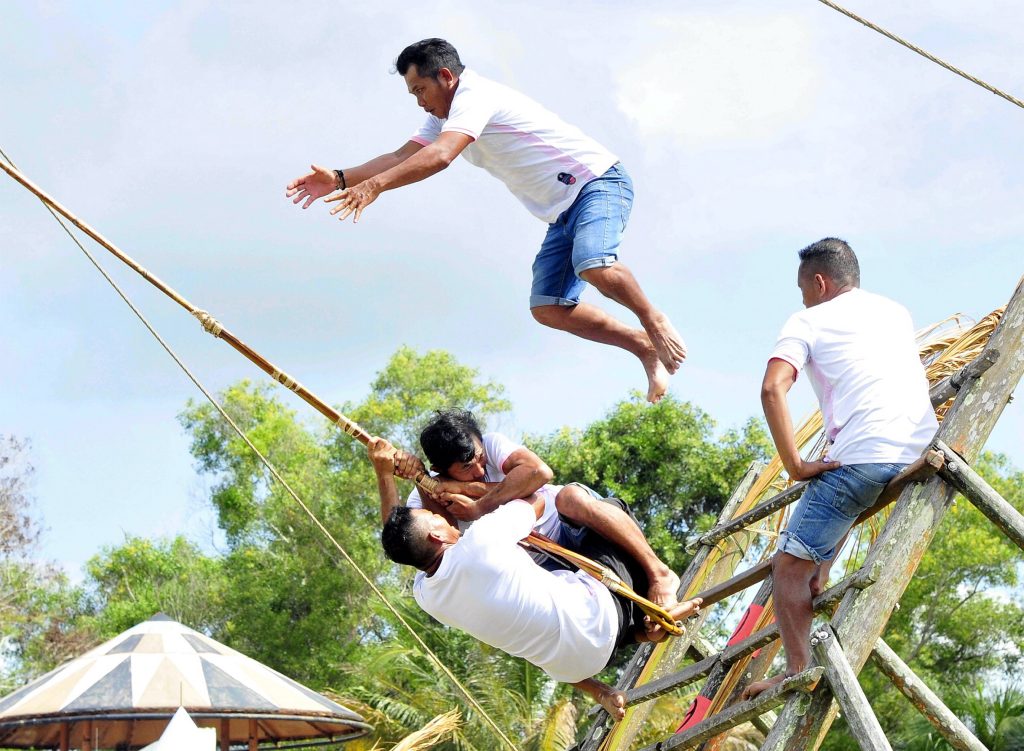
Suspended beneath it is the wai tibou, a thick rattan swing strong enough to carry several people at once. At its upper end sits the pakok umik, fitted through the beam, while the lower section widens into the pakok ayeng, where the first participant — known as the uyan — begins the motion. From there, others leap on one by one, turning a single swing into a shared rhythm.
But long before the first swing, there is the making of it.
As Boniface Bait, who served as organising chairman of the 2024 Pisak Tibou Kaul Mukah Festival, shared, the tibou begins with gotong-royong — a communal effort where the whole kampung comes together to raise it. It is careful, deliberate work. Every joint must hold. Every binding must be secure, because once the game begins, there is no room for doubt.
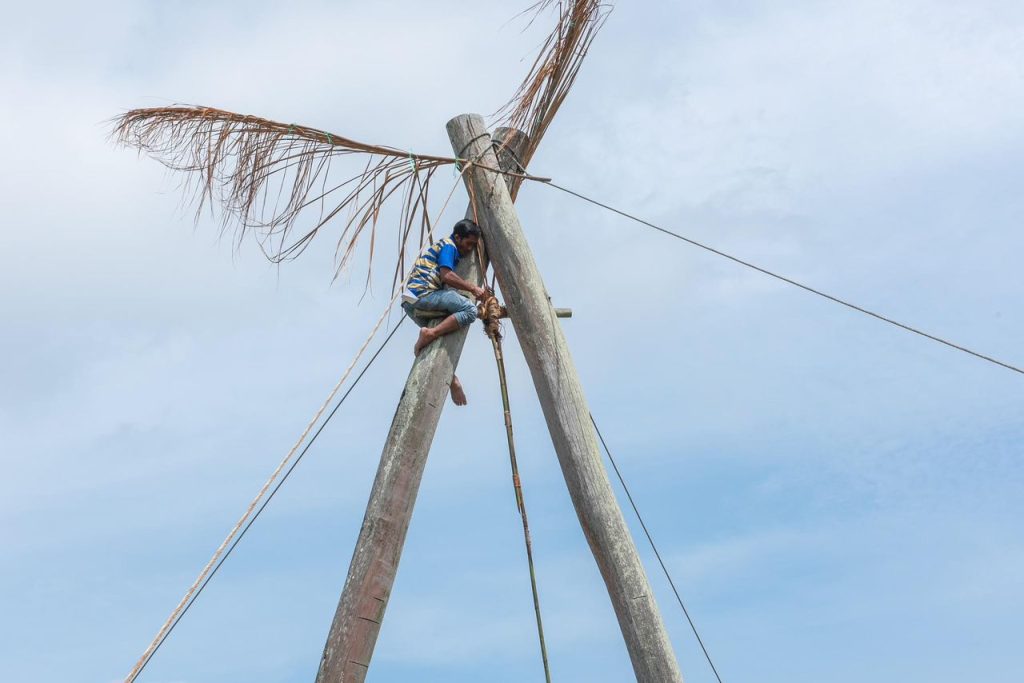
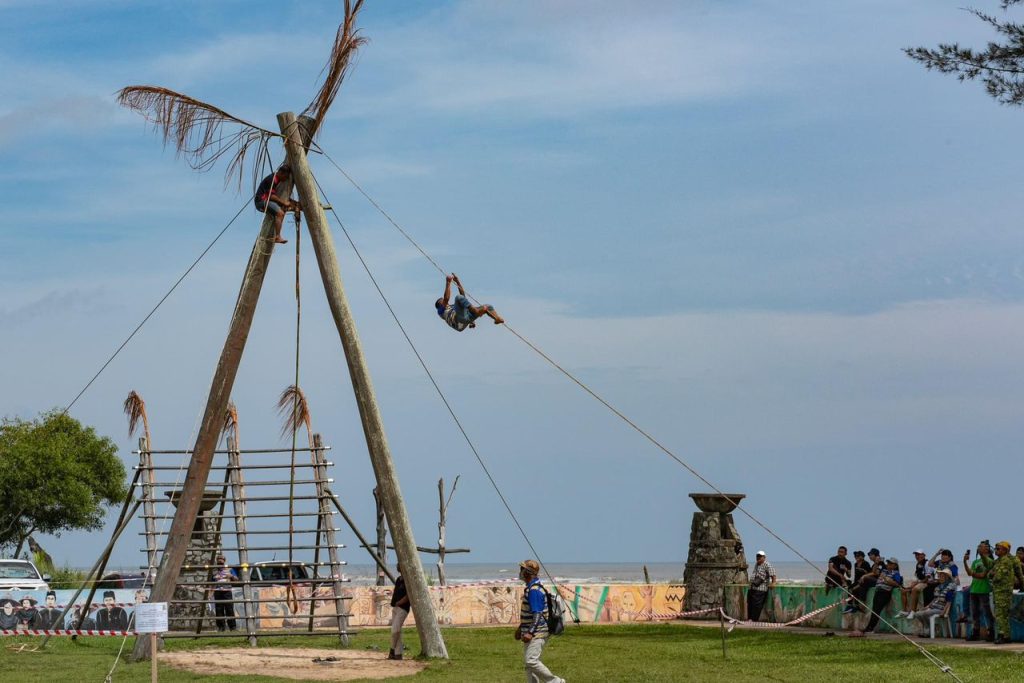
I remember watching the men climb the poles that day, high above the ground, repairing loosened ties at the top before the competition began. No cranes, no harnesses — just experience, balance and a quiet kind of courage that often goes unnoticed.
Before anyone can leap, someone else has already taken the first risk.
For the Melanau community, tibou is not simply a game played during the Kaul Festival — it is a living expression of identity, carried across generations not through instruction, but through participation.
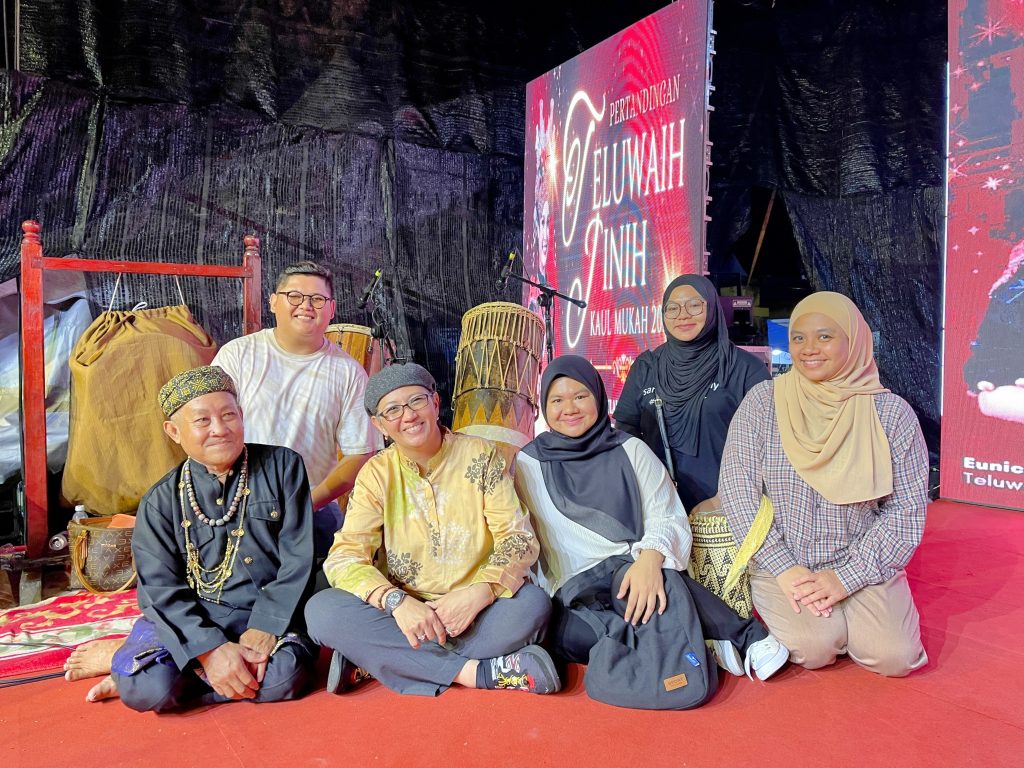
The rhythm of courage
In its competitive form, known as Pisak Tibou, the game becomes a test of timing, control and composure.
Participants begin by climbing the tangga tibou, a tall wooden ladder that can reach up to 10 metres, depending on the height of the structure. At the top, there is often a brief pause — a moment to steady oneself — before stepping onto the moving swing below.
The first participant sets the motion. Then, in quick succession, others leap from the ladder, joining the swing mid-air. Their timing must be precise: too early or too late, and the rhythm falters. But when done well, the movement becomes seamless — a coordinated flow of bodies, rope and momentum.
In competition, participants are judged not only on courage, but also on control. Points are awarded based on the height of their jump — the rung from which they launch — the consistency of the swing, and how well they maintain balance without swaying sideways.
Etiquette and attire also form part of the assessment, while each team works within a limited time to complete as many controlled swings as possible.
But beyond the rules, there is something more enduring.
Traditionally, the tibou would come alive in the late afternoon and continue into the evening, sometimes under the glow of a full moon.
Young men would sing pesak — playful, poetic verses — as they swung, their voices carrying across the crowd. It was, in many ways, a subtle form of courtship — a way of being seen not just for strength, but for charm and expression.
In those moments, tibou becomes more than a test of courage; it becomes a performance of identity, confidence and connection.
Holding on, and letting go
At its heart, the Kaul Festival marks a turning point — the end of the padi harvest and the beginning of the fishing season. A time of gratitude, release and renewal.
The tibou mirrors that rhythm.
You climb, holding on tightly, unsure of what comes next. And then, at some point, you let go.
It was my first time experiencing Kaul — and perhaps that made everything feel more vivid, more personal.
The sounds, the sea, the people, and that fleeting moment on the tibou where fear and excitement became almost indistinguishable.
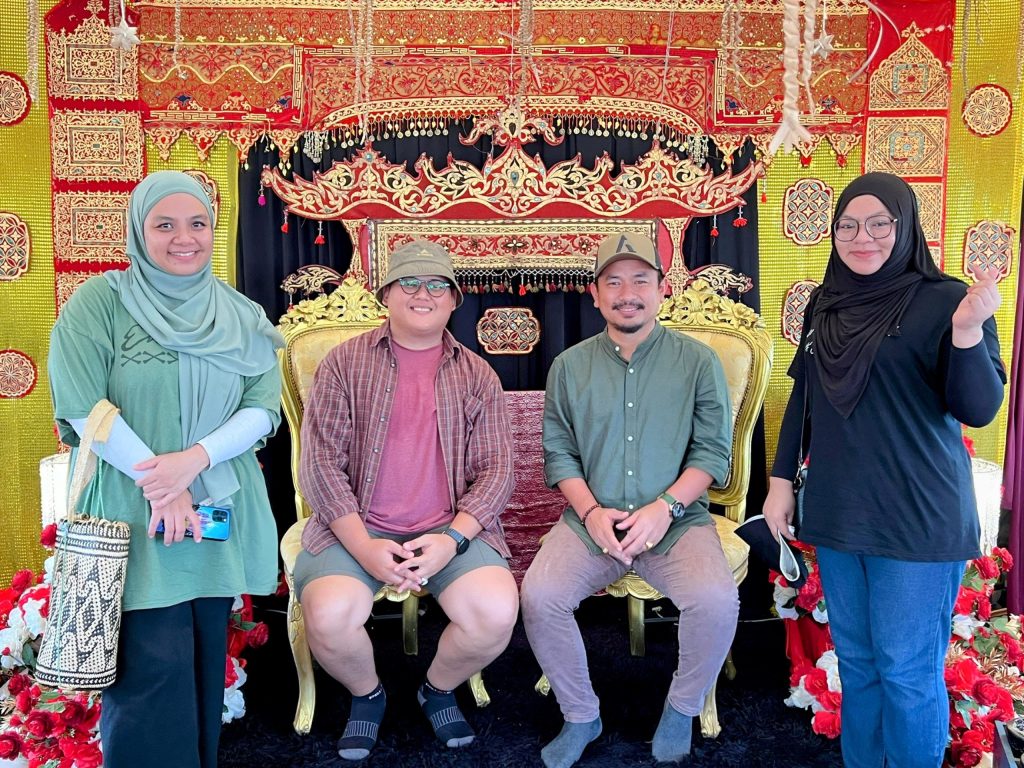
For that, I remain grateful to the Mukah Parliamentary Service Centre, especially the Member of Parliament, Datuk Hanifah Hajar Taib, for the opportunity to experience the festival in a way I never expected.
Because long after the crowd disperses and the structures come down, what stays with you is not just the memory of a celebration, but that brief, weightless moment when your heart races ahead of you — and you realise the fear was never really about the height, but about trusting yourself enough to let go.