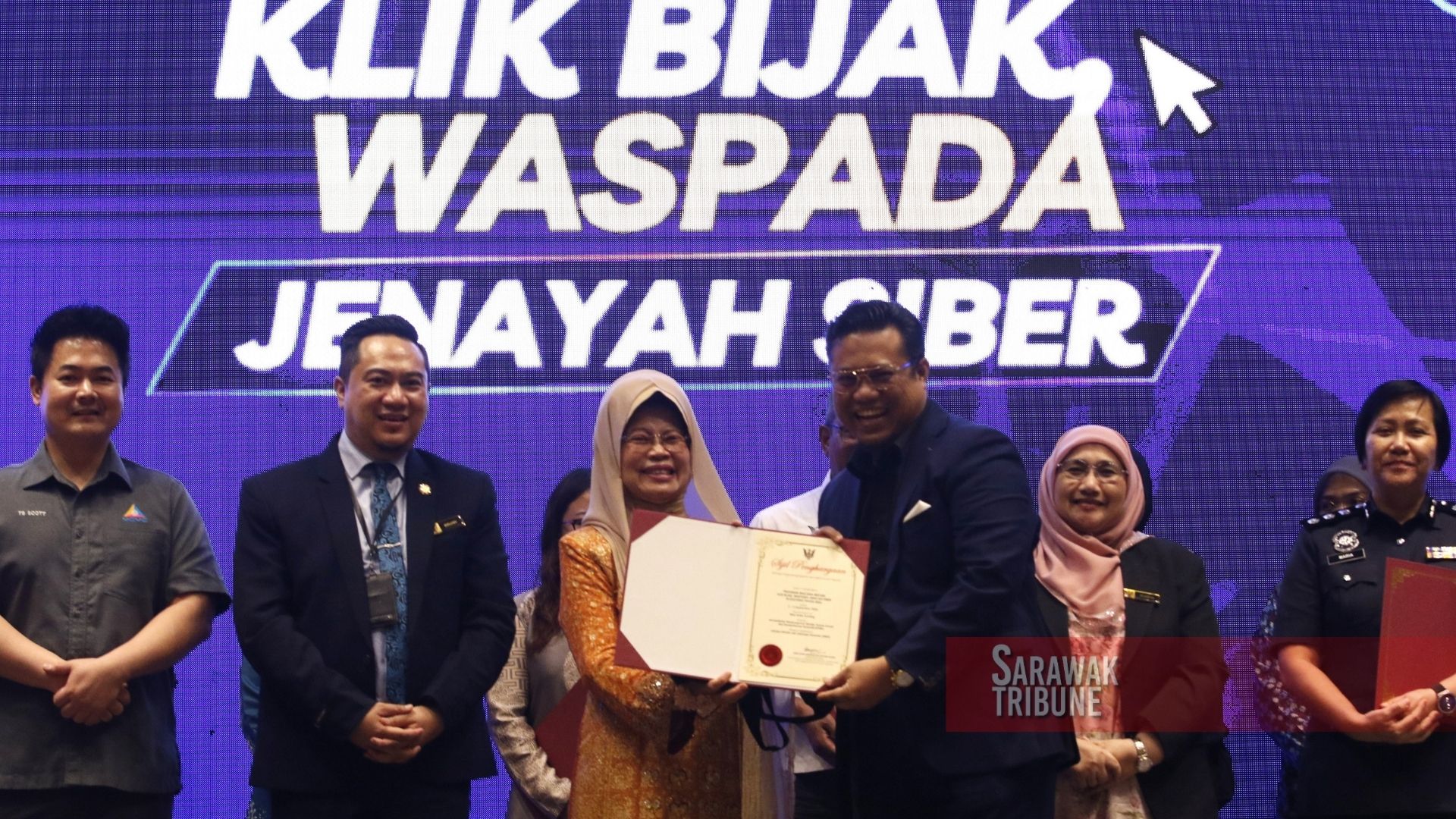
KUCHING: The highest cybercrime losses in Sarawak totaling RM45.77 million was recorded in Kuching involving 782 cases between 2024 and April 2026, said Women, Early Childhood and Community Wellbeing Development Minister, Datuk Seri Fatimah Abdullah.
She revealed this figure was followed by Miri with RM33.13 million involving 766 cases and Sibu with RM20.40 million involving 721 cases.
Fatimah added that the three areas collectively recorded losses of approximately RM99.30 million, underscoring the growing impact of online scams and commercial crime.
“These figures show that commercial crime and online scams have a significant impact, particularly in urban centres and areas with high levels of economic activity and digital usage.
“However, we must also recognise that this threat is not confined to specific areas. It can affect anyone, regardless of location, age or background,” she stressed during the Smart Clicking, Staying Alert Against Cybercrime Forum at Raia Hotel and Convention Centre here today.
Fatimah said e-commerce scams were among the most frequently reported, with 1,612 cases recorded during the period.
However, she pointed out the category with the highest number of cases did not necessarily resulted in the greatest financial losses.
“Investment scams, for example, recorded losses of approximately RM132.9 million, accounting for about 57 per cent of the total losses recorded.
“This serves as a reminder that seemingly convincing offers, particularly those promising extraordinary returns within a short period, must be assessed with great caution,” she said.
Fatimah reminded the impact of cybercrime extended beyond financial losses, with victims potentially suffering emotional distress, loss of confidence and strained family relationships.
“Therefore, we must view cybercrime not merely as an issue of technology or law enforcement, but as a social challenge that has a direct impact on individual well-being, family stability and community resilience,” she said.
She added the programme was part of an ongoing effort to strengthen digital safety education and awareness among communities across Sarawak.
The programme was first held in Sibu on June 24, attracting 116 participants, followed by Miri on August 26 and 27 with 157 participants.
Its latest edition, held on September 2 and 3, brought together 160 participants from various segments of society, bringing the total number reached through the three editions to 433.
Fatimah said the programme’s impact should not be measured solely by the number of participants, but also by how the knowledge gained was shared and applied in everyday life.
“If every participant shares the knowledge gained with their families, colleagues, neighbours and communities, the actual reach of the programme will be far greater than the number of people who attend directly,” she said.
She added that the Sarawak Government would continue to ensure digitalisation and technological development went hand in hand with efforts to strengthen digital security, improve public literacy and build community resilience.
“We want the people of Sarawak not only to enjoy the benefits and seize the opportunities offered by the digital economy, but also to have the knowledge, skills and confidence to use technology safely, wisely and responsibly,” she said.
Fatimah urged the public to remember four simple principles when navigating the digital world: click wisely, check before trusting, think before acting, and always stay vigilant.