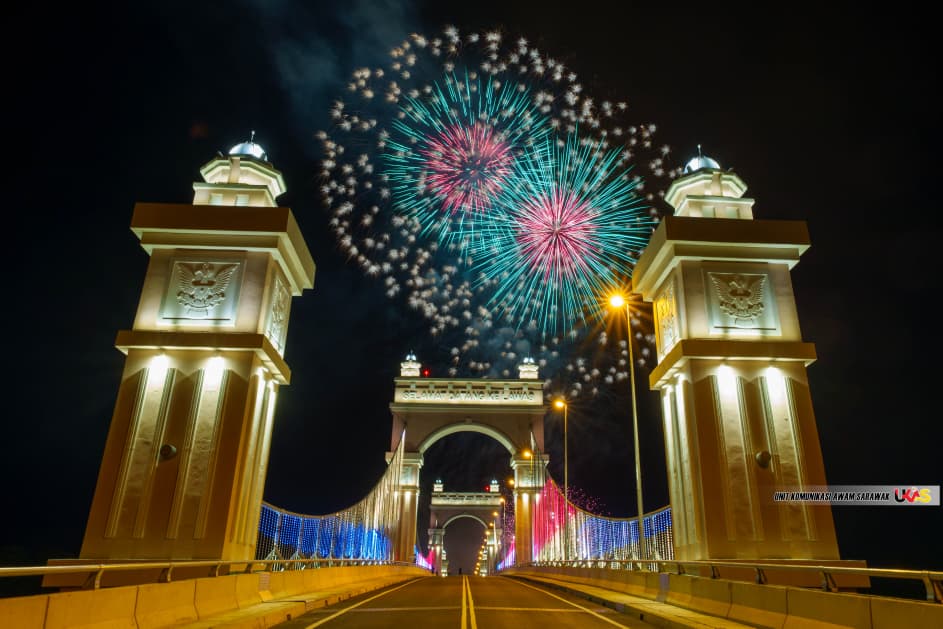
LAWAS: The iconic Lawas Town Bridge is expected to facilitate future expansion and development of the town by improving connectivity between both sides of the Lawas River.
Deputy Premier Datuk Amar Awang Tengah Ali Hasan said the bridge would provide a stronger foundation for development planning, prompting a review of the existing master plan and local plan to accommodate the new connectivity.
He said the previous plans had not taken the bridge’s construction into consideration, making it necessary to reassess how Lawas Town should expand with the improved access.
“With the bridge now in place, it connects both sides of the Lawas River, including the area known as Kampung Seberang Kedai, as well as nearby villages such as Ladang, Karangan and Lukutan.
“The completion of this bridge will therefore make it easier for us to plan the expansion and development of Lawas Town,” he said.
He said this in his speech during the launch of Lawas Town Bridge on Wednesday (Nov. 18).
Awang Tengah said the bridge formed part of the state government’s RM1.5-billion allocations to the Northern Region Development Agency (NRDA) for development projects.
He said three designs had initially been presented to Premier Datuk Patinggi Tan Sri Abang Johari Tun Openg, who personally selected the final design for the bridge.
Beyond improving connectivity, Awang Tengah said the state government also intended to transform Lawas’ waterfront into a more attractive commercial and tourism destination.
He said the Premier had highlighted the need to improve the existing waterfront, which currently extended only as far as the second market, with the area underneath and its surroundings requiring significant improvements.
“We intend to develop and improve the waterfront. God-willing, if Gabungan Parti Sarawak (GPS) receives the mandate in the coming election and Abang Johari continues as our Premier, this is among the projects we hope to implement.
“We also want to ensure that the area across the river is properly planned and developed, taking into account the importance of the river itself,” he said.
He said his visits to Budapest and Vienna had shown how waterfront developments could transform riverfront areas into vibrant centres for commercial activities and tourism, bringing together businesses, traders and visitors.