Multiyear framework could shield rural healthcare access from operational disruptions
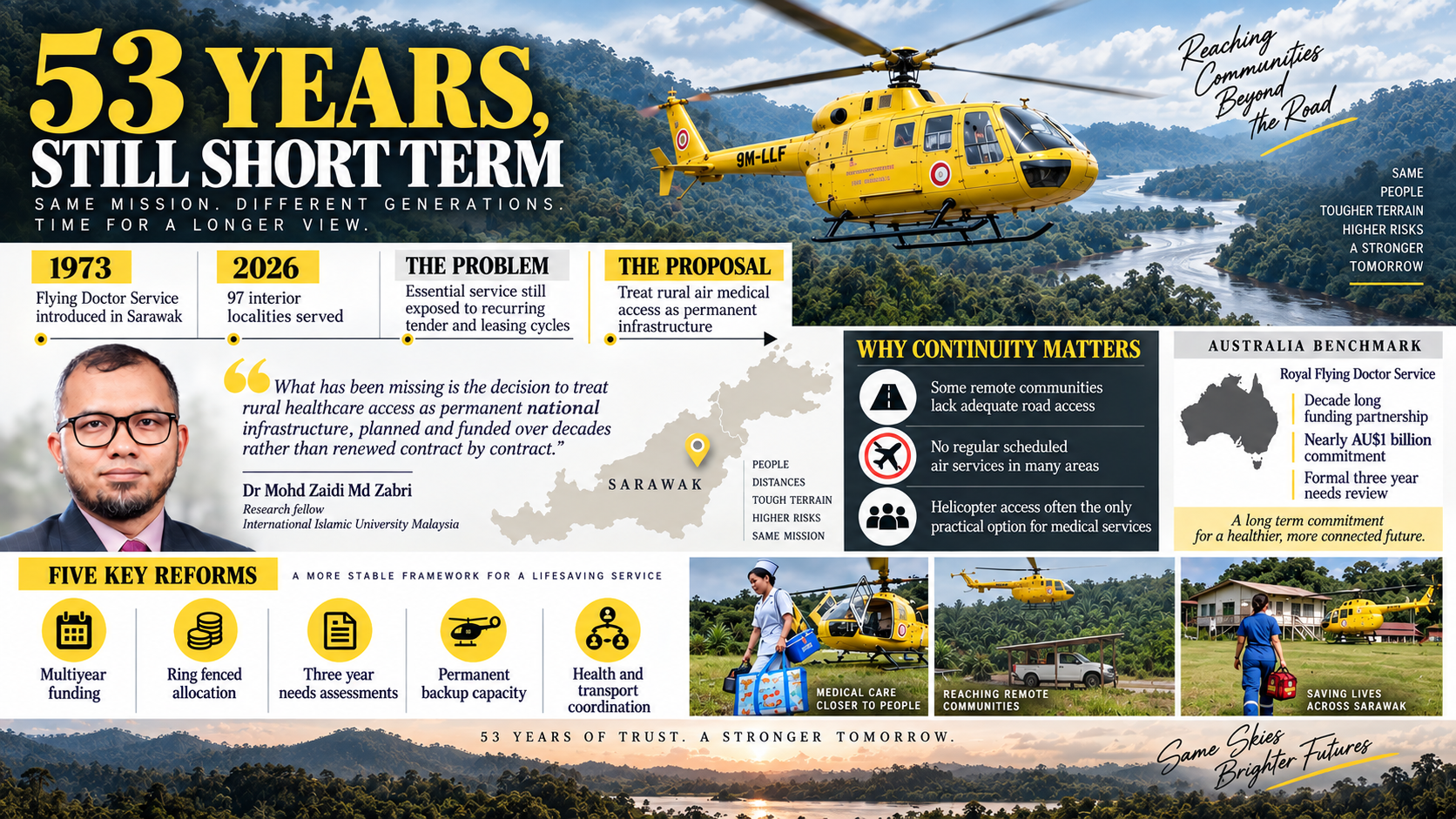
KUCHING: Sarawak’s Flying Doctor Service (FDS) should be placed on a multiyear funding framework instead of relying on short-term leasing arrangements and recurring tender cycles.
International Islamic University Malaysia (IIUM) research fellow Dr Mohd Zaidi Md Zabri said funding should be ring-fenced for the service and tied to published assessments of healthcare needs in remote communities.
“A significant first step would be to move the FDS beyond the uncertainty of short-term leasing arrangements and annual competition for funding,” said the economist.
His proposal follows the Sept 8 FDS helicopter crash at Long Lellang Airport in Ulu Baram, which killed all five people on board: the pilot, a medical officer, an assistant medical officer and two nurses.
The Health Ministry subsequently suspended all FDS operations in Sarawak pending a review, a decision Mohd Zaidi described as necessary and appropriate.
Health Minister Datuk Seri Dr Dzulkefly Ahmad has said the review would cover contracts, governance, operational safety, coverage requirements and the effectiveness of the existing service model.
Emergency evacuations would continue in cooperation with the Fire and Rescue Department, while discussions were under way with the Armed Forces over possible backup transport.
Mohd Zaidi said the suspension highlighted a deeper problem: communities across Sarawak’s interior remained heavily dependent on a service whose operations were vulnerable to disruptions.
As of April 2026, the FDS covered 97 localities across the interior regions of Kapit, Miri and Limbang.
Most communities received visits once a month, while some were served only once every two months depending on operational capacity.
“Introduced in Sarawak in 1973, the FDS remained a principal means of accessing medical care for many remote communities 53 years later,” he said.
He said geographic isolation and inadequate road and scheduled air transport alternatives meant the service remained essential to many communities.
In Ulu Baram, for example, access to healthcare could depend on whether a leased helicopter was airworthy, weather permitted a flight and the operator had an aircraft and crew available.
Yet despite the FDS’ longstanding role, Mohd Zaidi said the service continued to be re-tendered every few years.
“What has been missing is the decision to treat rural healthcare access as permanent national infrastructure, planned and funded over decades rather than renewed contract by contract,” he said.
He pointed to Australia’s Royal Flying Doctor Service (RFDS), which operates under a decade-long government partnership worth close to AU$1 billion covering 2022-23 to 2031-32.
Introduced in 2022, the arrangement replaced four-year agreements that had been used for decades.
The Australian government subsequently announced another AU$74.8 million over three years in December 2024.
Mohd Zaidi said the RFDS, founded in 1928 and supported by Australian government funding since the 1930s, records more than 345,000 patient contacts annually through clinics, aeromedical transport and telehealth consultations.
Its funding arrangement requires a formal needs assessment every three years to direct services towards documented coverage gaps.
“The lesson for Malaysia is not the size of Australia’s fleet or the scale of its budget. It is the policy discipline of planning beyond the next contract cycle,” he said.
Drawing on that model, Mohd Zaidi proposed a three-year review cycle for Sarawak’s FDS to ensure future allocations reflected documented coverage gaps rather than changing budget priorities.
He said the reviews could also determine whether routes, visit frequencies and transport arrangements remained adequate as communities and healthcare needs evolved.
The exercise should involve the Health and Transport ministries, aviation regulators, the Sarawak government, emergency services and airport operators.
“In remote communities where access to healthcare depends on aviation, health policy and transport policy are inseparable,” he said.
Potential cooperation with state-linked aviation providers such as AirBorneo could also be considered as part of the broader review.
Mohd Zaidi said backup capacity should be built permanently into the FDS, whether through a second operator, supplementary transport arrangements, shared access to government assets or a dedicated contingency mechanism.
“Resilience carries a cost. But so does dependence on a single point of failure,” he said.
He did not specify the amount of funding required or estimate the cost of the proposed backup arrangements.
Mohd Zaidi acknowledged that stronger funding and contingency planning would not eliminate weather disruptions, difficult terrain or the inherent risks of aviation.
However, he said they could reduce the extent to which rural healthcare access depended on a single aircraft, operator or procurement exercise.
“What matters is whether they enable people in remote communities to receive care when they need it,” he said.