WHEN Soviet cosmonaut Yuri Gagarin became the first human to travel into space in 1961, it marked more than a historic scientific achievement.
It signalled the beginning of a global contest that would come to define an era.
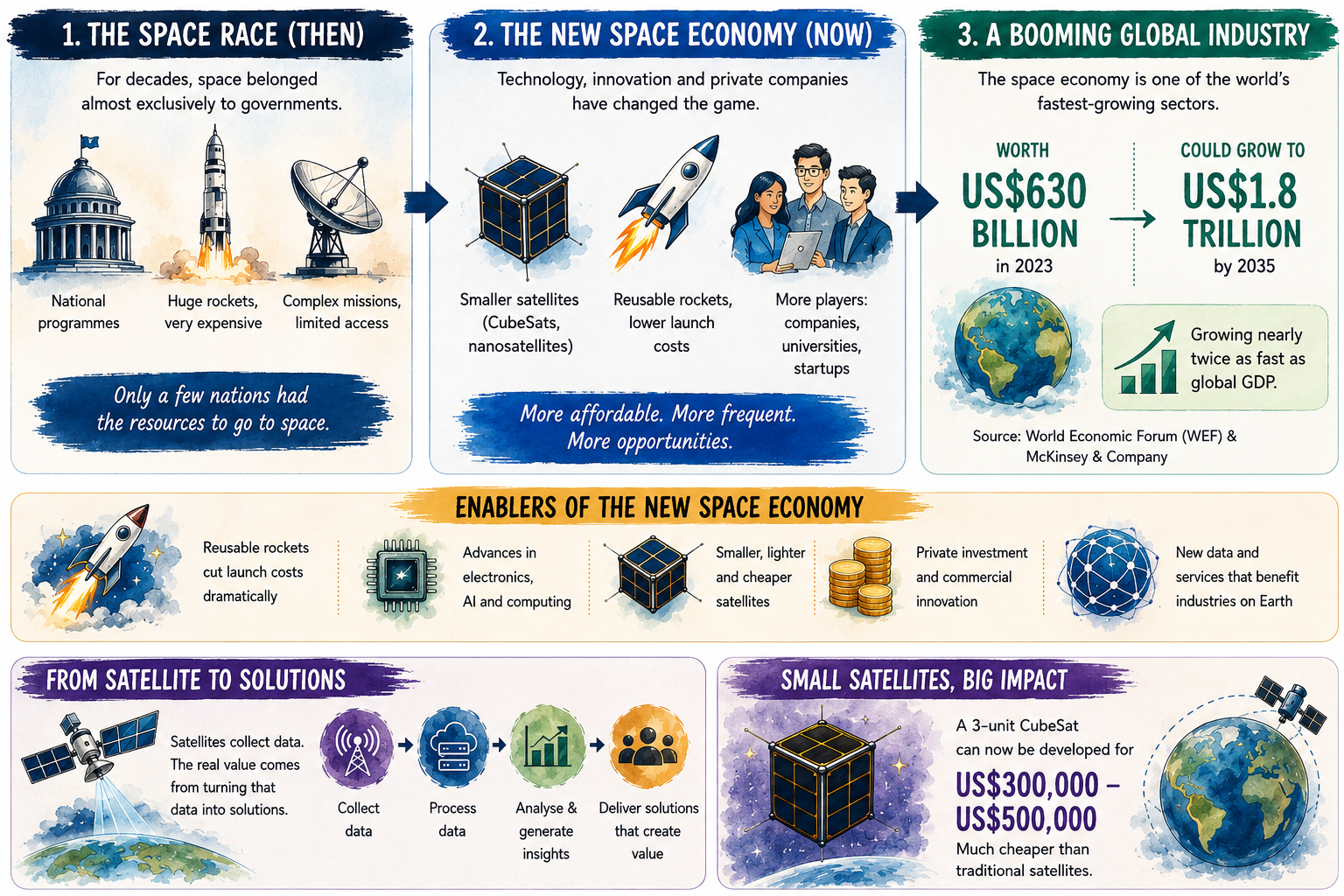
For much of the next three decades, space belonged almost exclusively to governments.
The United States and the former Soviet Union competed to send astronauts into orbit, land humans on the Moon and develop increasingly sophisticated satellites capable of supporting military operations, scientific research and global communications.
Building a satellite requires enormous financial resources.
Launching one demanded years of planning, specialised facilities and rockets that were discarded after every mission.
For decades, the space industry remained beyond the reach of all but a handful of nations.
Today, however, that landscape has changed dramatically.
The global space industry is no longer defined solely by national space agencies or billion-dollar government programmes.
Instead, it is increasingly being shaped by private companies, universities, research institutions and start-ups developing smaller satellites, reusable rockets and technologies that support industries far beyond aerospace itself.
This transformation has given rise to what experts describe as the New Space Economy.
Unlike the traditional Space Race, where success was measured by who reached space first, the New Space Economy is driven by commercial innovation and the products and services made possible through space-based technologies.
According to the Organisation for Economic Co-operation and Development (OECD), the space economy encompasses all public and private activities that create value through the exploration and utilisation of space, including satellite communications, Earth observation, navigation, manufacturing, research and a growing range of downstream applications that support almost every sector of the modern economy.
The industry’s rapid expansion has also made it one of the world’s fastest-growing technology sectors.
A joint report by the World Economic Forum (WEF) and global consulting firm McKinsey & Company estimated the global space economy was worth approximately US$630 billion in 2023 and projected it could grow to US$1.8 trillion by 2035, expanding at nearly twice the rate of global gross domestic product (GDP).
Much of that growth is expected to come not from rockets or spacecraft themselves, but from industries that increasingly depend on satellite-enabled technologies.
The industries include communications, navigation, supply chain management, agriculture, climate monitoring, disaster management, financial services and digital connectivity.
In other words, the world’s fastest-growing space businesses are increasingly being built on Earth.
Against this backdrop, Sarawak has quietly begun positioning itself within one of the world’s fastest-evolving industries.
Over the past several years, Premier Datuk Patinggi Tan Sri Abang Johari Tun Openg has consistently spoken about aerospace as one of the sectors expected to underpin Sarawak’s next phase of economic development.
Alongside renewable energy, semiconductors, hydrogen, digital technologies and artificial intelligence, aerospace has emerged as another strategic industry that the state hopes will help transform Sarawak into a high-income, innovation-driven economy.
Rather than attempting to compete with established space powers, Sarawak’s strategy focuses on developing capabilities in areas where it believes it can create long-term value.
These include semiconductor manufacturing, satellite engineering, earth observation, aerospace education, advanced electronics and data-driven technologies.
Plans to establish a Low Earth Orbit (LEO) satellite ecosystem, strengthen aerospace engineering education and develop Sarawak’s first nano satellite by 2030 all form part of this broader vision.
Collectively, they represent something much larger than a single satellite launch.
They signal an ambition to participate in an industry increasingly driven by innovation, engineering expertise and knowledge rather than by natural resources alone.
Yet for many Sarawakians, the idea of aerospace remains unfamiliar.
Why would a state better known for its vast rainforests, renewable energy resources and biodiversity invest in satellites?
What does space have to do with everyday life in Sarawak?

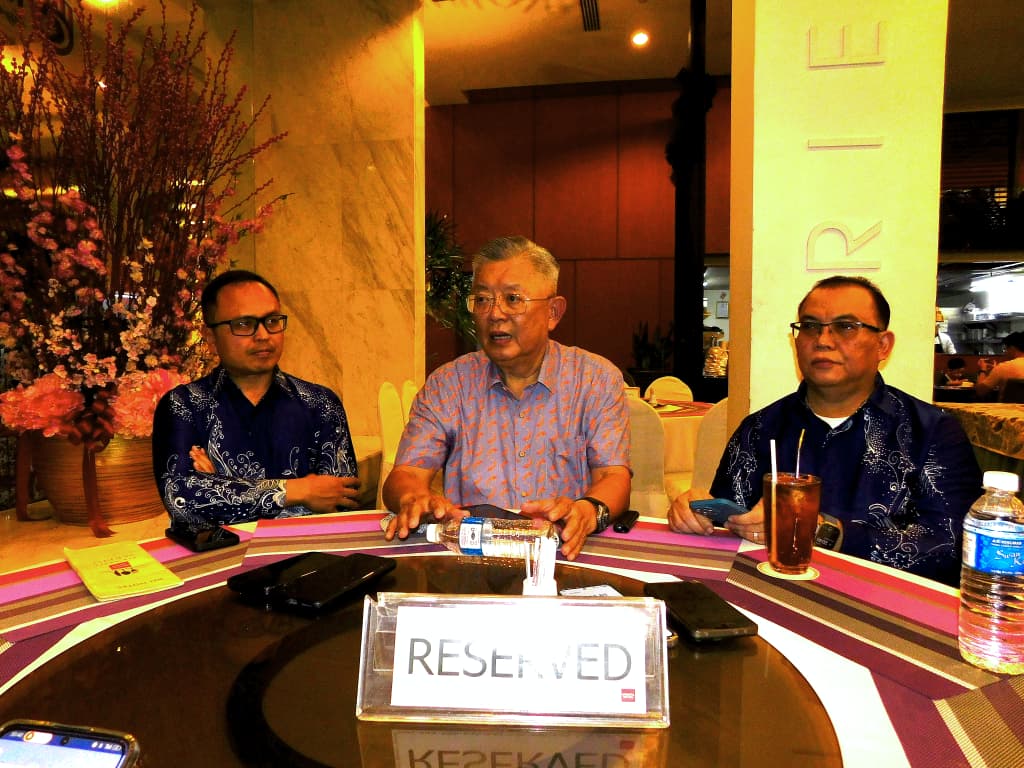
Deputy Dean of the Faculty of Aerospace Engineering and senior lecturer at iCATS University College, Abdul Qaiyum Alidin believes those questions stem from one common misconception.
“The biggest misconception is that people still think space is only about rockets or astronauts. That was the traditional space industry.
“Today, we are entering what is known as the New Space Economy,” he said.
Abdul Qaiyum affirmed advances in technology have fundamentally changed who can participate in the aerospace industry.
Where once only national governments possessed the resources to design and launch satellites, rapid improvements in electronics, computing power and manufacturing have significantly lowered development costs.
“The technology has become much cheaper and much more accessible. In the past, satellites were extremely large and very expensive, so only countries with substantial financial resources could build them.
“Today, satellites have become smaller, lighter and more affordable whereby universities and companies can build them,” he said.
One of the biggest catalysts behind this transformation has been the emergence of commercial space companies.
Among them, SpaceX, founded by billionaire entrepreneur Elon Musk in 2002, and has fundamentally reshaped the economics of space transportation.
For decades, rockets were designed for a single journey.
Once they delivered satellites into orbit, they were discarded into the ocean or allowed to burn up in the atmosphere.
Every launch therefore required building an entirely new rocket, making access to space extraordinarily expensive.
SpaceX challenged that model.
By successfully developing reusable Falcon rockets capable of returning to Earth and landing safely after launch, the company demonstrated that rockets could be flown repeatedly, reducing launch costs dramatically while increasing launch frequency.
The company also developed Starlink, one of the world’s largest satellite constellations, providing broadband internet services through thousands of satellites orbiting Earth.
Together, these innovations demonstrated that private companies— not just governments— could build and operate large-scale space infrastructure while transforming space into a commercially viable industry.
The ripple effects have been felt across the global aerospace sector.
Lower launch costs have encouraged investment in smaller satellites, attracted venture capital into space technology start-ups and enabled universities and emerging economies to participate in industries that would have once been financially out of reach.
For Abdul Qaiyum, one of the clearest examples of this transformation is the emergence of CubeSats and nanosatellites.
Unlike traditional satellites weighing several tonnes, CubeSats are compact spacecraft built using standardised modular units.
“Many weigh only a few kilogrammes yet remain capable of performing Earth observation, communications and scientific research. Their smaller size significantly reduces manufacturing and launch costs, making them attractive platforms for universities, research institutions and countries seeking affordable access to space,” he said.
Abdul Qaiyum estimated that a three-unit CubeSat can now be developed for between USD300,000 and USD500,000 – a fraction of what conventional satellites once cost.
That dramatic reduction in cost is one of the main reasons he believes Sarawak’s target of launching its first nano satellite by 2030 is realistic.
“I believe the 2030 target is very realistic. In the New Space Economy, satellites no longer have to be as large as they were in the past.
“Technology has progressed to the point where smaller satellites can perform many important functions at a much lower cost,” he said.
The shift towards smaller satellites has fundamentally changed the economics of the industry.
Instead of asking whether only major powers can afford to participate in space, governments and researchers are increasingly asking how they can apply satellite technology to solve problems on Earth.

For Sarawak, Abdul Qaiyum believes this is where the greatest opportunity lies.
He stressed that the state’s proposed nano satellite should never be viewed as an end in itself.
Rather, it should be regarded as the foundation of a much broader aerospace ecosystem encompassing engineering, software development, semiconductor technologies, communications systems, artificial intelligence, research and data analytics.
“The satellite itself is only one component. What we are really trying to build is an ecosystem.”
Abdul Qaiyum said that distinction is often overlooked.
He pointed out that many people assume aerospace is an entirely separate industry from electronics or semiconductors.
“In reality, the sectors are closely intertwined. A modern satellite is essentially a sophisticated electronic system comprising semiconductor chips, sensors, communication modules, onboard computers, power management systems and embedded software.
“Every subsystem relies upon expertise that already exists within today’s advanced electronics manufacturing industry,” he explained.
That overlap could prove particularly significant for Sarawak.
Over the past decade, the state has steadily expanded its semiconductor ecosystem while simultaneously investing in renewable energy, hydrogen, digital infrastructure and advanced manufacturing.
Abdul Qaiyum said these investments have created a strong technological foundation upon which an aerospace industry can gradually be built.
“Rather than starting from scratch, Sarawak already possesses engineers, researchers and manufacturers whose expertise is transferable to aerospace technologies. The challenge now is integrating these capabilities into a broader innovation ecosystem,” he stressed.
That vision aligns closely with the direction repeatedly outlined by the Premier.
In recent years, he has consistently described aerospace as part of Sarawak’s transition towards a knowledge-based economy, where growth is increasingly driven by innovation, research and high-value industries rather than the extraction of natural resources alone.
It is a philosophy that reflects a broader evolution in the state’s economic strategy.
For decades, Sarawak’s development was closely associated with timber, agriculture and later oil, gas and hydropower.
Today, those sectors still remain important but the state is increasingly investing in industries where intellectual property, engineering expertise and technological innovation generate greater long-term value.
Abdul Qaiyum asserted that this evolution represents more than economic diversification.
“It reflects how the global economy itself is changing. Countries are no longer competing solely on the resources beneath their soil
“Increasingly, they are competing on knowledge, innovation and technological capability,” he said.
As such, Abdul Qaiyum opined discussions surrounding aerospace should move beyond rockets, launch dates and ambitious announcements.
“The first satellite is important because it demonstrates that we have the capability. Once we successfully build and launch the first one, we can continue with the second, the third and eventually many more satellites,” he said.
The real success, however, will not be measured by the number of satellites Sarawak eventually places into orbit.
Instead, Abdul Qaiyum said success will depend on whether the state succeeds in developing an ecosystem where universities conduct cutting-edge research, local companies manufacture specialised components, engineers design increasingly sophisticated systems and entrepreneurs create commercial products using satellite-derived technologies.
In many ways, that mirrors what has happened elsewhere in the world.
Companies such as SpaceX did not transform the global aerospace industry simply because they launched rockets.
They succeeded because they created an ecosystem encompassing manufacturing, software engineering, satellite communications, reusable launch systems and thousands of highly skilled jobs.
Likewise, many of today’s fastest-growing businesses within the global space economy never build rockets at all.
Instead, they develop software, analyse satellite imagery, provide navigation services, improve weather forecasting or create digital platforms powered by information collected hundreds of kilometres above earth.
Increasingly, the greatest value lies not in reaching space but in what can be done with space.
For Sarawak, that may ultimately prove to be the most important lesson.
The proposed nano satellite should therefore be viewed not merely as another technological milestone, but as an entry point into an industry where innovation, engineering and data increasingly define economic competitiveness.
If realised, the satellite could become the catalyst for developing local expertise, strengthening university-industry collaboration and encouraging the growth of companies capable of competing in global high-technology markets.
Against the backdrop of a rapidly expanding global space economy, Sarawak’s ambitions therefore extend far beyond placing a small satellite into orbit by 2030.
They represent an attempt to participate in one of the defining technological transformations of the 21st century.
And in the New Space Economy, that transformation is no longer measured simply by who reaches space first.
It is increasingly measured by who can create the greatest value from it.