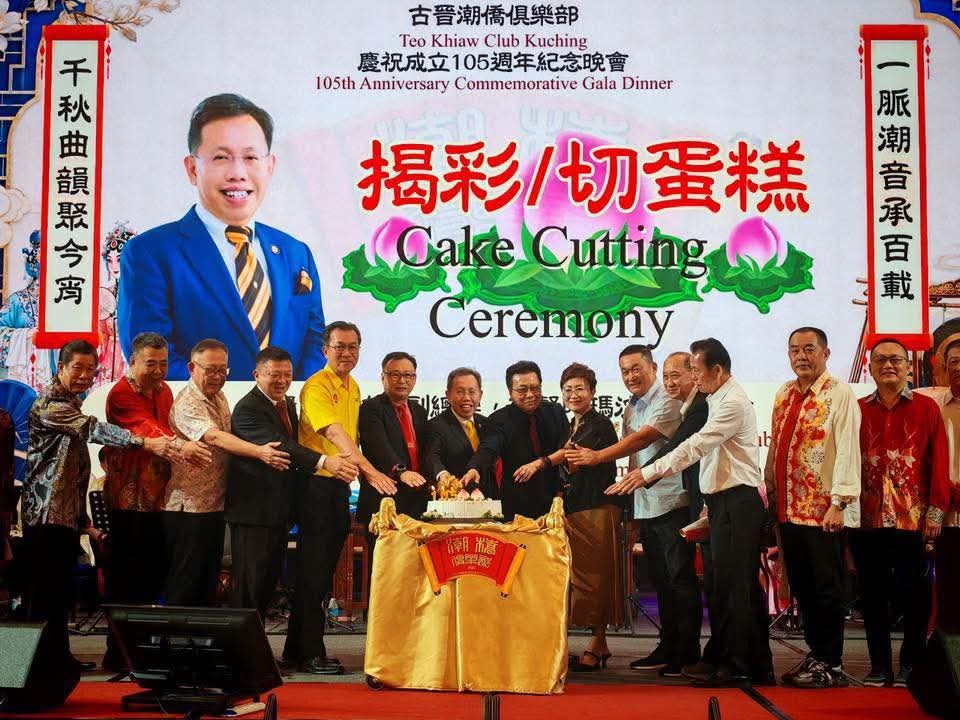
KUCHING: The legacy of Teo Khiaw Club Kuching has built a strong foundation over the past century through perseverance, unity and cultural continuity, says Sarawak United People’s Party (SUPP) Stakan branch chairman Datuk Sim Kiang Chiok.
He said the club had made invaluable contributions to Kuching’s early economic development, as well as to education and charitable causes, leaving a lasting legacy for the community.
“At the same time, they laid a strong foundation for strengthening community bonds, and for the continuous preservation of Teochew performing arts and culture.
“This legacy remains deeply rooted today,” said Sim during the Teo Khiaw Club 105th Anniversary Gala Dinner held at the UNIFOR Complex on Saturday (May 23).
Sim, who was also the organising chairman, said the Teo Khiaw Club traces its origins to the early days of the Kuching Teochew Association during the era of the Shun Feng Company and was officially registered as a legal entity in 1921.
“The founding purpose of the Club was to provide a gathering place for early Teochew migrants engaged in trade and enterprise.
“As time passes, our club has journeyed through 105 years.
“To have endured over a century of challenges and change is in itself a remarkable historical achievement and a great honour,” he said.
Sim added that since 2005, the club has organised the Teochew Cultural Heritage Tour to Chaozhou almost every year.
“Over more than a decade, it has actively promoted exchanges between Sarawak and Chaozhou in areas such as cultural interaction, ancestral tracing, cultural education, as well as business and tourism collaboration, serving as a vital bridge, achieving remarkable results and wider recognition.
“In 2017 and 2018, the club collaborated with the Chao’an District Government, China successfully organising Sarawak youth delegations to participate in summer and winter camps in their ancestral homeland.
“This initiative strengthened cultural exchange among younger generations and fostered deeper emotional connections, with lasting significance,” he noted.
On preserving Teochew performing arts, Sim admitted the club faces challenges including the gradual passing of the older generation, declining use of the dialect and limitations as an amateur ensemble.
“Despite that, we remain steadfast in our mission, continuing to promote Teochew opera, string ensemble music, big gong and drum ensembles, small percussion ensembles, as well as folk songs and music. We also invite renowned masters from Chaozhou to provide guidance
At the same time, Sim said the club is actively exploring innovation within a multicultural environment while preserving tradition.
“We seek growth through preservation, bringing traditional Teochew arts into schools to nurture cultural roots and into communities to integrate with modern life.
“Hence, our heritage can truly live in the present and continue into the future. At the same time, amateur groups serve as an important training ground for many professional talents and as a significant cultural identity.