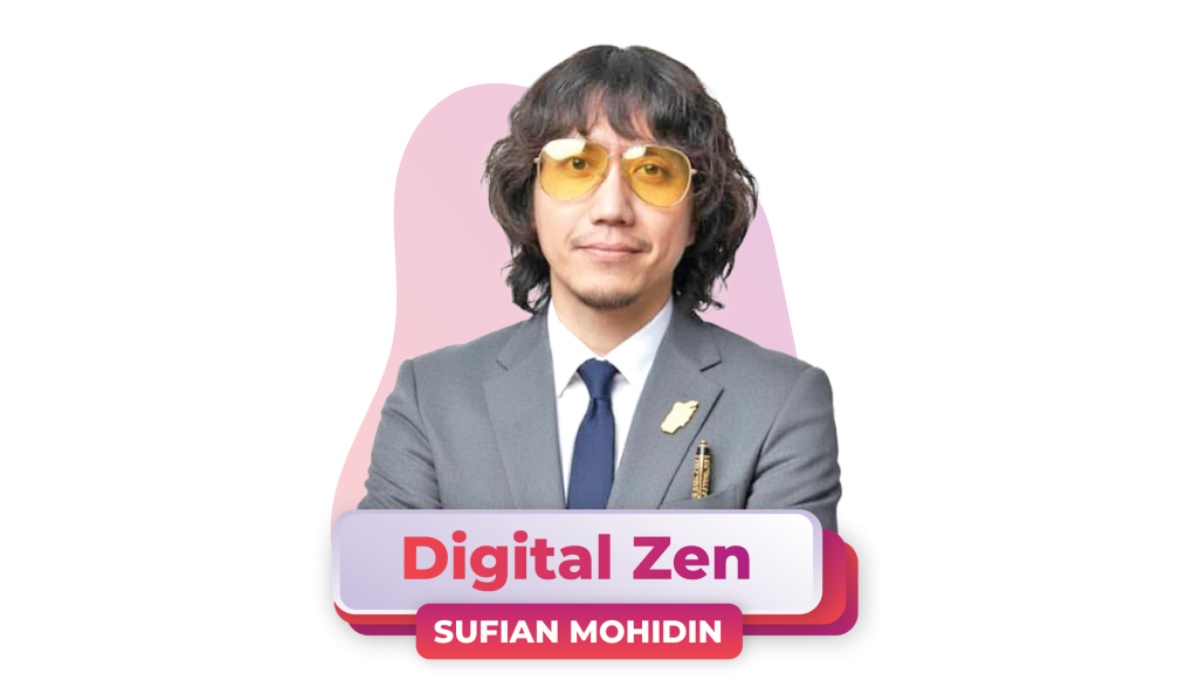
YESTERDAY, my primary school daughter asked me a question over breakfast: “Ayah, what does butter have to do with butterfly?”
I paused mid-bite. Etymology wasn’t in my morning brain. “Good question,” I said. “Let’s ask ChatGPT.”
We opened the app. She typed it herself – hunt-and-peck, focused. Ten seconds later, the answer appeared: the word “butterfly” likely comes from Old English buttorfleoge, possibly because butterflies were believed to steal butter and milk, or because common species had butter-yellow wings. Nothing to do with actual butter.
She looked up. “That’s funny. Words lie sometimes.”
Then: “Ayah, can AI help me draw better?”
Five seconds. From etymology to what can this do for me? Hi everyone. Welcome to a Digital Zen Saturday.
The Stoics taught: the obstacle is the way. My obstacle that morning was explaining a technology I’d spent years writing about. My daughter became the way – she cut through the cathedral I was building and pointed at the door.
Because some 405 hectares away in Tanjung Embang, Sarawak is building an actual cathedral – the AI Data Campus that will anchor Southeast Asia’s digital future. And most Sarawakians don’t realise we are already inside the construction site.
The tools our ancestors would recognise
First came the pen and paper. Then the typewriter. Before printed books, there were woodblocks and movable type – each revolution expanding who could hold knowledge.
The Daoist principle says: the usefulness of a cup is in its emptiness. Tools are only vessels. The pen, the computer, the phone – all empty until filled with intention. AI is no different.
When computers arrived, intelligence was already in the machine, dormant like a seed in winter soil. Over time, letters became code, screens replaced paper, and phones became small worlds in our pockets. Yet the more powerful the tools became, the less we noticed them.
Between 2016 and 2026, something shifted. AI stopped being background noise and started speaking back.
Marcus Aurelius wrote: You have power over your mind – not outside events. Realise this, and you will find strength. We do not control that AI exists. We control what we do with it.
And in that gap between what it is and what we understand lies both possibility and risk.
The architecture already rising
The numbers matter because they are real:
405 hectares in Tanjung Embang – the Kuching AI Data Campus designed for large-scale regional computing. Not future tense. Steel, fibre, cooling systems already going in.
IDECS 2025/2026, themed ‘AI & Green Evolution’ – signalling data infrastructure powered by hydroelectric energy.
Government AI tools like the Dayang chatbot are already answering public queries today.
This is not a vision waiting to arrive. It is a system already executing.
Three things AI does
My daughter taught me something simple: stop building cathedrals in explanations. Build doors.
AI, in practice, does three things well:
It writes first drafts – emails, reports, ideas
It helps design – visuals, products, presentations
It recreates lost things – from old styles to reconstructed voices and imagery
A recent example: I produced a cinematic AI-generated music video featuring P. Ramlee, digitally reconstructed from archival material. An icon performing again decades later.
The tools now available are equally simple:
ChatGPT or Claude for writing and thinking
Canva AI for design
Gamma for presentations
The barrier between idea and execution is now the prompt itself.
In Malay, I call it Akal Internet – connected intellect. Not artificial but extended. The machine processes. You direct meaning.
What gets lost in translation
I spent years collecting certifications – not for decoration, but for literacy. AI courses, business tech, digital systems. Not to build a résumé, but to understand the terrain.
Because we are living in a rare moment: a single individual with AI tools can now function like an entire organisation. The distance between idea and output has collapsed.
I am now, in practice, a designer without formal tools, a coder without coding, a filmmaker without traditional production pipelines.
Last month’s AI music video project proved that shift for me. The gatekeepers are no longer required in the same way. The question is no longer can I access the system, but what do I choose to build with it.
Fear around AI is understandable, but it is also expensive. While we debate it abstractly, infrastructure and capability continue to scale.
The weight we carry, the weight we choose
This column itself is written with AI assistance – not replacing thought but structuring it. Like a second layer of syntax for ideas.
I bring my own voice, adat, Sarawak context. The model helps refine structure and clarity, not intention. It is collaborative, not automated authorship.
We all already think in systems. We just rarely externalise them.
Most people still treat writing as rigid: correct or incorrect, acceptable or not. But in practice, meaning is shaped by perspective and context.
The old version of me had to loosen its grip for this version to emerge.
The practice
Epictetus said: first decide what you want to be, then do what you must do.
I call myself a bridge – between infrastructure and understanding, between systems being built and people meant to use them.
In Sarawak, that means connecting large-scale digital development like the Tanjung Embang campus with everyday access and literacy. Not as authority, but as translator.
The work is not theoretical. It is already happening.
So here is the practice:
Pick one AI tool. Open it. Ask it something real – not experimental, but useful. Then shape the answer. Don’t consume it passively. Work with it.
That moment of interaction is the real shift.
If a handful of people do this and realise the system is not distant or abstract, but usable today, then something important begins to change.
Not through scale. Through initiation.
The Tao Te Ching says: a journey of a thousand miles begins with a single step.
The pen became the typewriter, the computer, the phone – and now the systems that respond.
The revolution is not arriving later.
It is already operational.
The only question left is participation.
Walk through the door.
The views expressed here are those of the writer and do not necessarily represent the views of Sarawak Tribune.