KUCHING: Sarawak’s growth cannot rely on new investment alone while capital sits idle in unused industrial assets.
Deputy Minister for Energy and Environmental Sustainability Datuk Dr Hazland Abang Hipni said Sarawak was undergoing a transformation, with established industries evolving, new sectors entering and the state positioning itself as a regional player in oil and gas, green energy and other high-growth industries.
He said two priorities under the Post COVID Development Strategy 2030 (PCDS 2030) and the Sarawak Sustainability Blueprint were particularly relevant to that transformation: the circular economy and asset optimisation.
He noted that the circular economy was aimed at ensuring resources and capital remained productive for as long as possible instead of being written off prematurely.
“Asset optimisation, meanwhile, meant making fuller use of what Sarawak already had before looking elsewhere.
“These are not policies for their own sake. They reflect a fundamental belief that Sarawak’s growth cannot rely on new investment alone.
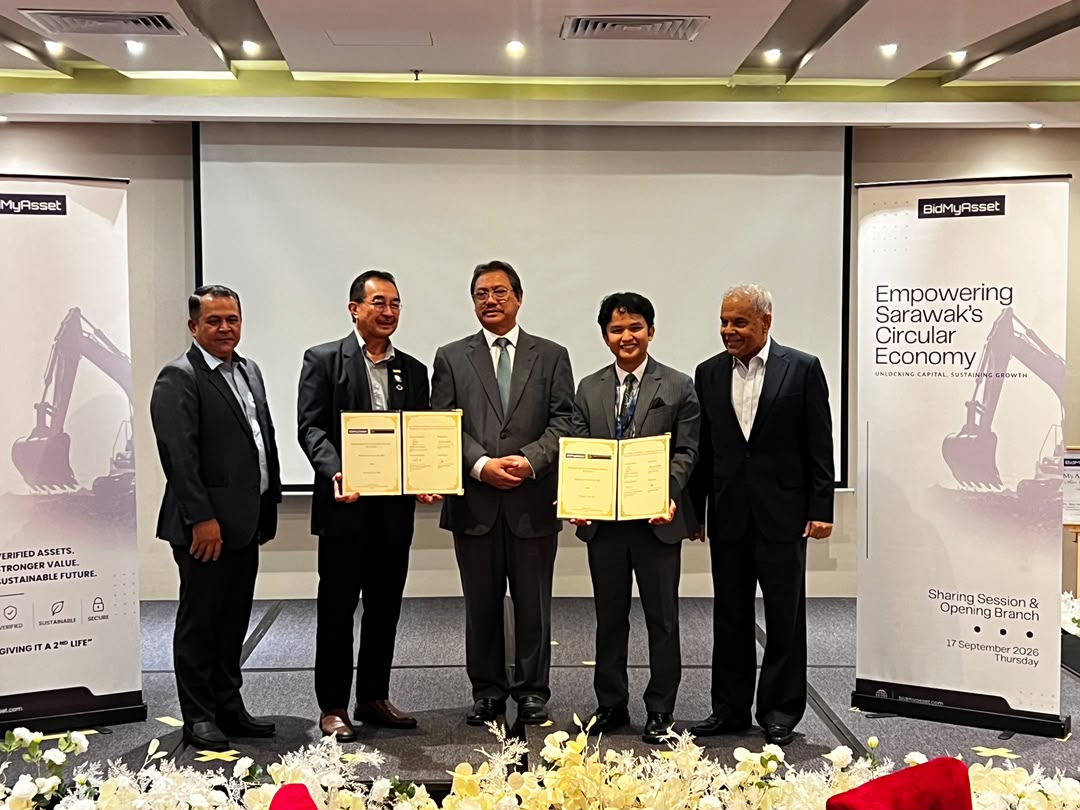
“We must also be intelligent about the capital already within our system,” he said at the launching of BidMyAsset Borneo at the Waterfront Hotel here yesterday.
He said unused equipment, retired machinery and surplus industrial assets represented capital that was no longer contributing to the state when left idle.
“Capital that sits idle in the form of unused equipment, retired machinery, or surplus industrial assets is capital that is not contributing to the state.
“And that is a cost that Sarawak cannot afford as we accelerate towards our development goals,” he said.
Hazland said the Sarawak government had deliberately signalled that direction to the private sector and expected businesses operating in the state to examine how they managed their existing assets.
“What we need in return is for businesses operating in this state to take that signal seriously, to look at how they manage their assets, and to make decisions that will keep capital active and productive within Sarawak’s economy,” he said.
Meanwhile, BidMyAsset Borneo Sdn Bhd director Amirul Annuar said Sarawak’s target of growing its economy to RM282 billion by 2030 under PCDS 2030 would require businesses to expand and upgrade their machinery, technology and facilities.
He said upgrading also raised the question of what companies should do with equipment they no longer required after bringing in newer machinery or technology.
“Old equipment is often left in warehouses or factories, occupying space and gradually losing value despite potentially remaining functional and in good condition.
“It might still work perfectly, it might still be in good condition, but because the business has moved on, it gets left behind and eventually written off as a loss,” he said.
He said businesses were already encountering the issue as industries across Sarawak evolved.
He cited timber and forestry, where he said some companies were moving towards more sustainable practices and consequently no longer required certain equipment.
“Similar changes were taking place in oil and gas, manufacturing and agriculture as businesses evolved.
“The longer those assets sit idle, the more value they lose, and that lost value is money that could have gone back into the business,” Amirul said.
He said machinery that was no longer required by one company did not necessarily have to be treated as a write-off because it could still be sought by businesses elsewhere.
According to Amirul, buyers in Malaysia and other regional markets were looking for equipment that Sarawak businesses might no longer require.
“What may be a sunset industry in Sarawak is a sunrise industry in another part of the world,” he said.
He described an old machine sitting unused in a warehouse as capital that could be unlocked rather than simply written off.
“There is an opportunity in front of us. That old machine sitting in your warehouse is not a write-off; it is capital waiting to be unlocked,” he said.
He said businesses that recovered value from surplus assets could redirect the proceeds towards new equipment, new technology or even a move into another industry.
He urged businesses to assess the potential value of redundant equipment before treating it as scrap or writing it off.
“Before you write off that old asset as a loss or treat it as scrap, come and talk to us first. It may be worth more than you think,” he said.