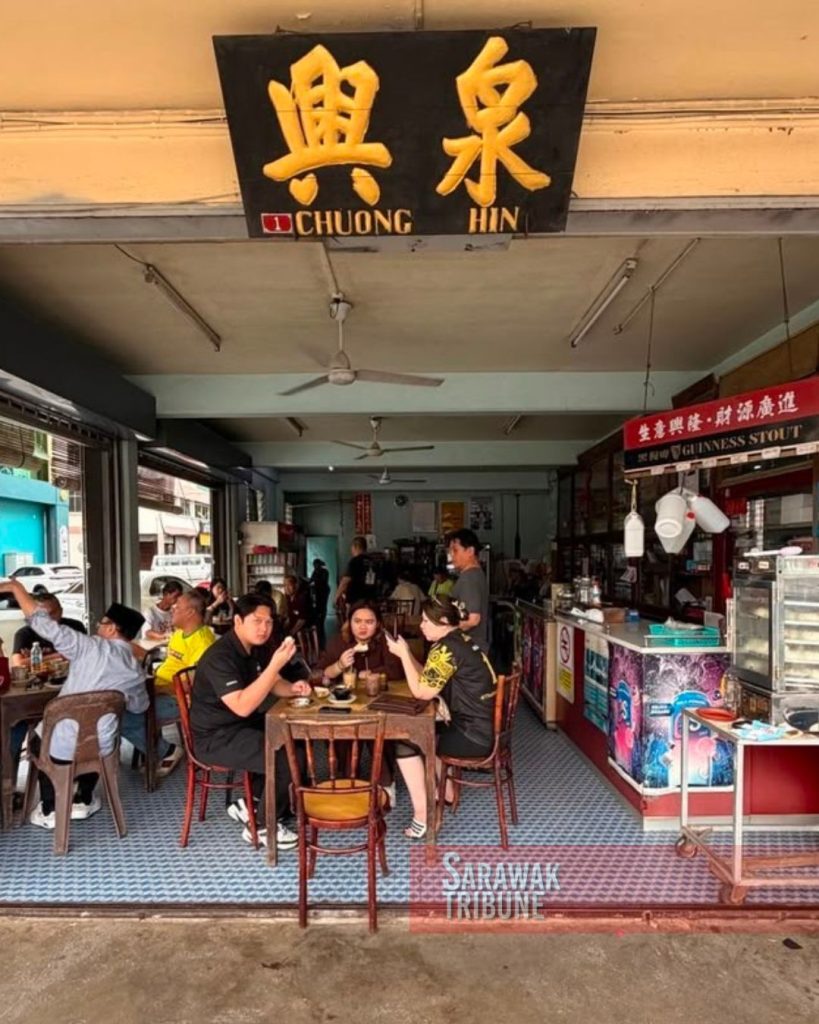
JUST a short walk from Kapit’s express boat jetty, a faded Sarawak Tribune sign still hangs outside Chuong Hin Coffee Shop, a familiar landmark that for decades served not only cups of coffee but also as Kapit’s first and only Sarawak Tribune newspaper agent.
Founded in 1945, Sarawak Tribune, Sarawak’s oldest English language newspaper, has chronicled the state’s history for more than eight decades. In Kapit, that history lives on through the weathered sign, a quiet reminder of a time when newspapers were eagerly awaited, subscribers relied on doorstep deliveries and news travelled much more slowly than it does today.
For 78-year-old Wong Liong Shung, it is a symbol of a family business that once connected Kapit with the rest of Sarawak through the printed word.
“We were the only Sarawak Tribune agent in Kapit,” he recalled.
The newspaper agency was started by Wong’s late father in the 1960s.
Located near the express boat jetty, Chuong Hin Coffee Shop became the centre of newspaper distribution in Kapit, receiving deliveries from Kuching before supplying them to readers across the town.

Besides Sarawak Tribune, the family also sold and distributed English, Malay and Chinese newspapers, making the coffee shop the only place in Kapit where residents could obtain a wide selection of daily newspapers.
While customers gathered over coffee, bundles of freshly arrived newspapers were sorted and prepared for delivery, making the coffee shop both a meeting place and a vital source of information for the community.
Newspapers were supplied almost entirely through monthly subscriptions.
According to Wong, subscribers initially paid RM8 a month before the fee was later increased to RM10.
Most subscribers were government departments, including the Resident’s Office, District Office, Information Department, Education Department and Agriculture Department. Schools and several other organisations also received regular deliveries.
Business reached its peak in the late 1970s.
“The highest was nearly 80 subscribers, around 1978 or 1979,” Wong recalled.
The newspaper agency became part of the family’s daily routine.
Wong said his son began helping with newspaper deliveries when he was just 13 years old.
Using his father’s bicycle, the teenager cycled around Kapit delivering newspapers to subscribers before returning to help at the family business.
Those bicycle deliveries became a familiar sight around town, ensuring newspapers reached readers each day.
In an era before digital technology, newspapers were the principal source of news for many people in Kapit. Government offices depended on them to keep abreast of current affairs, while families often shared a single copy after it had made its rounds through the workplace.
Over the years, however, reading habits changed.
Wong said demand for English newspapers gradually declined as Bahasa Malaysia newspapers became more popular. Later, digital technology transformed the way people consumed news.
“People now have handphones. They just want the headlines. They don’t really read the details anymore,” he said.
As readership declined, so did newspaper subscriptions.
Eventually, deliveries from Kuching stopped more than a decade ago, ending Chuong Hin Coffee Shop’s long association with Sarawak Tribune as its newspaper agent.
Asked whether he would consider selling the newspaper again if deliveries resumed, Wong smiled.
“I don’t think there are subscribers anymore,” he said.
Although newspapers are no longer sold from the coffee shop, the faded Sarawak Tribune sign remains above its entrance, greeting customers and travellers heading to and from the nearby express boat jetty.
For Wong, it is more than an old signboard.
It is a reminder of his late father, the newspaper agency they built together and the generations who helped keep the people of Kapit informed.
Today, headlines appear instantly on mobile phones, but the weathered sign continues to tell a story that cannot be found on a screen.
More than half a century after Wong’s father established the newspaper agency, the Sarawak Tribune sign still stands above Chuong Hin Coffee Shop, preserving the memory of a family whose business became part of Kapit’s daily life and a lasting chapter in the newspaper’s history.