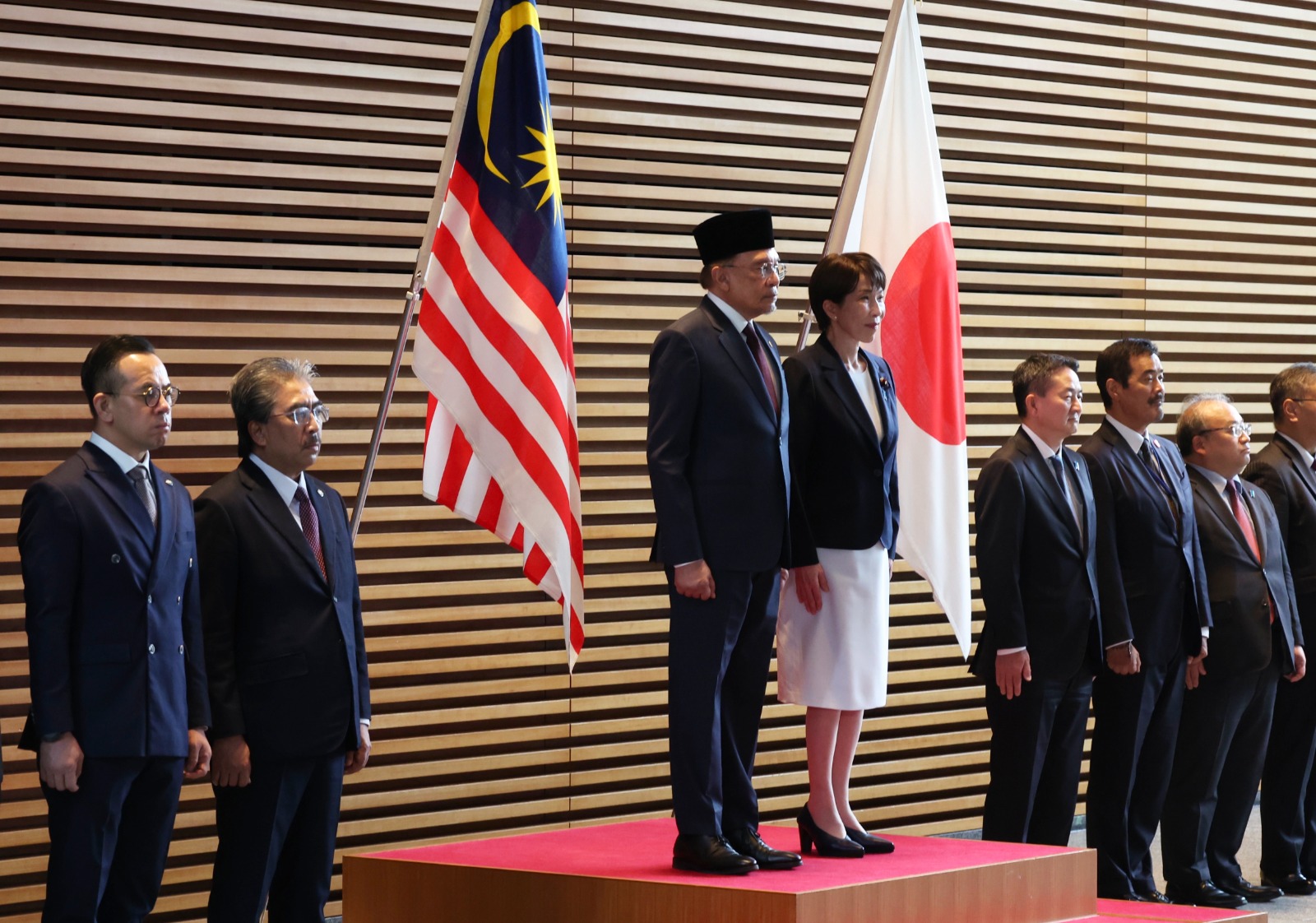
TOKYO: The world is currently facing a shortage of leadership clarity rather than power, Prime Minister Datuk Seri Anwar Ibrahim said yesterday (June 9).
Speaking at the Nikkei Forum on “Navigating Strategic Uncertainty”, Anwar urged renewed global cooperation to address mounting geopolitical challenges, stressing that effective leadership requires a clear sense of direction amid global uncertainty.
“The sailors of old could not predict every storm. They could not control the currents, nor could they see beyond every horizon. What they possessed was a clear sense of direction,” he said.
He said the world does not lack power but clarity, with institutions needing reform and renewal rather than abandonment, cooperation preferred over division, and leadership requiring initiative rather than resignation.
“If we remain guided by these principles, I earnestly believe we can transform today’s challenges into tomorrow’s opportunities,” he said.
Anwar’s address was the first item on the agenda of the 31st Nikkei Forum, under the theme “Working Together for a More Resilient and Prosperous Asia”.
Anwar said the current strategic uncertainty has been building over time rather than emerging overnight, warranting a closer examination of its root causes as many leaders remain bound by an outdated geopolitical mindset.
He noted that in this mindset, realpolitik and hegemonic considerations continue to fuel the pursuit of power under the guise of strategic security.
Anwar pointed out that the continuing tragedy in Gaza, tensions across West Asia and their compounding global effects, as well as the prolonged war in Ukraine, underscore the fragility of peace and the limits of international consensus.
“These are urgent and pressing concerns directly impacting the very fabric of international order. But this is not all,” he said, adding that great-power rivalry in the region, particularly disputes in the South China Sea, threatens maritime stability and keeps Southeast Asia on edge.
Anwar also highlighted the multilayered threat posed by North Korea, citing its nuclear programme and significant conventional and cyber warfare capabilities.
He said leaders must have the courage to confront injustice and champion a more proactive approach to peace and progress, noting that long before the emergence of modern states, the peoples of the Malay world and the Japanese archipelago had already learned to navigate uncertain waters.
“As maritime civilisations, we came to understand a simple truth: prosperity did not come from turning inward, but from engaging the wider world through trade, dialogue and cooperation,” he said.
Anwar said middle powers today face steep and cumulative challenges amid an increasingly complex strategic landscape, adding that while not all geopolitical currents can be controlled or disruptions predicted, countries possessing credibility must remain guided by clear principles to navigate the path ahead.
“We understand the aspirations of developing nations and the concerns of advanced economies. We are uniquely positioned to build bridges where others see divides, and build consensus where others see discord,” he explained.
On Artificial Intelligence (AI), Anwar warned that the future of AI must not be shaped by a handful of technological powers or private corporations alone, cautioning against new forms of “digital colonisation” or technological domination.
He said developing countries must have a stronger voice in global rule-making, rejecting what he described as modern forms of technological domination.
“The answer lies in collaboration, grounded in cooperation, trust and institutions capable of bringing together diverse interests,” he said.–BERNAMA