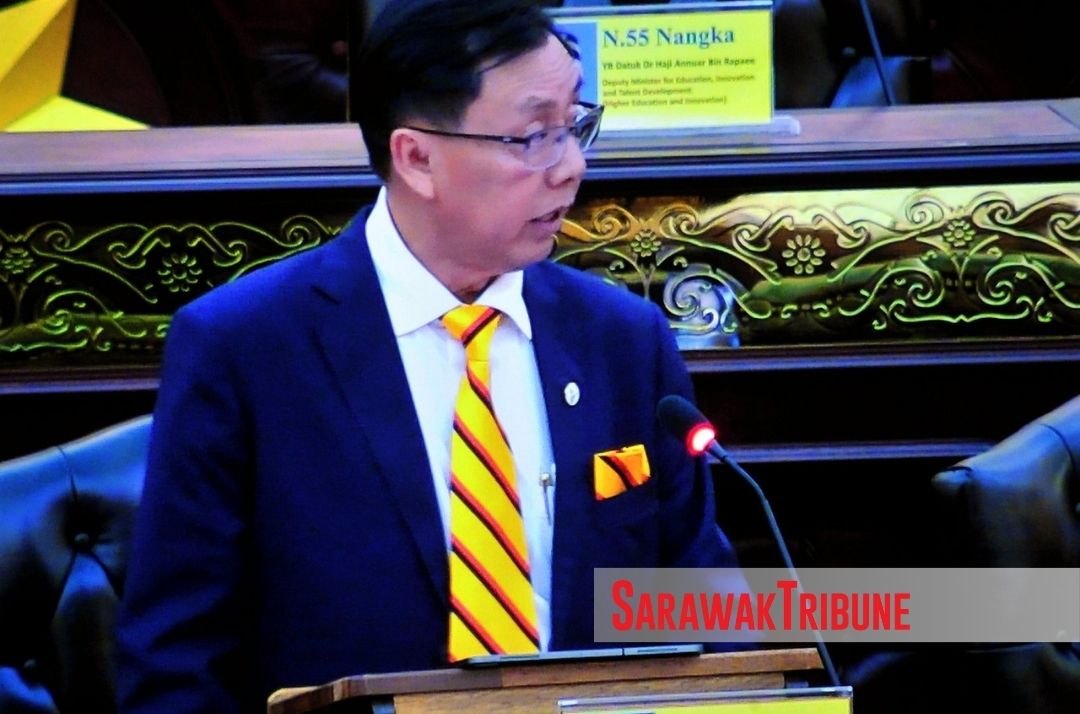
THE Ministry of Food Industry, Commodity and Regional Development has identified about 15,000 hectares for commercial paddy cultivation under the Design, Build, Operate and Transfer (DBOT) Public-Private Partnership model.
Its Minister Datuk Seri Stephen Rundi Utom said 6,100 hectares have so far been approved for implementation, including areas in Tanjung Purun, Linga Banting, Stumbin Bijat, Seduku, Selepong, Limbang and Sundar.
“My ministry will continue to identify more suitable areas for commercial paddy cultivation,” he said during his ministerial winding up speech at the august House, here today.
Rundi said Sarawak achieved a Self-Sufficiency Level (SSL) of 21 per cent in 2024 with an output of about 51,000 metric tonnes of paddy. However, production in 2025 is projected to decline to 48,700 metric tonnes, potentially reducing the SSL to 20 per cent.
“This shortfall has contributed to the need to import 173,000 metric tonnes of rice valued at RM460 million from January to October 2025, thus reinforcing the urgency of the government’s commitment to increase the SSL,” he added.
Touching on ongoing research into high-yielding and resilient rice varieties in collaboration with the Malaysian Nuclear Agency, Universiti Putra Malaysia, Universiti Kebangsaan Malaysia and UiTM at Stumbin, Sri Aman, Dr Rundi said the findings show the new rice lines recorded a 30 per cent higher yield compared to the control variety MR297.
“In 2025, several new rice varieties, including hybrid and perennial paddy, were introduced into Sarawak for evaluation trials, adaptability studies and potential commercial planting.
“These varieties were imported in full compliance with departmental biosecurity protocols and Sarawak’s plant health requirements,” he said.
To strengthen capacity in the paddy and rice industry, he said the state government is working with the Muda Agricultural Development Authority (MADA) to provide technical training aligned with the National Occupational Skills Standards (NOSS).
“While Sarawak prepares to establish its own training facilities and structured programmes, 25 Sarawakian students will undergo a fully sponsored two-year training at the MADA Rice Training Centre in Kedah beginning January 2026,” he added.
Rundi also said that the state Cabinet has approved the establishment of the Sarawak Paddy and Rice Board, which will serve as the central authority to coordinate, regulate and oversee the development of the paddy and rice industry in the state.