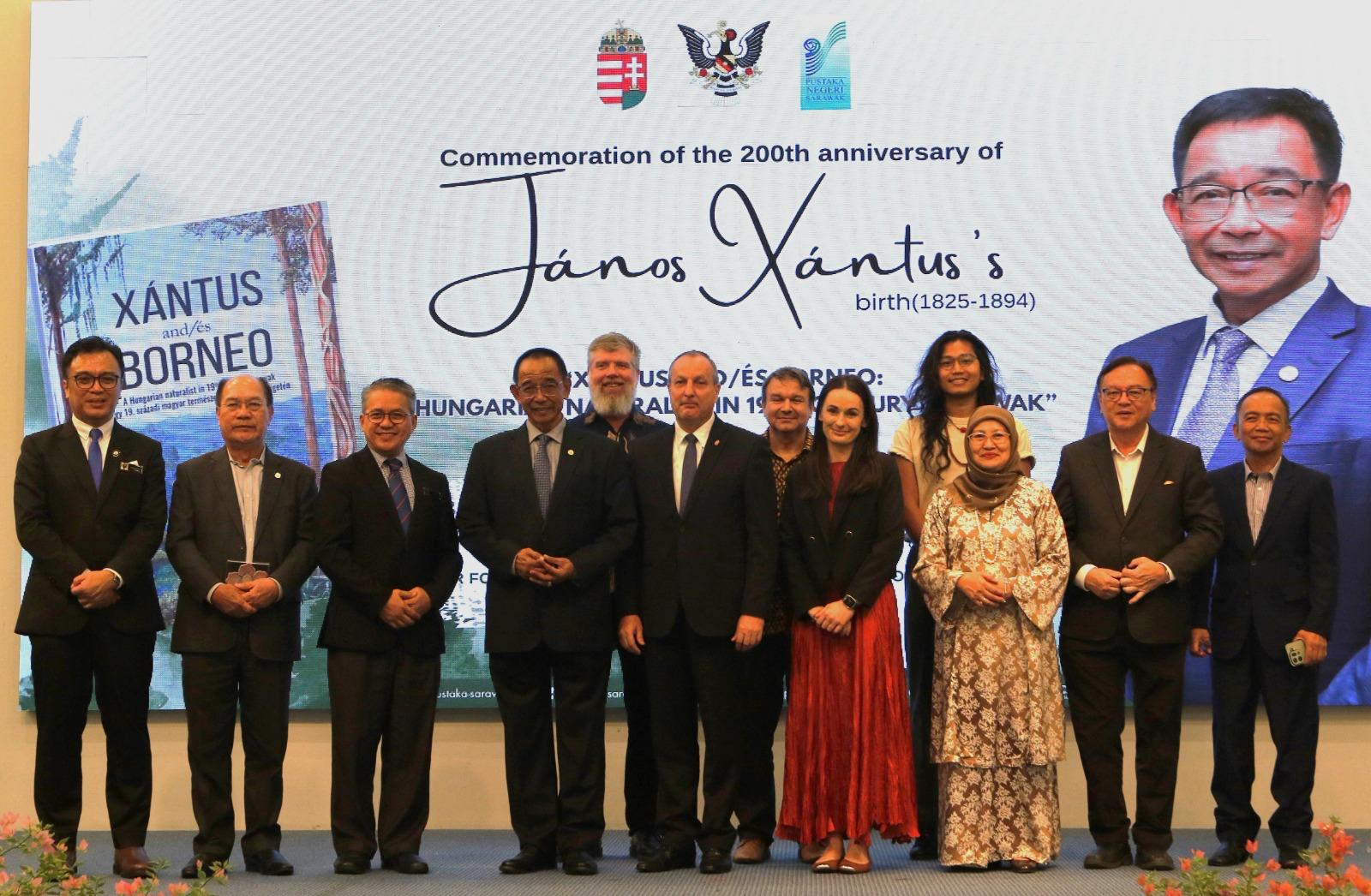
KUCHING: The Sarawak State Library held a programme to commemorate the 200th anniversary of the birth of János Xantus, a Hungarian naturalist and traveller who conducted important research in Sarawak in the 19th century.
The programme aims to appreciate the legacy and contributions of Xantus in the field of natural sciences as well as to strengthen the long-standing historical, cultural and academic ties between Sarawak and Hungary.
Minister for Tourism, Creative Industry and Performing Arts Datuk Seri Abdul Karim Rahman Hamzah said the programme pays tribute to Xántus (1825-1894) whose work embodied the best virtues of scientific inquiry: open-minded curiosity and a deep respect for the diversity of life and cultures.
“His journey to Sarawak placed him at the crossroads of curiosity and responsibility, exploration and documentation to inform future generations about the island’s rich biodiversity, its habitats, and us, the people who call it home,” he said during his speech at the commemoration as well as the launch of a book related to Xantus at the Sarawak State Library, on Friday (June 19).
Abdul Karim said most Sarawakians are more familiar with figures such as Alfred Russel Wallace and Odoardo Beccari, but not many know that Xantus also conducted research in Sarawak.
He said that during his approximately four months in the state, Xantus had explored several areas, including Kuching, Matang, Sri Aman and Gedong to conduct research.
“This shows that even in a short period of time, he managed to travel to various places and record his observations.
“His writings which are being republished today provide a valuable insight into Sarawak at that time.”
He also expressed his appreciation to the Hungarian Embassy, Sunway University and the Sarawak State Library for their efforts in publishing works that highlight Xantus’ contributions to the world of knowledge.
“Such publications would not only introduce Sarawak’s history to the international community, but also have the potential to strengthen relations between Sarawak and Hungary, including in the fields of tourism and research.”