Every September, communities around the world turn gold in recognition of Childhood Cancer Awareness Month, a global effort to draw attention to children and adolescents living with cancer, the inequalities surrounding their treatment and the families accompanying them through the journey.
Gold has become the international colour associated with childhood cancer awareness, with the gold ribbon serving as a symbol of solidarity with children and adolescents with cancer, survivors and their families.
Through the annual Gold September campaign, buildings and landmarks around the world have also been illuminated in gold, while communities, hospitals, organisations and individuals organise awareness activities throughout the month.
For 2026, Childhood Cancer International (CCI) and the International Society of Paediatric Oncology (SIOP) are again calling on communities worldwide to “Turn the World Gold”, culminating in a global moment on Sept 30 as activities are shared across different time zones.
Behind the gold ribbons and awareness campaigns is a significant global health challenge.
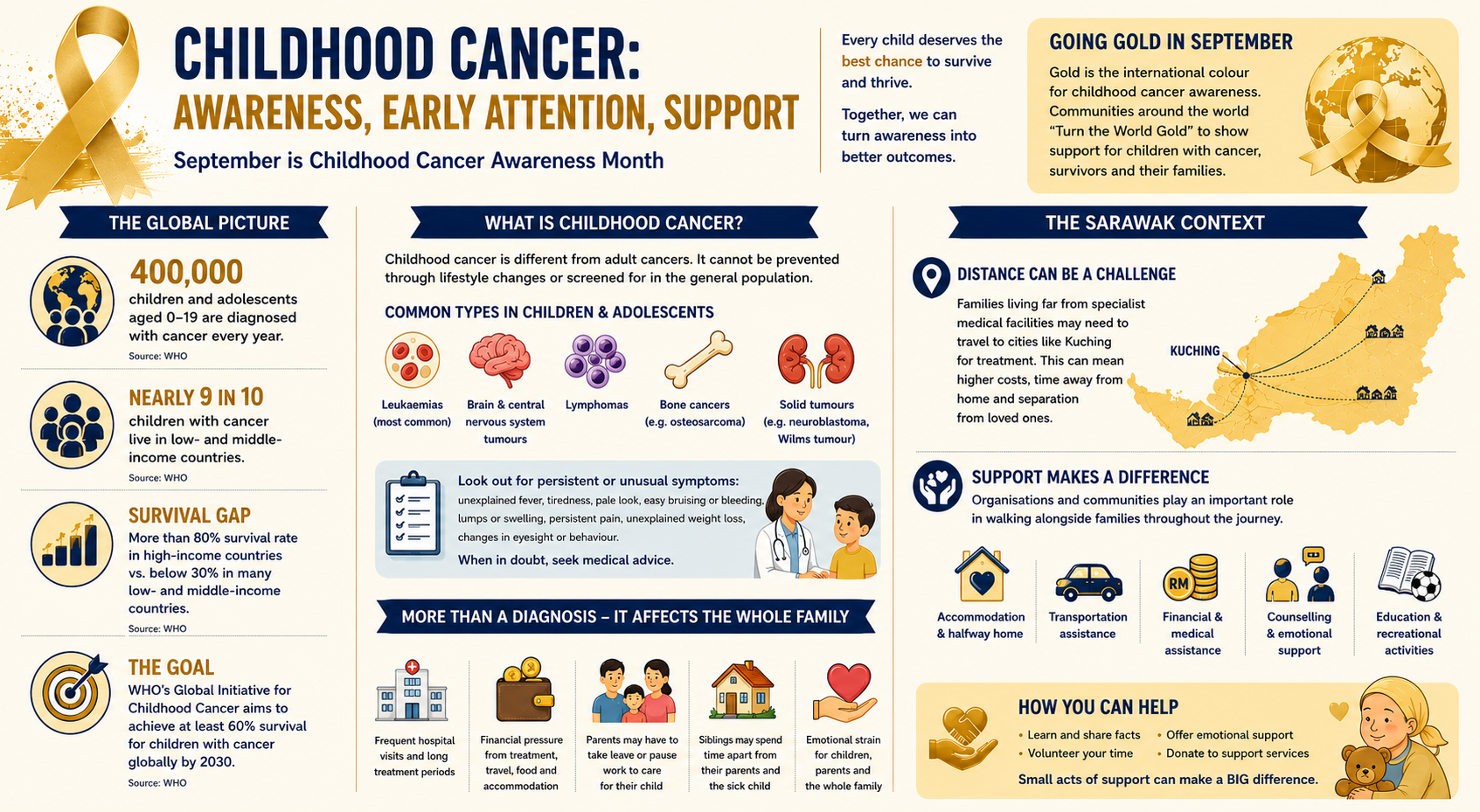
The World Health Organisation (WHO) estimates that approximately 400,000 children and adolescents aged up to 19 develop cancer every year.
Among the most common cancers affecting children are leukaemias, brain tumours and solid tumours such as neuroblastoma and Wilms tumour, while lymphomas, bone cancer and thyroid cancer are more common during adolescence.
Cancer also remains a leading cause of death among children and adolescents.
A wide survival gap
Perhaps one of the most striking realities surrounding childhood cancer is that where a child lives can significantly influence their chances of survival.
According to WHO, more than 80 per cent of children diagnosed with cancer in high-income countries are cured.
In many low- and middle-income countries, however, the figure is below 30 per cent.
WHO attributes the disparity to factors including delayed or inaccurate diagnosis, difficulties accessing treatment, treatment abandonment, deaths from treatment-related toxicity and relapse.
Nearly nine in 10 children who develop cancer worldwide live in low- and middle-income countries.
The disparity has prompted an international effort to improve childhood cancer outcomes.
In 2018, WHO launched its Global Initiative for Childhood Cancer together with St Jude Children’s Research Hospital and other global partners, with the goal of achieving at least 60 per cent survival for children with cancer globally by 2030 while reducing suffering among affected children.
Childhood cancer is different
Unlike some cancers affecting adults, childhood cancer generally cannot be prevented through lifestyle changes or detected through population screening programmes.
This makes timely diagnosis and access to appropriate treatment particularly important.
At the same time, awareness should not cause parents to assume that every fever, ache or change in appetite is cancer.
Children become unwell for many reasons, and symptoms commonly associated with cancer can also be caused by far more common childhood illnesses.
What matters is recognising persistent or unexplained changes and seeking medical assessment when something does not appear right.
Parents are often the people most familiar with their child’s normal behaviour, appetite, energy level and routines.
When something persists, repeatedly returns or causes concern, medical assessment can help establish what is happening.
When cancer changes childhood
A cancer diagnosis can transform everyday family life almost overnight.
For most children, childhood revolves around school, playing with friends, family outings and reaching new milestones.
For a child undergoing cancer treatment, hospital appointments, procedures and extended periods away from school can suddenly become part of that routine.
Parents may have to rearrange work and family responsibilities to accompany their child through treatment.
For younger children who may not fully understand what is happening, repeated hospital stays and procedures can be frightening.
Older children and adolescents may face a different emotional burden as they become more aware of their illness and the changes it brings to their lives.
The impact also extends beyond the child undergoing treatment.
Siblings may spend extended periods away from their parents, while families can face additional expenses for transportation, accommodation, food and other necessities alongside the emotional strain of the diagnosis itself.
Sarawak’s geographical challenge
In Sarawak, geography can add another dimension to that journey.
The state population is spread across cities, towns and rural communities, with some families living considerable distances from specialist medical facilities.
For families outside Kuching who need to accompany a child receiving treatment in the city, the journey can therefore involve much more than travelling to a hospital appointment.
Some may have to remain away from home for extended periods, find accommodation and manage transportation and everyday expenses while simultaneously caring for a sick child.
Parents may also have to take extended leave from work, while other children remain at home with relatives.
These practical realities demonstrate why childhood cancer care extends beyond medicine alone.
A support system beyond the hospital
This is where organisations such as the Sarawak Children’s Cancer Society (SCCS) have become part of the support system surrounding affected families in Sarawak.
For the past 25 years, SCCS has advocated for and supported children with cancer and their families.
As previously explored in Sarawak Tribune’s series on childhood cancer, that support extends beyond the hospital to address some of the practical and emotional challenges accompanying treatment.
The society provides assistance including accommodation, transportation, financial and medical support, counselling as well as educational and recreational activities.
Its role also demonstrates an important aspect of childhood cancer that can sometimes be overlooked – treatment is only one part of the journey.
A family may need somewhere to stay while their child undergoes treatment, help getting to appointments, financial assistance or simply someone who understands what they are experiencing.
Support may continue into remission and survivorship, while some families may require palliative and bereavement support.
Awareness beyond the gold ribbon
Childhood Cancer Awareness Month therefore serves several purposes.
Internationally, it raises awareness of the hundreds of thousands of children and adolescents affected by cancer each year and the enormous disparity in survival between different parts of the world.
Closer to home, it provides an opportunity to better understand what childhood cancer means for Sarawakian families and the challenges that can accompany treatment, particularly when distance and geography are involved.
The gold ribbon may be most visible during September, but childhood cancer does not follow an awareness calendar.
For the children undergoing treatment, survivors and the families supporting them, the journey continues long after September ends.
Going gold, therefore, is not merely about wearing a ribbon.
It is about recognising that behind every childhood cancer diagnosis is still a child who wants to learn, play, laugh and grow, and a family doing everything it can to help them get there.