Better alignment with actual liability could ease M40 household cash flow
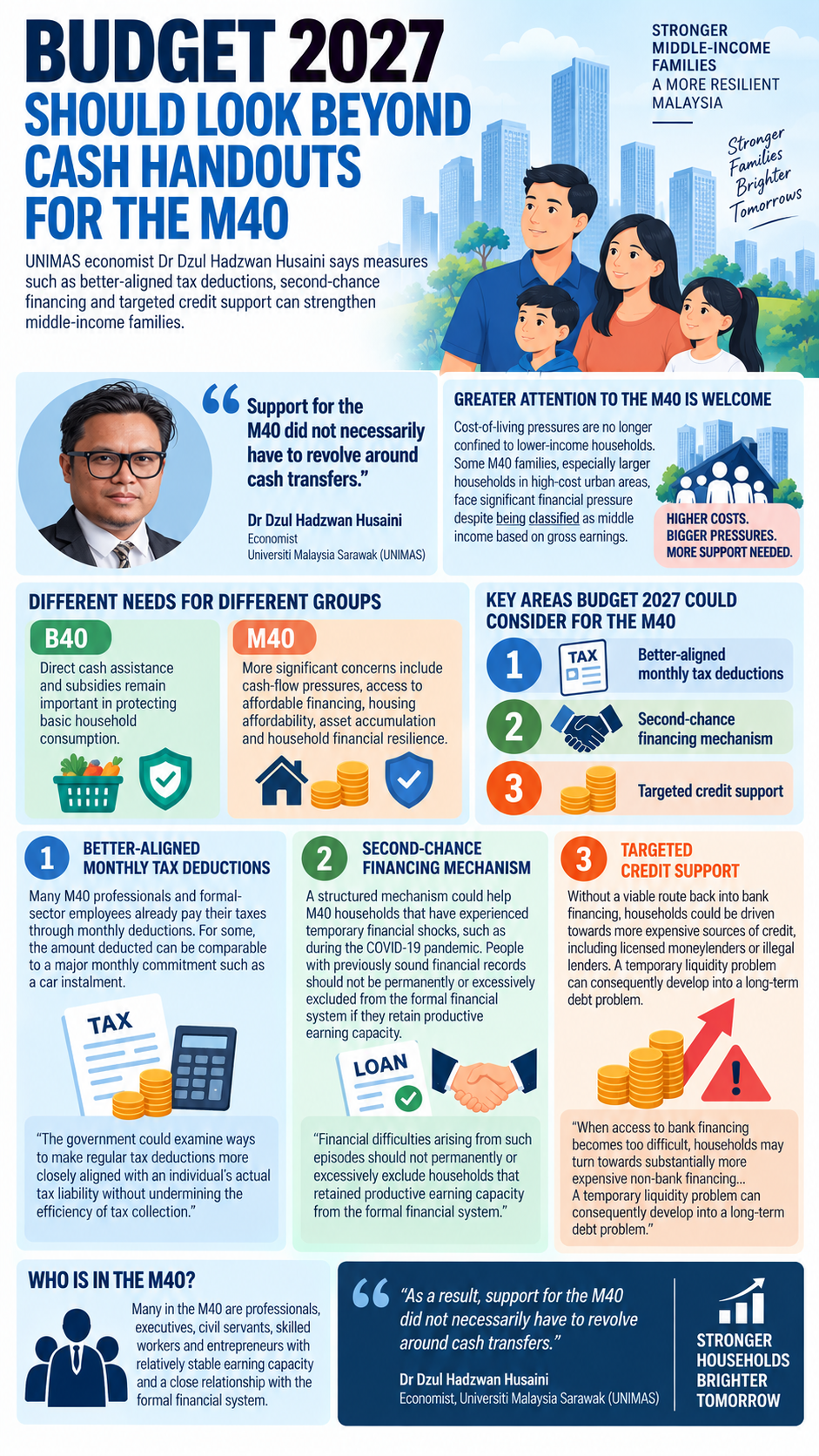
KUCHING: Budget 2027 should look beyond cash handouts for the M40 and consider measures ranging from better-aligned monthly tax deductions to second-chance financing and targeted credit support.
Universiti Malaysia Sarawak (UNIMAS) economist Dr Dzul Hadzwan Husaini said such measures could help improve household cash flow, preserve access to formal financing and strengthen the ability of middle-income families to withstand financial shocks.
He said the government’s intention to give greater attention to the M40 was welcome, particularly as cost-of-living pressures were no longer confined to lower-income households.
Some M40 families, especially larger households in high-cost urban areas, were facing significant financial pressure despite being classified as middle income based on gross earnings.
“For the B40, direct cash assistance and subsidies remain important in protecting basic household consumption.
“For the M40, more significant concerns include cash-flow pressures, access to affordable financing, housing affordability, asset accumulation and household financial resilience,” he told Sarawak Tribune.
One area Budget 2027 could examine, Dzul said, was the impact of monthly income-tax deductions on household cash flow.
Many M40 professionals and formal-sector employees were already within the tax system and paid their taxes through monthly deductions.
For some, he said, the amount deducted could be comparable to a major monthly commitment such as a car instalment.
If excess payments were only returned after tax assessment, households lost access to money that could otherwise have been used for emergency savings, debt reduction or housing-related needs.
“The government could therefore examine ways to make regular tax deductions more closely aligned with an individual’s actual tax liability without undermining the efficiency of tax collection,” he said.
Dzul said another area worth considering was a structured second-chance financing mechanism for M40 households that had experienced temporary financial shocks.
He said the COVID-19 experience demonstrated how people with previously sound financial records could encounter repayment difficulties because of circumstances beyond their control.
“Financial difficulties arising from such episodes should not permanently or excessively exclude households that retained productive earning capacity from the formal financial system.”
Without a viable route back into bank financing, he warned that households could be driven towards more expensive sources of credit.
“When access to bank financing becomes too difficult, households may turn towards substantially more expensive non-bank financing, including licensed moneylenders or, more worryingly, illegal lenders.
“A temporary liquidity problem can consequently develop into a long-term debt problem,” he said.
Dzul said the government, Bank Negara Malaysia and financial institutions could work together on such a mechanism, given the M40’s relatively close relationship with the formal financial system.
Many in the group were professionals, executives, civil servants, skilled workers and entrepreneurs with relatively stable earning capacity.
“As a result, support for the M40 did not necessarily have to revolve around cash transfers.