
PRIVATE enterprises have long served as the backbone of Malaysia’s economy. They generate employment, sustain local communities and embody an entrepreneurial spirit passed down through generations.
Yet beneath this tradition lies a pressing dilemma: the way a minority of privately managed small and medium sized (SME) businesses organise their supply chains can inadvertently compromise integrity, drive up consumer prices and erode employee welfare.
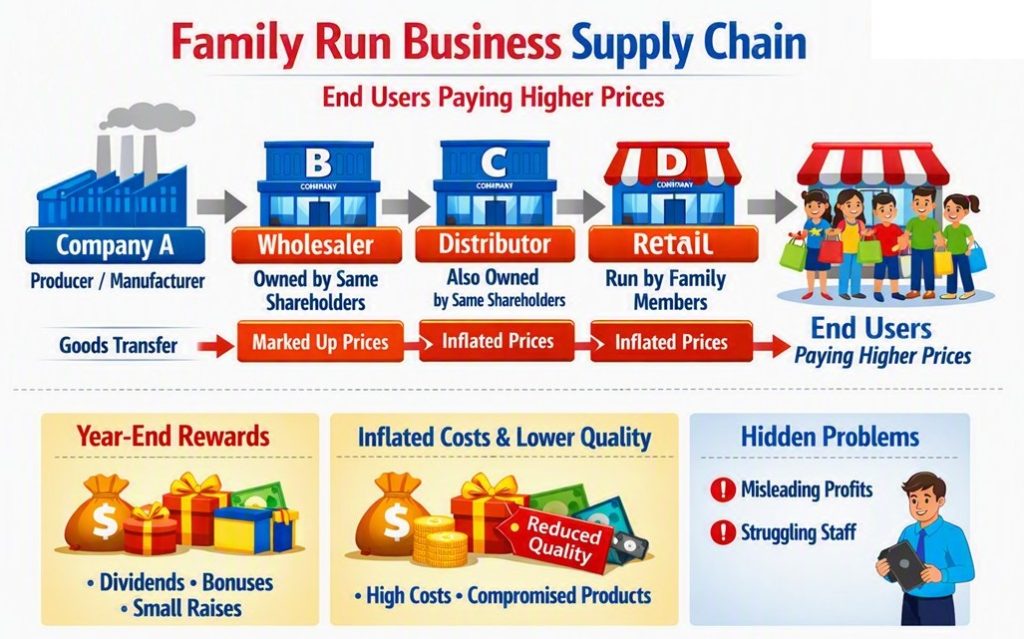
For example, Company A, a manufacturer, routes goods through Companies B and C, owned by relatives, before reaching Company D, a privately run retailer. Each intermediary inflates prices, leaving consumers burdened.
Meanwhile, competitive pricing pressures that manufacturer to cut corners, risking product quality. Though profits appear healthy, this supply chain structure undermines integrity, raises costs and weakens employee welfare.
At first glance, this arrangement may appear to be a clever way of maximising shareholder returns. Each company in the chain records profits and dividends are paid at year end. Staff bonuses are distributed and salaries are adjusted—albeit modestly, with increments ranging from RM50 to RM200. But beneath the surface, the practice raises serious concerns.
Inflated prices, eroded trust
When multiple companies in the same ownership circle inflate prices, the result is predictable: consumers pay more than necessary. Goods that could have reached the market at a fair price are burdened with layer upon layer of mark ups. This not only undermines competitiveness but also risks crossing the line into financial fraud if the intent is to manipulate accounts for shareholder gain.
The irony could not be clearer. By year’s end, Company D — the retailer—reports a financial loss, yet dividends and staff bonuses are still distributed, financed through debts or loans. This creates a misleading impression of profitability and sustainability. While shareholders may reap short term rewards, the long term stability and health of the business are undermined, leaving the enterprise exposed to deeper risks.
Staff welfare: The silent casualty
Employees are the silent casualties of this system. Salary increments of RM50 to RM200 are not aligned with inflationary realities. If consumer prices rise by 7–10%, a nominal increase of 2% to cover inflation, in wages translates into no real gain. Staff find themselves struggling to afford daily necessities, even as the companies they work for distribute dividends to shareholders.
This disconnect between shareholder rewards and employee welfare erodes morale and loyalty. It sends a troubling message: profits matter more than people. In the long run, such practices can lead to higher turnover, weaker productivity and reputational damage.
Integrity at stake
Business integrity is not just about compliance with laws; it is about fairness, transparency and accountability. When companies inflate prices within a closed ownership circle, they risk breaching these principles. The practice may not always be illegal but it undermines trust among employees, customers and the wider public.
Malaysia’s economy thrives on credibility. Investors, regulators and consumers expect businesses to operate with integrity. Privately run enterprises that prioritise short term shareholder gain over sustainable practices jeopardise not only their own future but also the broader reputation of Malaysian business.
Recommendations for reform
Privately run businesses must rethink their practices if they are to remain competitive, fair and sustainable. Several reforms can help restore integrity and protect both consumers and employees.
First, streamlining supply chains is essential. Privately owned groups should minimise unnecessary intermediaries. When Company A sells directly to Company D — or even to external retailers — goods reach the market faster and at fairer prices. Eliminating redundant steps reduces inflated mark ups and ensures consumers are not overburdened.
Second, transparent pricing must become the norm. Each company in the chain should justify its margins based on actual costs and the value it adds. Transparency builds trust among employees, customers and regulators while reducing suspicion of manipulation or hidden profiteering.
Third, businesses must align wages with inflation. Salary increments should be benchmarked against inflation plus a reasonable margin of 5–15%. This ensures employees maintain purchasing power, feel valued and remain motivated. Fair wages are not just a cost—they are an investment in productivity and loyalty.
Fourth, separating ownership from management can strengthen governance. Independent directors or external managers provide oversight, ensuring decisions are made for long term sustainability rather than short term shareholder gain. This separation reduces conflicts of interest and promotes accountability.
Fifth, regulatory oversight must be strengthened. Authorities should monitor related party transactions more closely, ensuring they do not distort markets or exploit consumers. Effective enforcement protects both the integrity of the business sector and the welfare of households.
Privately-run enterprises must promote an ethical culture. Integrity should be embraced as a core value. Training programmes, codes of conduct and accountability mechanisms can reinforce ethical decision making.
When businesses act responsibly, they not only safeguard their reputation but also contribute to Malaysia’s broader economic resilience.
Conclusion
The dilemma facing many privately run businesses is clear: balancing shareholder interests with consumer fairness and employee welfare. Inflated supply chains may deliver short term profits but they erode trust, weaken competitiveness and harm staff morale.
Malaysia’s economic resilience depends not only on GDP growth but also on the integrity of its businesses. Private enterprises must recognise that true prosperity lies in sustainable practices — fair pricing, transparent governance and wages that reflect real living costs.
By reforming their structures and embracing integrity, they can continue to be pillars of the economy while ensuring that prosperity is genuinely shared.
The views expressed here are those of the writer and do not necessarily represent the views of Sarawak Tribune. The writer can be reached at drjohnlau@gmail.com.