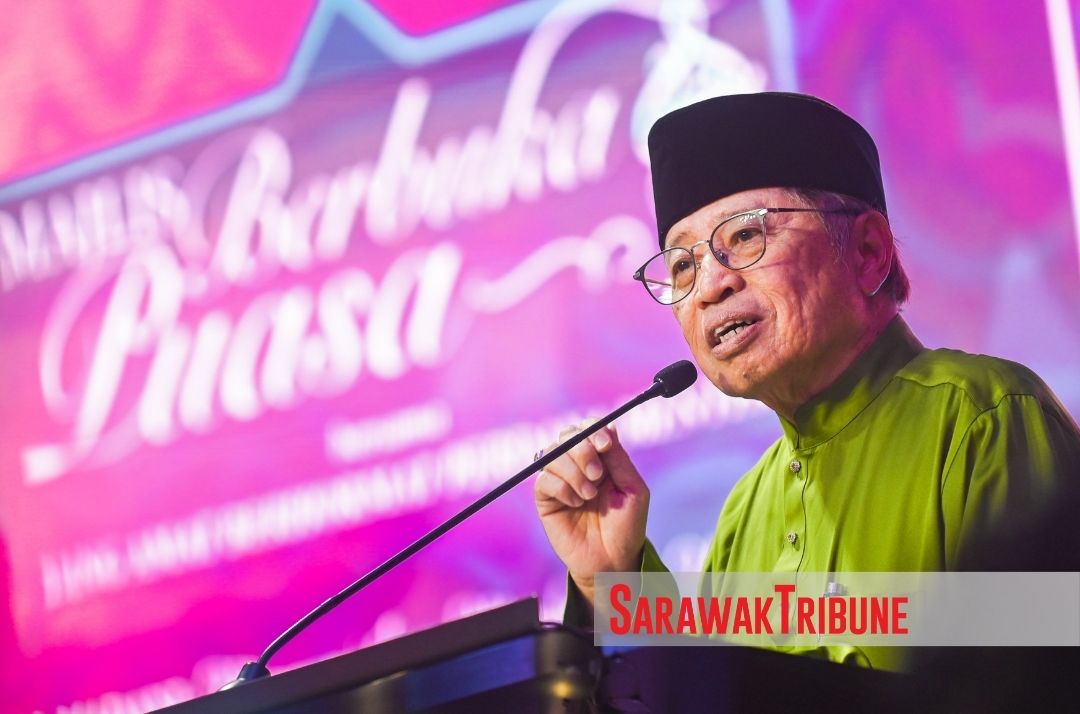
KUCHING: The widespread adoption of cashless payments among Sarawakians reflects the success of the state’s digital economy push, a key pillar under the Post COVID-19 Development Strategy (PCDS) 2030.
Premier Datuk Patinggi Tan Sri Abang Johari Tun Openg said what began as a necessity during the COVID-19 pandemic has since evolved into a norm, with people across all age groups now comfortable using technology for daily transactions.
“Today, Sarawakians at all levels know how to use cashless payments. Even at markets, whether young or old, everyone is paying using QR codes and mobile phones,” he said at the GPS Convention 2026 at the Borneo Convention Centre Kuching (BCCK) here today (April 19).
Recalling a visit to the Ramadan Bazaar Satok, Abang Johari pointed out that even small traders and elderly vendors had embraced digital payments.
He said this transformation was driven by the state government’s early move to introduce a digital economy, including mobile payment platforms such as Sarawak Pay (now known as S Pay Global).
“I wanted to buy murtabak at the Ramadan Bazaar and saw that everyone was paying using their phones. When I paid in cash because I had forgotten my phone, the young boy even asked why I wasn’t using cashless payment.
“Initially, many were sceptical of our digital economy initiative, but after COVID-19, people began to recognise its importance. Without technology during the pandemic, it would have been very difficult,” he said.
Abang Johari explained that the shift towards digitalisation was part of a broader strategy formulated during one of Sarawak’s most challenging periods.
Following the 2018 General Election and the onset of the COVID-19 pandemic, he said the state faced multiple crises – from political uncertainty to public health emergencies and economic downturn.
“Many people lost their lives, families were separated, and daily life became difficult. It was hard to buy food, to send children to school, and the economy declined,” he said.
In response, the state government convened economic experts, non-governmental organisations and community leaders to chart a way forward, leading to the formulation of PCDS 2030.
Abang Johari said the strategy outlines a comprehensive roadmap anchored on six key economic sectors namely agriculture, tourism, forestry, mining, manufacturing and services which are supported by seven strategic enablers.
Beyond economic growth, Abang Johari stressed that social development was also prioritised, with various initiatives introduced to support the rakyat.
These include financial assistance for newborns, aid for mothers, and support for students repaying their National Higher Education Fund Corporation (PTPTN) loans to ease their financial burden.
“We realised that we could no longer rely on the old economic model. We had to transform and adopt modern technology to drive our economy forward,” he said.
He added that the success of cashless payment adoption today is a clear indicator that Sarawak is on the right track in embracing digital transformation under PCDS 2030.