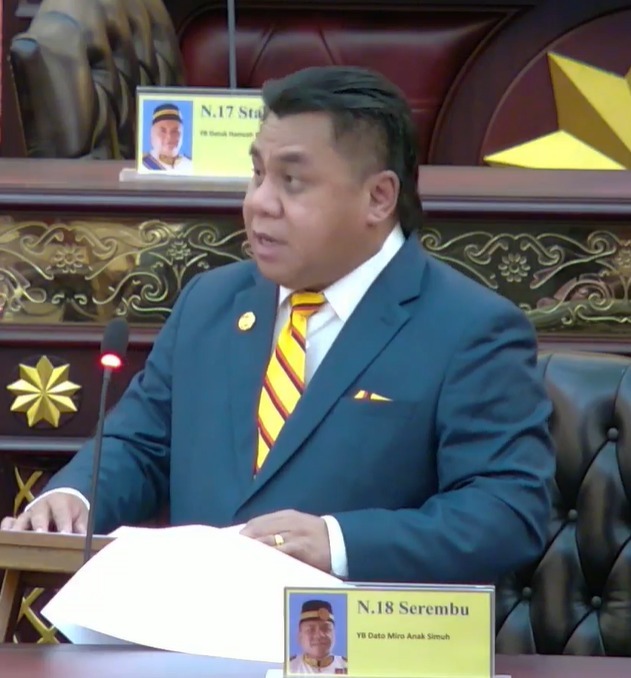
FASTER implementation of development initiatives, improved rural education and stronger support for key economic sectors are needed, said Datuk Miro Simuh (GPS-Serembu).
He raised several issues and concerns that require answers and clarification from the relevant ministries and departments, including Native Customary Rights (NCR) land, which remains close to the hearts of rural Bidayuh communities.
“As elected representatives, we bear a great responsibility to ensure that every policy and plan announced is translated into action that brings direct benefits to the people as a whole.
“Although the government has implemented various initiatives and policies related to NCR land measurement, the reality in many Bidayuh areas in Bau, Padawan and Serian is that the process is still seen as too slow, incomplete and far from meeting the people’s expectations.
“This issue often becomes a major burden for us as elected representatives, as we are perceived as not taking action or doing enough to bring the matter to the higher administrative level,” he said during the debate on the Head of State’s address at the DUN Complex.
Apart from that, Miro also raised concerns over delays in technical approvals and coordination of regional development projects involving multiple departments and agencies.
“Although the state government under the leadership of the Premier of Sarawak has repeatedly emphasised the need to expedite the implementation of all development projects, at the implementation level, there are still various procedural delays that ultimately affect project effectiveness and public confidence.
“We can see that many projects under regional development agencies such as GKCDA, HDA, URDA and others are facing delays not due to insufficient allocations, but because of slow approval processes, particularly in site investigations, technical reviews by relevant agencies, land status verification and acquisition, utility matters, environmental approvals, and inter-agency coordination,” he said
On education, he proposed the expansion of Digital Classroom initiatives in rural primary schools to prepare students for the digital economy, artificial intelligence (AI), robotics and smart technologies.
He said the learning process would become more interactive, engaging and easier to understand, where students are no longer limited to textbooks but are exposed to science simulations, visual learning, digital experiments and practical applications of technology.
“However, if implementation at the federal level continues to progress slowly or lacks clear planning, I believe the Sarawak Government, through the Ministry of Education, Innovation and Talent Development, can take the lead in driving this initiative more aggressively and in a more structured manner,” he said.
The assemblyman also proposed the establishment of a Sarawak Livestock Industry Board to coordinate and modernise the livestock sector, reduce dependence on imported beef and goat products, and strengthen the state’s food security strategy.
Miro said Sarawak possesses vast land resources and strong potential to commercially develop the ruminant industry, but lacks a dedicated agency focused on the sector’s economic growth and investment.
He also highlighted the significant potential of the coffee cultivation industry in the Serembu constituency, particularly in Tringgus, Krokong and Gumbang, which have a long history as well as suitable soil and climate conditions for high-quality liberica coffee production.
“For the record, the total coffee cultivation area in the Serembu constituency currently consists of more than 75,000 liberica coffee trees.
“However, to ensure that this industry can truly grow in a commercial and competitive manner, coffee growers require more comprehensive support from the Government,” he added.