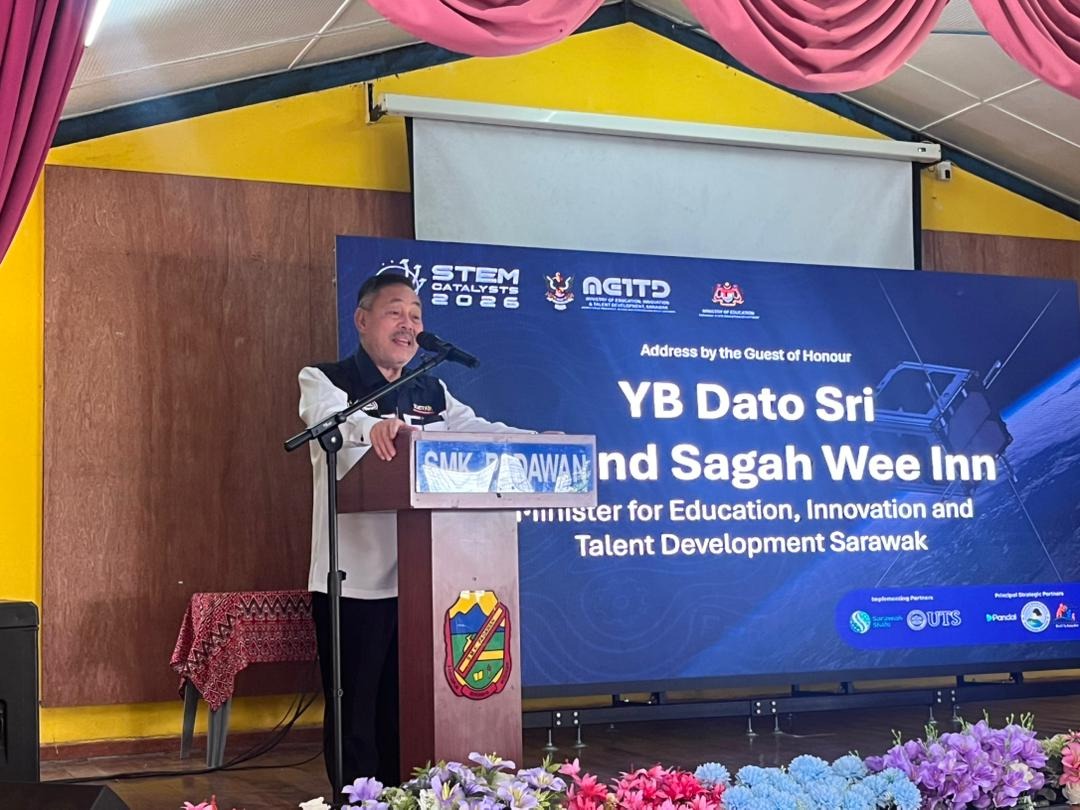
PADAWAN: The STEM Catalysts initiative has evolved into a “soft education infrastructure” to improve access to Science, Technology, Engineering and Mathematics (STEM) opportunities for rural pupils.
Education, Innovation and Talent Development Minister Datuk Seri Roland Sagah Wee Inn said the initiative was designed to connect rural pupils with the wider STEM ecosystem.
He said it would give students access to learning tools, university mentors, industry professionals and future employers.
“When my ministry first introduced STEM Catalysts, it began as a simple outreach initiative to ignite pupils’ curiosity and interest in science, technology, engineering and mathematics.
“Three years on, STEM Catalysts has grown into a powerful platform for direct STEM engagement with pupils across rural Sarawak.
“There is a saying: it takes a village to raise a child. Perhaps now, it takes an entire nation to nurture our children and prepare them for the future world of technology,” he said.
He said this when officiating the STEM Catalysts Grand Celebration 2026 at Sekolah Menengah Kebangsaan (SMK) Padawan here today.
Sagah said access to education should not be limited to physical infrastructure such as schools, smart boards and science laboratories.
He said students should also have access to learning applications, achievements and recognition, as well as exposure to universities and industries.
“My ministry, and indeed any government, cannot provide all this alone.
“Our role is to set policy, build the soft infrastructure and create the pathways so that others can contribute,” he said.
The Tarat assemblyman said universities, technical colleges, non-governmental organisations and private companies were actively supporting the initiative by engaging with pupils and teachers.
He said the collaboration was important to prepare the next generation for emerging sectors such as hydrogen, robotics, artificial intelligence, semiconductor technology, space and biotechnology.
Citing international and local findings, Sagah said student engagement in STEM activities had shown positive results.
He said international assessments such as the Programme for International Student Assessment (PISA) found Malaysia lagging not only in academic performance but also in student engagement with science and mathematics.
“Our own data tells the same story.
“Schools that actively participated in online learning and competitions recorded better results in the 2025 Upper Primary Dual Language Programme (UPDLP) assessments, particularly in rural areas.
“This was especially evident for rural schools, showing that engagement activities translate into measurable improvement,” he said.
He added that schools with STEM or Information and Communications Technology (ICT) clubs also consistently outperformed those without in the UPDLP examination.
“These environments give pupils the chance to explore, experiment and apply knowledge beyond the classroom,” he said.