WHAT would Malaysia be today if no one had been willing to sacrifice for it?
What if those who came before us had decided to mind their own business, live their own lives and not bother trying to change the future of their homeland?
A country’s independence was never won through one person’s struggle. It took many courageous individuals, each fighting for the nation in their own way.
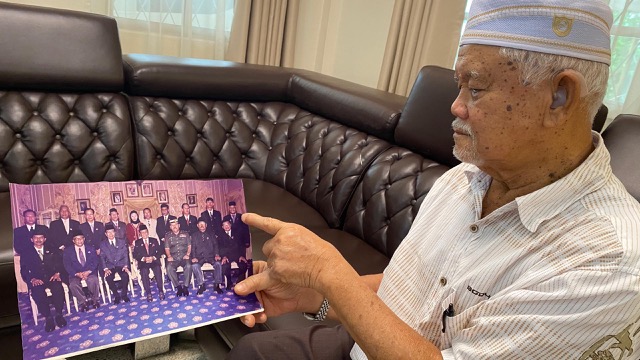
Military veteran Acher Ahmad believes the contributions of Malaysia’s first Prime Minister Tunku Abdul Rahman, Sarawak’s first federal minister Tun Jugah Barieng and many others should always be appreciated and remembered by generations to come.
Their struggles and sacrifices, he said, paved the way for the Malaysia that generations today call home.
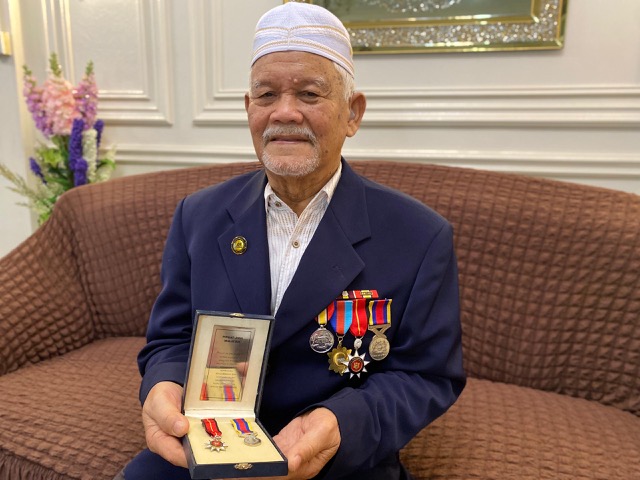
But Acher, 78, believes the nation must also remember those who bled for the country — those who put their lives on the line to defend what others had fought to build.
In conjunction with the Malaysia Day celebration on Sept 16, Sarawak Tribune sat down with the former sergeant as he revisited the memories and sacrifices of his 10 years in military service.
Looking back, Acher said joining the military was a decision he would always be proud of.
Bullets have no eyes
Fear was part of the job, and Acher never pretended otherwise.
But for a soldier, he said, fear could not be allowed to get in the way of the task at hand.
“Of course, there was fear. Bullets have no eyes.
“You just had to stay alert,” he recalled.
Acher entered military service in 1966, after passing an interview that year and undergoing recruit training in Port Dickson.
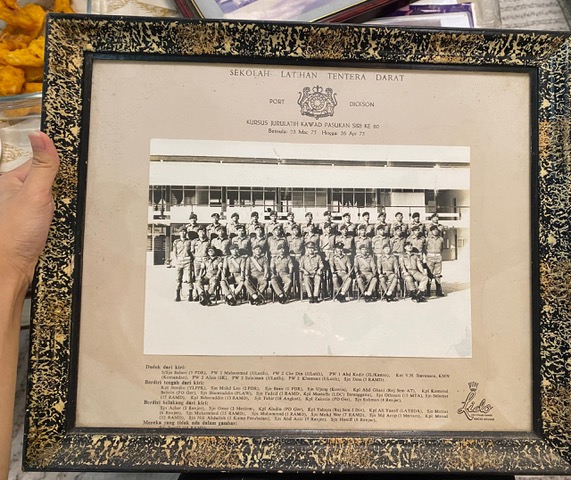
Before that, he had worked in land surveying around 1961 and 1962, followed by a stint with the Public Works Department (PWD) in 1965.
Still young and unmarried, he eventually grew tired of his previous work and decided to try something different.
That decision would keep him in uniform for the next 10 years.
For Acher, military service meant accepting the dangers that came with the job, particularly when operations took him into areas where communist insurgents were active.
“There were bombs and hand grenades around us. Of course I was afraid, but we knew how to handle them.
“To me, if death came, then it came. We were there to defend the country,” he said.
He said courage did not necessarily mean being without fear, but knowing that the job still had to be done despite it.
“If we don’t become soldiers, who else will?”
Ten years of close calls
Over his 10 years in service, Acher was sent to different parts of Malaysia, with many of his memories still tied to the jungles where he carried out operations.
One took him to the Balai Ringin area, followed by operations around Pakit Camp and later Mongkos, where movement meant travelling through the jungle on foot.
During an operation at Tong Nibong, he recalled a fellow serviceman becoming too ill to continue the journey.
With no road out, Acher carried the man through the jungle together with their weapons.
“He could not walk because it was a long journey through the jungle.
“I was really strong when I was young. I carried him and the weapons over that distance,” he recalled with a laugh.
Other memories came much closer to ending differently.
While serving as a corporal around Bukit Berapit in Perak, Acher recalled coming across an improperly concealed explosive device while carrying out his duties.
His first instinct was to fix it.
“I saw that it had not been properly covered, so I got angry and went to cover it properly with leaves.
“Then the tin hit me. Luckily, it did not explode,” he recalled.
The incident remains particularly vivid because it happened around Hari Raya, when his then-fiancée had sent him Chinese biscuits to enjoy while he was away.
“I did not even get to eat them because I went to deal with that explosive.
“Luckily, I did not kempunan (miss out on the food I had been looking forward to),” he joked.
Acher also recalled another close call in Sandakan, Sabah, in 1969, when a helicopter attempting to land came dangerously close to hitting him.
Looking back at the dangers, the jungle and the many experiences accumulated over those years, Acher said he had few complaints.
“I have had my share of everything — being in the jungle, eating in the jungle, flying in helicopters and the Nuri.
“I am satisfied. I am happy that I had those experiences in the military.”
The family waiting at home
Yet the life Acher remembers with pride came with sacrifices that were also borne by the family waiting for him at home.
By 1970, when he was posted to Kuching, Acher had become engaged to the woman who would later become his wife.
Marriage and children eventually gave him something else to worry about whenever duty took him away.
“When I was in the jungle, of course I worried about my wife. I missed her and sometimes felt like going home.
“But because of duty, what could I do?” he said.
His wife remembers one absence in particular.
Their second child, Mariya, was born in Setapak, Kuala Lumpur, while Acher was away on an operation in Gerik, Perak.
He was unable to return home immediately.
“From the day Mariya was born until she was three months old, only then did he come home.
“He said his officer would not allow him to return. I was alone at home with the children,” his wife recalled.
For Acher, it is one of the clearest examples of what sacrifice meant beyond facing danger in the field.
“The sacrifice for us in the military was being willing to leave our hometown behind.
“Especially when you already had a wife and children, of course there was sadness,” he said.
The repeated separations eventually became too much for his wife, who asked him to leave the military.
Acher, despite enjoying his life as a soldier, chose his family.
“I actually liked being in the military, but my wife did not agree anymore. She asked me to stop.
“Because I loved her, I stopped. I listened to her,” he said.
The ‘hikmah’ of coming home
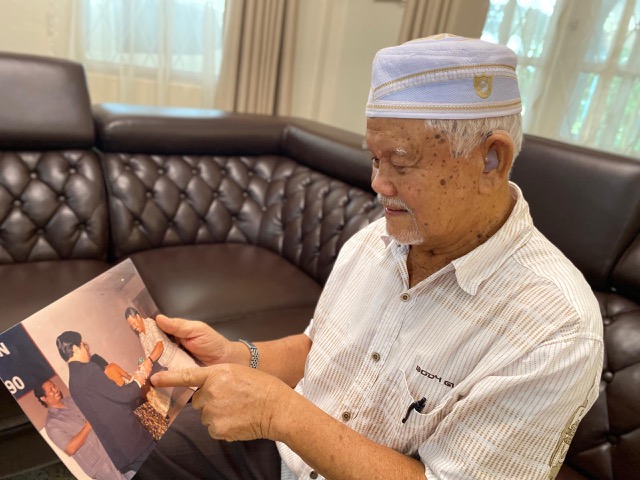
Acher ended his military service in 1976, having served for 10 years.
By then, he had risen to the rank of sergeant.
It was a decision made for his family, but an incident shortly afterwards would make Acher wonder whether there had been another reason for him to leave when he did.
Before leaving, he had been stationed at Oya Camp in Sibu under Rajang Area Security Command (RASCOM), where he recalled taking about 30 servicemen for training at Sungai Tapang.
Around two months after Acher left the military, the group went out for training again.
This time, they came under fire.
One of the servicemen, a man from Perlis who had served under Acher, was killed.
“I was sad when I heard about it. He was one of my men,” Acher said.
The news stayed with him, not least because of how recently he himself had been among them.
“There was a blessing in disguise in me leaving.
“If I had still been there, who knows what could have happened to me?” he said.
Nearly 50 years later, however, Acher does not look at his decision to leave as a rejection of military life.
If anything, his affection for those years has remained.
“I have never regretted becoming a soldier.
“The spirit is still there until today.”
Do not forget them
That spirit, Acher said, has not disappeared with age.
At 78, he still keeps up with developments in the country and remains interested in matters concerning the nation he once served.
He sees a very different life for today’s servicemen compared with his generation, recalling that his salary as a sergeant was only slightly above RM400.
More important than comparing generations, however, is ensuring the sacrifices of those who came before are not forgotten.
“Those of the younger generation today, do not forget the contributions of the servicemen before you, especially those who sacrificed their lives.
“Remember the people who served in the past,” he said.
Acher still remembers the songs that lifted the spirits of servicemen during his years in uniform.
Among them was Saloma’s classic Perwira, a song he said could immediately stir their fighting spirit.
“‘Majulah kekanda, maju, jangan undur’ — when we heard those words, they gave us spirit,” he recalled.
Even decades later, the song remains closely tied to his memories of life in the military.
His message of remembrance extends beyond those who carried weapons.
Acher said the contributions of Tunku Abdul Rahman and Tun Jugah should also never be forgotten, particularly their roles in paving the way for Sarawak to become part of Malaysia.
For him, the Malaysia enjoyed today was built through the contributions and sacrifices of many, each playing a different role.
“Do not forget the sacrifices of the people of the past.
“Remember their contributions.”