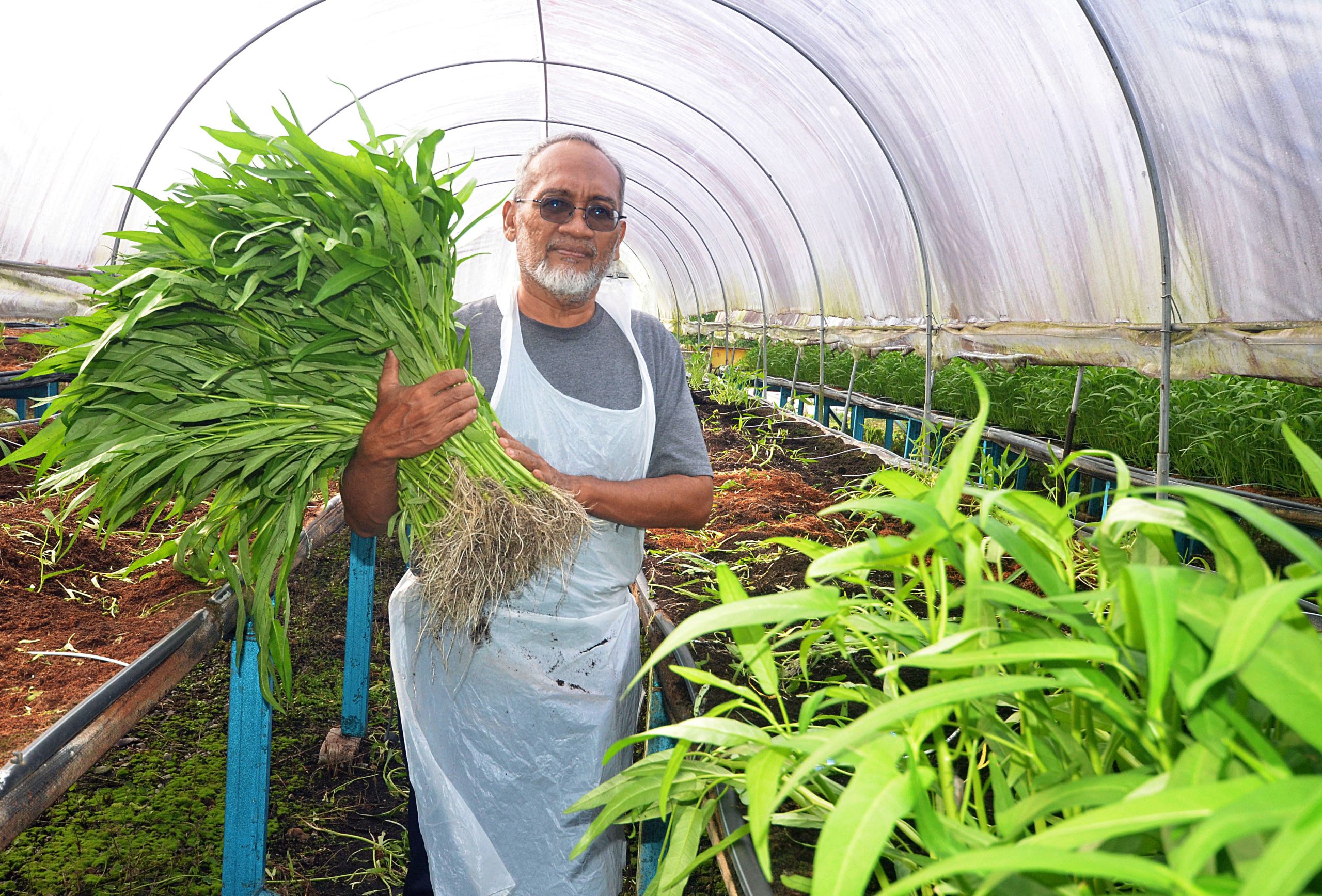
A table-based fertigation system, often referred to as a fertigation bench or raised cultivation table setup, used in a greenhouse is transforming kangkung (water spinach) cultivation by making it cleaner, more efficient, and capable of producing high-quality vegetables.
A participant in the water spinach project run by the Pelagat Area Farmers’ Organisation (PPK), Abu Dhairaz Razali, 54, said the innovative system, which uses coconut coir as the growing medium together with a controlled fertigation system, makes crop maintenance easier and more efficient than conventional farming methods.
He said the table-based fertigation approach offers several advantages, including lower pest infestations, reduced reliance on pesticides, and a consistent supply of water and nutrients, all of which contribute to better crop quality.
“Growing the crops on raised tables also makes harvesting easier because the work can be done while standing. In addition, the crops are not affected by floods and can be cultivated regardless of the season,” he told Bernama at the project site in Kampung Tok Has.
Encouraged by strong market demand, Abu Dhairaz said he now focuses exclusively on cultivating water spinach and aims to increase production to 100 kilogrammes per day by 2027.
He said the corporate project was awarded by the Farmers’ Organisation Authority (LPP) to the Pelagat Area Farmers’ Organisation (PPK Pelagat) in late 2021, with planting operations commencing in January 2022.
“The project is managed by two participants, including myself, with 30 per cent of the sales revenue shared with PPK Pelagat. It is carried out on a 0.1-hectare site comprising 12 greenhouses, each equipped with two planting tables measuring one metre wide, 18 metres long, and 0.9 metres high,” he said.
Abu Dhairaz added that he attended a table-based fertigation farming course at PPK Marang in late 2021 before joining the project.
He also said water spinach grown using the table-based fertigation system is noticeably fresher and can remain in good condition for two to three days after harvest, compared with Siamese water spinach, which typically lasts only about a day.
During the project’s early stages, he said, both mustard greens (sawi) and water spinach were cultivated. However,
persistent disease and pest attacks affected the mustard greens, prompting the operators to switch entirely to water spinach production.
According to Abu Dhairaz, each planting table produces between 30 and 60 kilogrammes of water spinach in a harvest cycle of about 23 days, with the project now entering its 40th planting cycle.
“Wholesale prices currently range between RM3 and RM4.50 per kilogramme, depending on weather conditions and the supply of water spinach from Thailand,” he said, adding that the produce is supplied to the Jertih Wholesale Market and several nearby retail outlets. – BERNAMA