After the Siren Ends: Part Five
THE fire is eventually extinguished.
Floodwaters recede, damaged vehicles are towed away, and the cries that once filled the air gradually give way to silence.
Communities begin rebuilding their homes, families mourn their loved ones, and life slowly resumes its familiar rhythm.
For most people, that is where the story ends.
For firefighters, however, it is often where another begins.
Long after the hoses have been rolled up, the protective gear removed and the emergency vehicles returned to the station, many continue carrying memories that cannot simply be packed away with their equipment.
Some resurface unexpectedly months or even years later through the smell of smoke drifting across a neighbourhood, the laughter of a child that recalls one they could not save, a familiar stretch of road where a fatal collision once occurred, or questions that have never truly found an answer.
These are the invisible burdens of a profession built on responding to other people’s worst days.
Throughout this series, retired and serving firefighters have spoken about the emergencies that have stayed with them long after the sirens fell silent, while their wives revealed how the emotional weight of those experiences often follows them home, shaping family life in ways rarely seen by the public.
Clinical psychologist Dr Chen Yoke Yong said these stories are neither unusual nor unexpected.
Rather, they reflect the psychological realities of a profession that repeatedly places ordinary people in extraordinary circumstances, asking them not only to save lives, but also to carry the emotional consequences of witnessing tragedy time and time again.
“Firefighters routinely encounter situations that most members of the public may experience only once or twice in their lifetime.
Besides making life-saving decisions under immense pressure, they repeatedly witness severe injuries, fatalities, fires involving children, road traffic accidents, industrial incidents, suicides, drownings and large-scale disasters while remaining calm enough to protect others.
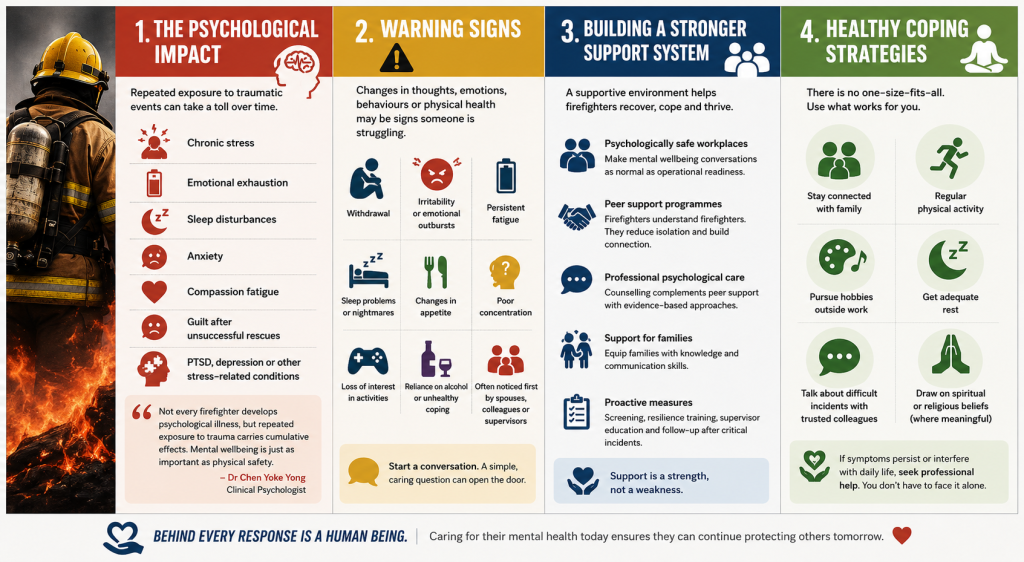
“Over time, repeated exposure to such incidents may contribute to chronic stress, emotional exhaustion, sleep disturbances, anxiety, compassion fatigue, feelings of guilt following unsuccessful rescues and, for some individuals, symptoms associated with post-traumatic stress disorder (PTSD), depression or other stressrelated conditions,” she said.
Dr Chen said not every firefighter develops these conditions and many demonstrate remarkable resilience.
However, she said the cumulative nature of their work places them at greater psychological risk than many other occupations but this should never be mistaken for inevitability.
“Many firefighters remain mentally healthy throughout long careers, supported by strong relationships with colleagues, supportive leadership, healthy coping strategies, close family support and timely access to professional mental health services.
These protective factors play an important role in helping firefighters process difficult experiences and reduce the likelihood of longer-term psychological difficulties,” she said.
That cumulative effect is reflected in many of the stories shared throughout this series. Former Fire and Rescue Department (BOMBA) deputy director-general Datuk Khirudin Drahman still vividly remembers the deaths of three siblings trapped inside a rented house despite the incident occurring more than two decades ago.
Former Special Malaysia Disaster Assistance and Rescue Team (SMART) rescuer Kurung Suwen continues to recall recovering victims from disasters that forever changed the lives of countless families.
Serving firefighter Muhammad Luqmanul Hakim admitted that recovering the body of a young mother from a river affected him far more deeply than he initially realised, while Head of Fire Investigation for Samarahan Zone Mirza Dzalmira Miraj said incidents involving children remain the most difficult to forget.
Dr Chen explained that there is an important psychological explanation for why some emergencies remain deeply embedded in memory while others gradually fade.
“Not every emergency carries the same psychological impact.
Incidents involving children, preventable deaths or situations that remind firefighters of their own loved ones often become deeply embedded because they carry significant emotional meaning,” she said.
Beyond traumatic memories themselves, Dr Chen said another concept that has gained increasing attention within psychology is moral injury, which differs from PTSD in important ways.
PTSD in important ways.
While PTSD is generally associated with fear-based reactions following traumatic experiences, moral injury develops when individuals witness, experience or are unable to prevent events that conflict with their deeply held moral beliefs and values.
Instead of reliving an incident through fear, firefighters experiencing moral injury may find themselves returning repeatedly to questions that have no satisfactory answers, questioning whether more could have been done, why innocent lives were lost or whether a tragedy might somehow have been prevented despite every effort made at the scene.
“They may continue asking themselves, ‘Why did innocent children have to die?’ or ‘Could this tragedy have been prevented?’ even many years later.
These unresolved moral and emotional questions may continue resurfacing despite the individual functioning well in other aspects of life,” she said.
Unlike physical injuries, Dr Chen pointed out that moral injury cannot be seen, nor can it be measured simply by the severity of an incident.
Instead, it often stems from situations that challenge a firefighter’s sense of fairness, responsibility or humanity, particularly when lives are lost despite every possible effort to save them.
“Repeated exposure to such experiences also contributes to what psychologists describe as cumulative trauma.
Individual incidents may appear manageable in isolation, but over years of service, each emergency adds another emotional layer if there are insufficient opportunities to recover or process what has happened before responding to the next call,” she explained.
Dr Chen’s research involving firefighters in Sarawak found that greater trauma exposure was associated with higher levels of PTSD symptoms, depressive symptoms and psychological distress.
Importantly, the findings also suggested that occupational trauma does not stop with the firefighter as its effects often extend beyond the fire station and into family life, shaping relationships in ways that may not always be immediately visible.
“Our findings indicate that occupational trauma may influence family relationships, highlighting that the psychological impact of firefighting often extends beyond the individual firefighter.
Greater trauma exposure and psychological distress may be associated with increased difficulties within marital relationships,” she said.
Those findings closely mirror the experiences shared by Datin Soryta Khan, Annie Juran and Farhana Mohd Kipli in the previous instalment of this series.
Each described recognising subtle changes after particularly demanding operations — moments when their husbands became quieter than usual, preferred spending time alone before speaking about their day, appeared emotionally exhausted despite saying very little, or simply carried an unspoken heaviness home after attending especially distressing emergencies.
While none of them viewed those moments as unusual, Dr Chen said they reflected a pattern commonly observed among first responders repeatedly exposed to traumatic events.
She explained that firefighters themselves are not always the first to recognise when they are struggling emotionally.
Warning signs may include becoming unusually withdrawn, increased irritability, emotional outbursts, persistent fatigue, nightmares, disrupted sleep, changes in appetite, reduced concentration, loss of interest in activities they once enjoyed or increasing reliance on unhealthy coping behaviours such as alcohol.
“In many cases, colleagues, supervisors or family members notice these subtle behavioural changes before the firefighter becomes aware of them.
Spouses are often the first to notice withdrawal, irritability or disrupted sleep, sometimes even before the firefighter recognises these changes themselves,” she said.
Rather than waiting until someone reaches a crisis point or asks for help, Dr Chen encouraged colleagues and family members to begin supportive, non-judgemental conversations whenever they notice meaningful behavioural changes.
She emphasised that such conversations are not intended to diagnose or solve psychological difficulties, but rather to remind firefighters that they do not have to carry those experiences alone.
“Sometimes simply asking, ‘I’ve noticed you’ve seemed quieter lately.
How are you coping?’ may provide an opportunity for meaningful discussion,” she said.
Dr Chen believes firefighters should never be viewed in isolation.
She said supporting their families is equally important because strong family relationships remain one of the most valuable protective factors against long-term psychological difficulties.
“Family members should not become therapists but equipping them with knowledge about trauma reactions and healthy communication can help create supportive home environments,” she said.
For many firefighters, the emotional burden of the profession extends beyond traumatic memories alone.
Another psychological challenge that receives comparatively little public attention is compassion fatigue.
Unlike burnout, which is commonly associated with excessive workload, long working hours or organisational pressures, compassion fatigue arises from prolonged exposure to other people’s trauma and suffering.
Dr Chen described it as one of the hidden psychological costs of careers centred on helping others.
“Firefighters spend much of their careers helping individuals during some of the worst moments of their lives.
Over time, this emotional investment may become draining,” she said.
Rather than a sudden emotional breakdown, compassion fatigue often develops gradually, making it difficult for individuals to recognise in themselves.
Unlike physical exhaustion after a demanding shift, compassion fatigue reflects the cumulative emotional cost of repeatedly caring for people experiencing grief, fear, injury and loss over many years of service.
Despite increasing awareness surrounding mental health, many firefighters remain reluctant to seek professional support.
Dr Chen believes this reluctance stems largely from occupational cultures that place considerable emphasis on resilience, courage and emotional control.
“Some worry that admitting psychological difficulties could be perceived as weakness, affect career progression or reduce colleagues’ confidence in them.
Others genuinely believe they should be able to cope independently because managing difficult situations is viewed as part of their professional responsibility,” she said.
Dr Chen said such attitudes contribute to mental health stigma, causing some firefighters to minimise their distress or convince themselves they simply need to become mentally stronger.
As a result, emotional difficulties may remain unnoticed until they begin affecting work performance, relationships or overall wellbeing.
Yet Dr Chen believes changing that culture requires more than simply encouraging firefighters to seek help.
It requires organisations themselves to create environments where discussions about psychological wellbeing become as routine as conversations about operational readiness, recognising that mental health is not separate from professional competence but an essential part of it.
“Meaningful change requires more than encouraging firefighters to speak up when they are struggling.
Organisations must create psychologically safe workplaces where seeking support is regarded as responsible selfcare rather than a sign of personal weakness,” she said.
Dr Chen believes peer support programmes, confidential counselling services, resilience training, routine psychological screening, supervisor education and structured follow-up after particularly distressing incidents should become standard components of occupational health rather than measures introduced only after a crisis.
She pointed out peer support programmes are particularly valuable because firefighters often feel most understood by colleagues who have experienced similar situations themselves.
“Simply knowing that emotional reactions are common can reduce feelings of isolation.
I also believe that support should extend to families wherever appropriate as spouses and children often become an important source of recovery and resilience,” she said.
At the same time, Dr Chan cautioned that peer support should complement rather than replace professional psychological care.
While colleagues may provide understanding through shared experiences, counselling offers evidence-based approaches that help firefighters process traumatic incidents, strengthen healthy coping strategies and reduce the likelihood of longer-term psychological difficulties.
“There is no single coping strategy that works for everyone.
However,maintaining close family relationships, engaging in regular physical activity, ensuring adequate rest, pursuing hobbies outside work, discussing difficult incidents with trusted colleagues and drawing upon spiritual or religious beliefs where personally meaningful can all contribute to healthier psychological recovery,” she said.
Looking beyond individual departments, Dr Chen hopes Malaysia will eventually develop a more comprehensive framework dedicated to protecting the psychological wellbeing of first responders.
She said such a framework could establish minimum standards for mental health services across emergency agencies, strengthen peer support systems, ensure confidential access to psychologists familiar with occupational trauma and provide resources for families who often shoulder part of the emotional burden of emergency service work.
“Protecting firefighters should mean protecting both their physical and psychological health.
Just as firefighters undergo regular fitness assessments, inspect their breathing apparatus before entering dangerous environments and rely on specialised protective equipment to safeguard themselves against physical hazards, their mental wellbeing deserves the same level of preparation, attention and investment throughout their careers.
“Mental health directly influences concentration, judgement, communication, teamwork and decision-making during emergency operations, making it not merely an employee welfare issue but an essential component of public safety,” she said.
For firefighters who may be struggling silently, Dr Chen provided a simple reminder.
“Experiencing emotional reactions after witnessing tragedy does not mean you are weak, it means you are human.
The qualities that make firefighters effective — compassion, empathy and a commitment to helping others — are often the very qualities that make difficult experiences emotionally significant.
“Seeking support is not a sign that you are unable to perform your duties.
Rather, it is an important step towards maintaining your own wellbeing so that you can continue protecting others while also protecting yourself,” she said.
The public often sees the flashing lights, the rushing fire engines and the dramatic rescues.
What they seldom see are the memories that accompany firefighters long after the crowds have dispersed, the smoke has cleared and the station doors have closed once again.
Those memories are not signs of weakness rather they are reminders of a profession built upon compassion, responsibility and service.
Recognising those invisible burdens, and ensuring that those who dedicate their lives to protecting others receive the same care they so readily provide, may ultimately be one of the most meaningful ways society can honour their service long after the sirens have fallen silent.
As Dr Chen observed, supporting firefighters’ mental health should not be viewed simply as an employee welfare initiative, but as an essential component of public safety, workforce sustainability and effective emergency response.
Because protecting those who protect others ultimately means recognising that psychological wellbeing deserves the same attention, preparation and investment as physical safety throughout every stage of a firefighter’s career.