
MOST people choose a cat or a dog when they decide to get a pet. I did not expect that a rabbit rescued from being raised for meat or for ‘sate’ would quietly take over my mornings, my furniture and eventually my daily routine.
I first saw Lily through a Facebook post advertising young rabbits from a farm supplying rabbit meat. I remember feeling sorry for them and thinking how different their lives might be if one of them ended up in a home instead. That was how I brought it back with me when it was just one month old.
At the time, I was also looking for companionship but I wanted something quiet. A rabbit seemed harmless, calm and easy to care for.
When I first held Lily, it fit perfectly in my palm. It slept on my chest like a small breathing cloud, completely still except for the gentle movement of its nose. It was hard to imagine that the same rabbit would later become my most reliable alarm clock.
Today, Lily is one year and four months old, and it wakes me up at 4 am every single day.
Lily’s method is simple. It jumps onto the bed, walks straight to my pillow and starts licking my face. People often assume this is affection. It is not. It is breakfast scheduling. If I ignore it, Lily moves to the next step and begins chewing my hair, which appears to be its final warning before formal complaints are issued.
Those formal complaints usually involve digging through my pillow or scratching at the mattress, perfectly normal rabbit behaviour, but less helpful at four in the morning. There is no snooze button when a rabbit decides it is time to eat.


I later learned that rabbits are crepuscular animals, meaning they are naturally most active at dawn and dusk. So while the timing feels unreasonable to me, to Lily it makes perfect sense.
Like many first-time rabbit owners, I assumed rabbits were easy pets. They do not bark. They do not meow. They do not demand attention loudly. What I did not realise was that rabbits replace noise with routine and expect you to follow it.
They also have very clear opinions.
Lily does not thump often but when it does, it is usually because I have crossed a boundary, typically by carrying it and giving too many cuddles and kisses. That is its official way of filing a complaint.
The only other time Lily thumped with equal determination was when neighbours started drilling in the apartment next door. The noise offended it immediately. Rabbits are surprisingly sensitive to sound, and Lily made it clear it did not approve of the renovation plans.
Lily is extremely food-motivated and has perfected selective hearing. If I call its name, she may pause briefly before continuing whatever she is doing. But if I touch the pellets container, even slightly, it appears immediately from somewhere nearby, as though it has been monitoring the situation all along.
Furniture, meanwhile, becomes temporary once a rabbit settles in.
My couch now has small holes that have somehow become one large one I don’t recall approving. My bedsheets have what I prefer to call “character.” And if I forget to close the wardrobe, Lily walks in with confidence and comes out having quietly “redesigned” or chewed at least one piece of clothing.
On more than one occasion, it has also chewed through press releases I was working on. I would be typing away at my laptop, focused on a deadline, only to realise it had reached the papers on the table and started ‘editing’ them. People often joke about pets eating their homework, but in my case, the pet really did eat my work.
Still, what surprised me most about living with a rabbit was not the chewing, the thumping or the early mornings. It was the companionship.
Rabbits do not show affection in obvious ways. They do not greet you noisily at the door or demand attention like dogs or cats. Instead, they stay close when it matters.
If I am away for several hours, Lily will run to the door the moment I return but not before conducting a very thorough inspection of my shoes.
Rabbits rely heavily on scent and it seems determined to trace exactly where I have been before deciding whether everything is in order. Lily circles them closely, sniffs with intense focus, and often rubs its chin against them, leaving its scent behind as though it is quietly reasserting ownership over anything that has left its sight.
On the day I had been to a pet store, this routine became especially dramatic. I had been holding bunnies, and even though it was only for a short while, that unfamiliar scent must have clung to me.
The moment I walked into the house, Lily reacted immediately. It went straight to my shoes first, then up towards me, sniffing more insistently than usual as if it had detected a foreign presence. Even the faint trace of the bunnies seemed to set it off and it followed it on me with intense focus as though conducting a full investigation into where I had been and who I had been with.
Only after this inspection did Lily begin rubbing its chin more firmly, not just on my shoes but my whole body as I was sitting on the floor, as though it was overwriting the scent of the bunnies with its own. It felt less like curiosity and more like confirmation, reclaiming what it believed had been slightly compromised.
And then, still unconvinced, it escalated its final statement in unmistakable Lily fashion, leaving a small puddle on me, as a clear territorial marker, as though to fully erase any remaining trace of the bunnies and reassert that I belonged firmly in its space.
When I am sick, Lily sits beside me quietly instead of running around the room. When I feel upset or close to tears, it sometimes licks my face again, this time without asking for food. It feels less like a reminder and more like a small check to see if I am alright.
Across Malaysia, rabbits are becoming more common as house pets, especially among owners drawn to their quiet nature. But rabbits are often misunderstood as low-maintenance animals. In reality, they require routine feeding, constant access to hay and safe indoor environments and owners willing to accept that wardrobe doors must remain closed at all times.
Morning now begins earlier than it used to. Feeding times have become part of the structure of the day. And somewhere between the thumping complaints, chewed press releases and the 4 am wake-up calls, Lily quietly became part of everyday life.
Sometimes I still think about the tiny rabbit who once fit in my palm and slept on my chest. Lily no longer fits there now. When it stretches out beside me, she is as long as my forearm. Confident, comfortable and entirely certain that the house belongs to it as much as it does to me.

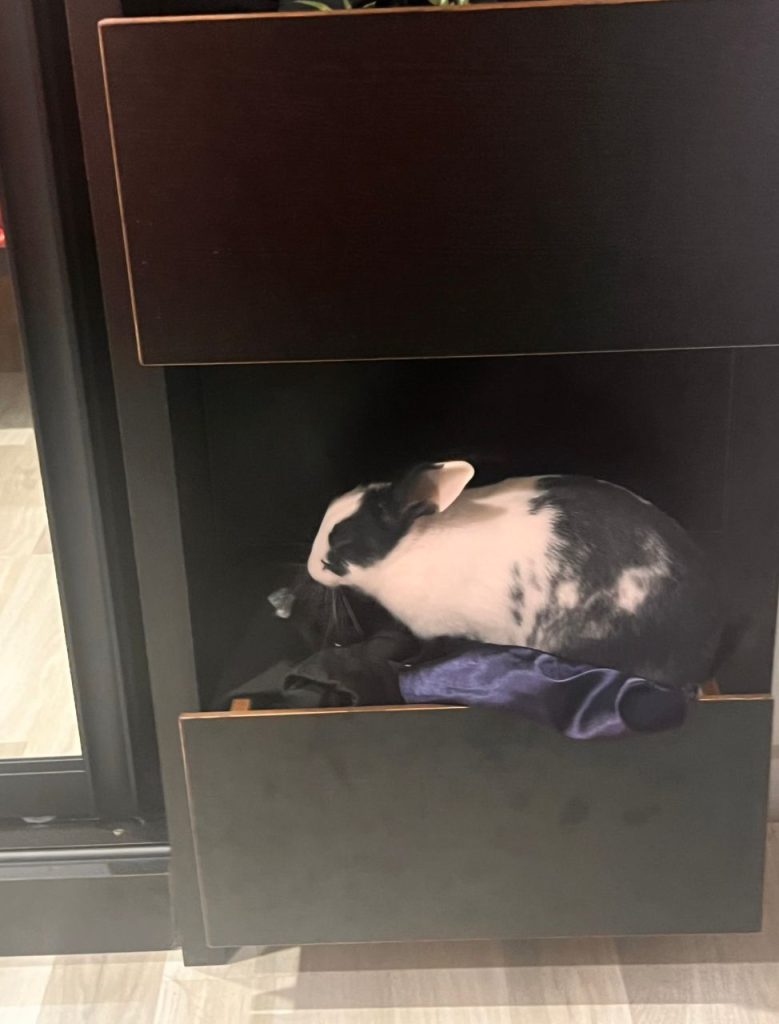
I chose a rabbit because I wanted something quiet.
Instead, I rescued Lily, part-time interior decorator, unofficial editorial assistant and an unexpectedly loyal companion who proved that living with a rabbit is very different from living with a cat or a dog.