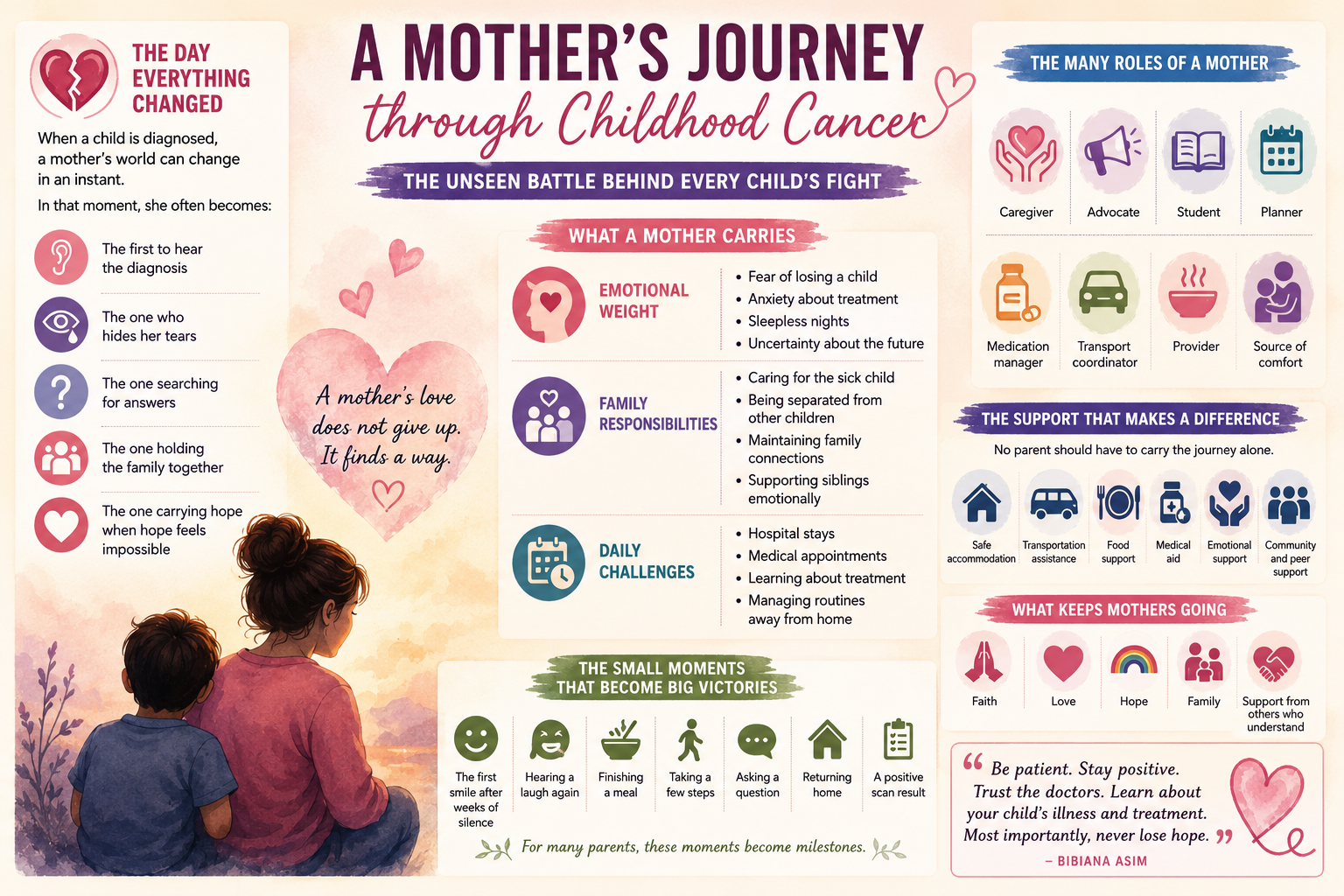
THERE are moments in life that do not pass — they stay, imprinted in memory, returning in fragments long after the words have been spoken.
For Bibiana Asim, it was the moment she was told that her fiveyear-old son had cancer.
She does not remember everything the doctor said, only the stillness that followed.
The way the room seemed to close in, time seemed to move slowly, and the quiet, sinking realisation that life, as she knew it, had just changed forever.
Before that moment, her son, Christian Deo Dennis was simply a child who was playful, curious, and full of laughter that filled their home.
He danced without hesitation, asked endless questions, and found joy in the smallest things. After that moment, everything became different.
Almost two years of Deo’s childhood gave way to hospital corridors, unfamiliar medical terms, and a journey no parent ever prepares for.
A journey that would test Bibiana’s strength in ways she never imagined and teach her to hold on to hope even when it felt impossibly far away.
A diagnosis that changed everything
Before the diagnosis, Deo was a little boy with a big personality.
Bibiana said he loved fried chicken, spent hours playing with miniature cars, and would burst into laughter as he danced with his siblings.
There was nothing to suggest that their lives would soon be defined by hospital visits and medical decisions no parent is ever prepared to make.
“When the doctor told me it was cancer, I went quiet for a moment. I could not believe those words were real,” she said. Bibiana explained the silence was not calmness but disbelief and a brief pause before the weight of reality began to settle in.
As doctors proceeded with further tests including a biopsy, the unfamiliar environment, the medical terms and the uncertainty quickly became overwhelming.
“It felt like my world went dark. I did not fully understand anything, and it was as if we were simply moving through each moment without knowing what came next,” she recalled.
In the weeks leading up to the diagnosis, Bibiana said Deo had been experiencing persistent fever and severe constipation for about two months.
At the time, they did not think it was something serious.
It was only after further investigations, including ultrasound and CT scans, that the truth became unavoidable.
“Deo was diagnosed with Stage 4 neuroblastoma when he was five years old. I was told that it is a rare and aggressive form of childhood cancer,” she said.
From that moment on, life as they knew it ceased to exist.
The long road through treatment
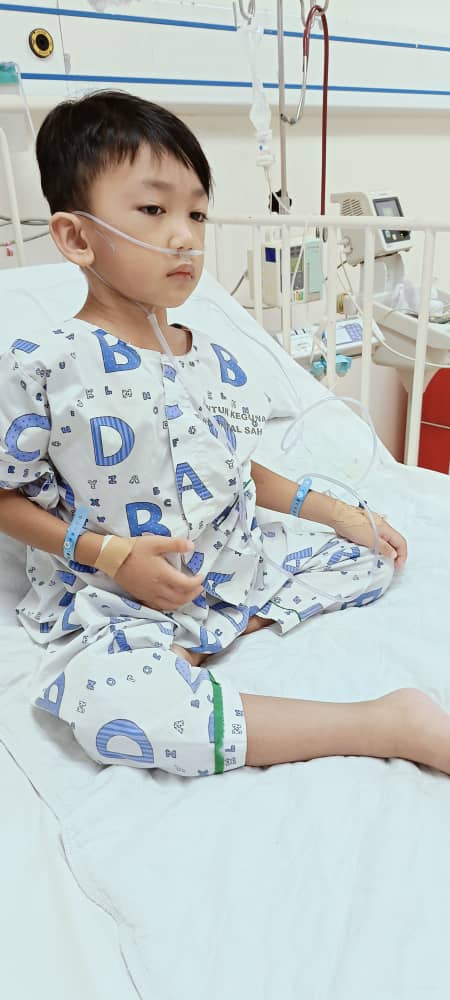
Even before the biopsy results were fully confirmed, Bibiana said doctors had already begun chemotherapy based on what they suspected.
What followed was a long and physically demanding journey, one that unfolded in cycles of treatment, waiting and quiet uncertainty, where each step forward was met with both hope and fear.
Deo underwent eight rounds of chemotherapy with additional sessions, two surgeries, a stem cell transplant, fourteen sessions of radiotherapy and multiple cycles of immunotherapy — a series of treatments that would push his small body beyond what most would imagine a child could endure.
Each phase came with its own challenges, but for Bibiana, the most difficult moments were not always found in the treatment room.
She said it was in the gradual changes she began to see in her son as Deo became unusually quiet for several weeks.
“He had no voice and no response.
When we asked him something, he would not nod or shake his head.
“Even when he was in pain, his reactions were subdued, and he would only whimper softly,” she recalled.
Bibiana said it was during this period that fear took on a deeper and more unsettling form — one that went beyond the diagnosis itself.
“It was not just fear of the illness, but the fear of losing the child I knew,” she said. After the initial rounds of chemotherapy, Deo began to show small but unmistakable signs of life returning.
Bibiana still vividly remembers the moment he laughed again when she teased him — a sound she had not heard for weeks.
“Hearing his little laugh after weeks of silence, I could not hold back my tears.
It felt like light returning after my world had gone dark,” she said.
The weight of financial uncertainty
While the emotional toll was already immense, the financial burden of treatment added another layer of fear.
Bibiana recalled being told that certain treatments could cost tens of thousands of ringgit, with some reaching up to RM100,000.
As a homemaker in a singleincome household, the weight of that reality was overwhelming.
With three other children to care for, the thought of depending on one income while navigating her son’s treatment felt almost impossible.
“At that time, I kept thinking, where would we get that kind of money?” she said.
A lifeline in the darkest days
It was a question that lingered and one without an immediate answer.
At that point, Bibiana had never heard of the Sarawak Children’s Cancer Society (SCCS) and she did not expect that such a support system even existed, let alone one that could provide the kind of assistance her family would come to rely on.
In the midst of that uncertainty, when everything felt overwhelming and unclear, the SCCS team approached her in the ward and took the time to explain the support that was available.
“That was when I first knew about SCCS and I began to understand that I wouldn’t have to face this journey alone,” she said.
For Bibiana, SCCS quickly became more than just an organisation offering support. She said SCCS became a lifeline at a time when everything else felt uncertain.
“Because of SCCS, I did not have to choose between my child’s life and money.
I could focus fully on being there for him,” she said. Bibiana said SCCS’ support extended far beyond what she had imagined.
SCCS not only helped cover additional treatment and medical costs, but also provided accommodation at its halfway home in Kuching, food supplies, transport assistance and arrangements for travel when Deo required treatment in Kuala Lumpur.
“They also provided a weekly allowance to help us manage daily expenses during long hospital stays,” she said.
In a journey where so much felt out of her control, Bibiana said SCCS’ support brought a sense of stability and relief.
She said it enabled her to shift her focus away from financial survival and towards what mattered most which was being present for her son.
“More than anything, SCCS gave me something I had not expected to find in those early days: reassurance that I did not have to carry the weight of the journey alone,” she said.
Deo’s case remains the most costly in SCCS’ history, with RM590,000 spent on immunotherapy alone.
In 2025, SCCS spent approximately RM2 million on medical aid for more than 100 children, the highest expenditure recorded since the society was registered in 2001.
Holding the family together
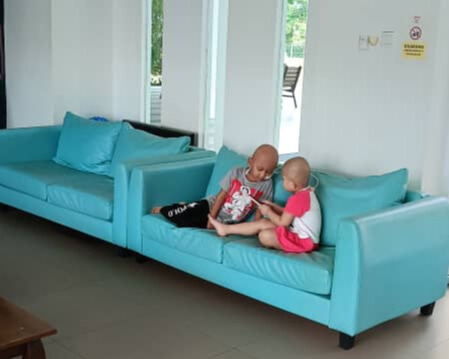
While Bibiana stayed with Deo throughout his treatment, her other children remained in Serian under the care of their grandmother.
She said it was a separation that lasted more than a year and carried its own emotional weight.
“Altogether, Deo and I have been away from our family for about one year and six months,” she said.
Despite the distance, Bibiana said the family found ways to stay connected, holding on to small moments that helped bridge the gap.
She expressed gratitude for the opportunities to reunite during SCCS programmes, even though those moments were often brief and shaped by the realities of treatment.
“We have a family WhatsApp group and we video call every day.
I miss my other children, and Deo misses his siblings, but we know that this separation is only temporary,” she said.
Learning to cope through uncertainty
Throughout the journey, Bibiana learned to navigate not only her son’s illness, but her own emotions.
At one point, she turned to the internet to understand more about the disease, but what she found was overwhelming.
“When I saw the images, they were very frightening.
After that, I stopped looking,” she said.
Instead, Bibiana chose to focus on understanding the treatment and medication being given to her son, grounding herself in what she could control.
She also learned that strength did not always come from having answers, but from finding ways to endure.
There were moments when Bibiana struggled to express what she was feeling, especially during long hospital procedures and the uncertainty that came with waiting.
“The waiting period while Deo was in the operating theatre was very daunting.
Sitting outside and not knowing what was happening, it was a very difficult situation to be in.
“I remember when one of the SCCS staff came to see me, I just hugged her and cried but I could not say anything,” she said.
Even without words, Bibiana said the moment brought an unexpected sense of relief.
“After that, I felt relieved and lighter. I still couldn’t explain what I was feeling, but at least I had let it out,” she said.
Holding on to hope
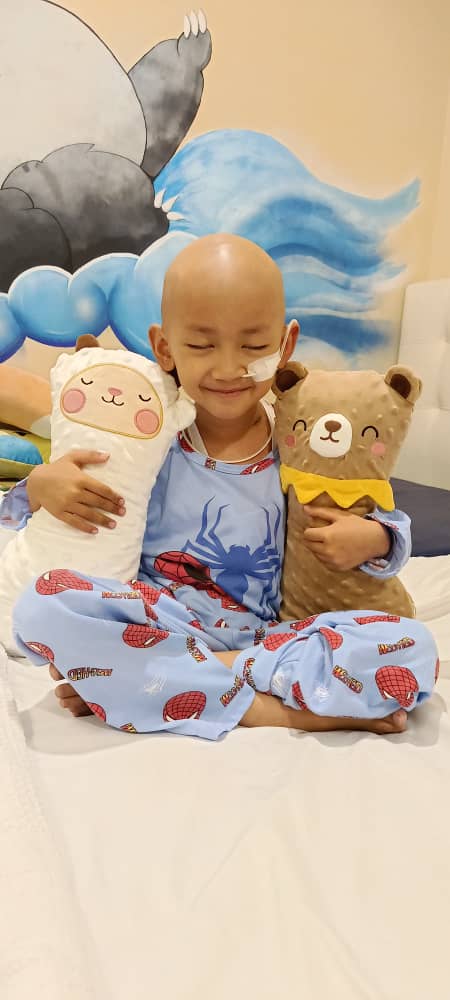
Today, Deo has completed his treatment and is undergoing regular follow-up scans.
Looking at him now, it is difficult to imagine the journey he has gone through.
Yet for Bibiana, the experience has reshaped her understanding of strength and hope.
She believes that even in the most difficult moments, hope can still exist — not as something distant, but as something found in everyday moments, in small signs of progress, and in the presence of people who care.
“Children are stronger than we think.
A child will change during treatment, there will be good days and difficult days, but we must stay hopeful,” she said.
Bibiana also stressed the importance of trusting medical advice and remaining attentive to a child’s needs.
“Sometimes it is not easy to accept what the doctors tell us, but we have to trust that they are doing their best for our child.
When our child starts to get better, we must continue to follow their guidance, because we are the ones caring for them every day,” she said.
A shared responsibility
Deo’s story is a reminder that childhood cancer is not only a medical battle, but also an emotional and financial one.
Bibiana said she looks forward to supporting SCCS by sharing her experience and reaching out to families who have recently received a diagnosis.
She understands how overwhelming those early days can feel — the fear, the uncertainty and the many questions that seem to come all at once.
She hopes that by sharing her journey, other parents will find some comfort in knowing they are not alone.
“If I can help even one family feel less afraid, then it is worth it,” she said.
Bibiana’s journey, like many others, reflects the quiet strength that often goes unseen — the resilience of parents, the courage of children, and the importance of having a support system that walks alongside them every step of the way.
For organisations like SCCS, that support continues to be made possible through the generosity of donors and the wider community.
While Deo’s story is one that can now be told, there are many more families across Sarawak walking this same path in silence, their journeys unfolding quietly, their strength unseen, and their stories still waiting to be heard.
In Part Five of this special report, Sarawak Tribune shares the story of Eleanor Von Macbuth, who lost her daughter Edeva Von Edith to childhood cancer last year.