KUCHING: Staying indoors with the air-conditioning running may provide some relief from the haze, but it does not necessarily protect households from harmful fine particulate matter.
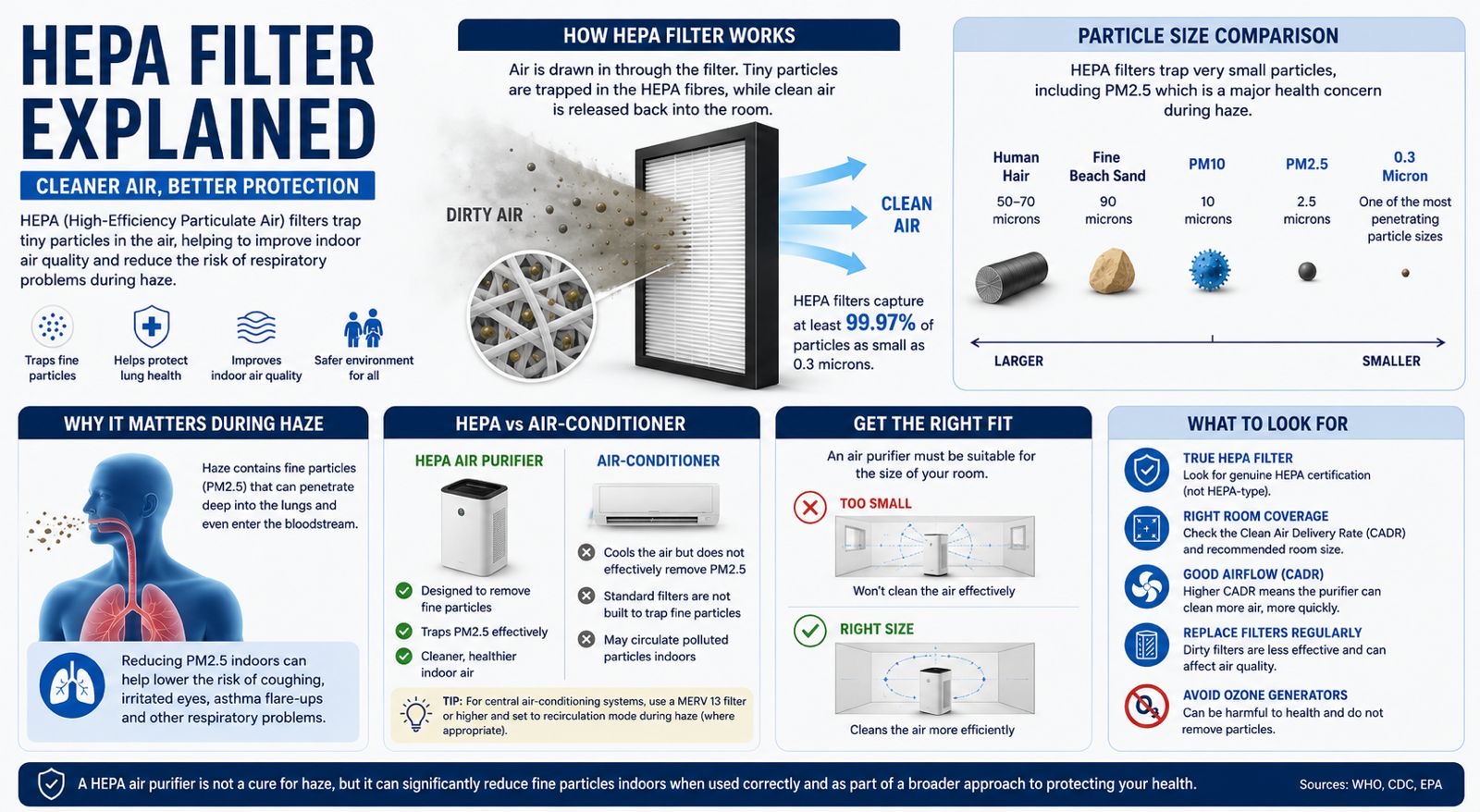
Borneo Medical Centre (BMC) Kuching Consultant Respiratory and Internal Medicine physician Dr Kho Sze Shyang said one common misconception was that air-conditioning alone could adequately filter PM2.5 from indoor air.
“Air-conditioning may reduce the temperature and humidity, but its standard filter is not designed to remove fine particles such as PM2.5,” he told Sarawak Tribune.
Dr Kho said an air purifier fitted with an appropriate How High-Efficiency Particulate Air (HEPA) filter could help reduce exposure to fine particles indoors.
However, he said choosing an air purifier involved more than simply looking for a HEPA filter.
“You need to make sure it has a proper HEPA filter and that the unit is suitable for the size of the room. There is little point in using a small air purifier in a large space because it may not be able to adequately filter the air,” he said.
Dr Kho said consumers should also consider the unit’s airflow and air exchange capacity to ensure it was appropriate for the space in which it was being used.
While air purifiers could help improve indoor air quality, he acknowledged that they might not be a practical solution for every household, particularly given the cost of placing units in multiple rooms.
“Air purifiers do help, but the question is whether it is practical to have several units in one house, especially if you need one for each room. It can become very expensive,” he said.
Beyond the physical health implications, Dr Kho said the prolonged haze could also take a toll on mental wellbeing as families were forced to spend more time indoors and curtail their usual activities.
“This is something we haven’t talked about enough — mental health. In some ways, it feels like going back to the COVID-19 period because people are again having to limit their outdoor activities,” he said.
Dr Kho said his own family had also been affected by the prolonged haze, with his child unable to spend as much time outdoors, while he had experienced dry eyes that required regular use of eye drops.
He said while households could take measures to improve the air quality inside their homes, addressing outdoor air pollution was largely beyond the control of individuals.
“Indoors, there are things we can control, such as improving the air quality and using an appropriate air purifier. But outside, there is only so much an individual can do and we have to depend on wider efforts to address the problem,” he added.