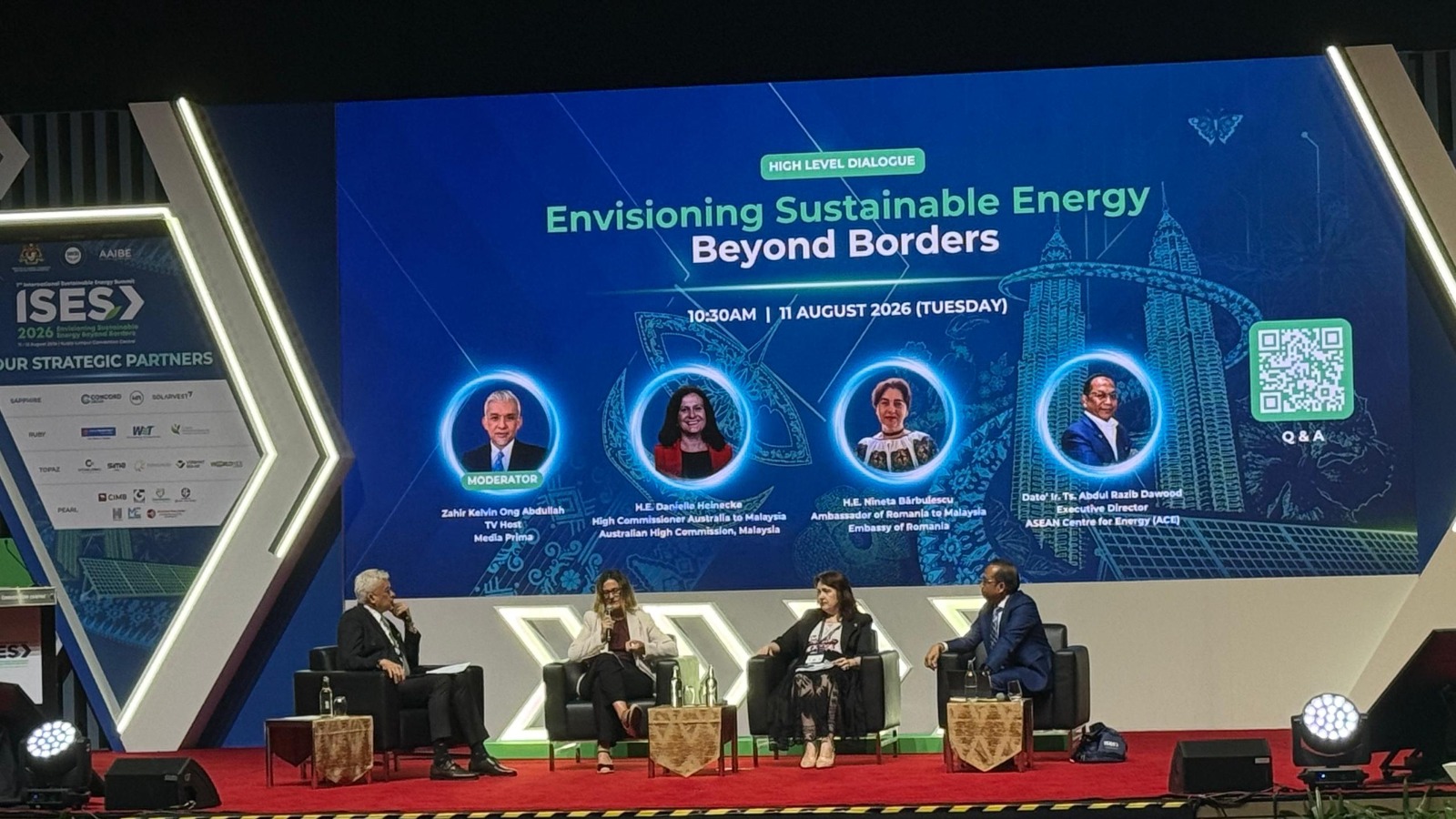
KUALA LUMPUR: Australia is looking to Sarawak’s hydropower potential, including pumped hydro, as an important part of the region’s transition towards renewable energy.
High Commissioner of Australia to Malaysia Danielle Heinecke said Australia was also increasingly focused on Sarawak’s hydropower development as opportunities for regional clean energy cooperation continued to grow.
“We’re all looking at Sarawak and we’re all looking at hydro there. Pumped hydro in Australia is getting behind that,” she said this during the high-level dialogue session titled ‘Envisioning Sustainable Energy beyond Borders’, held in conjunction with the 7th International Sustainable Energy Summit 2026 at the Kuala Lumpur Convention Centre today.
Heinecke said Australia’s own energy transition had taken decades and was not a smooth process, with political alignment among its federal and state governments proving to be one of the major challenges.
She said Australia’s electricity markets were decentralised at the state level, requiring time to establish common agreements on how electricity markets should operate.
“The hardest challenge is always political alignment, to be honest,” she said, stressing the need to establish the right regulatory environment to encourage private sector financing and investment.
She said Australia’s experience showed that once rules, technical standards and market mechanisms were aligned, investment would begin to flow into renewable energy.
Heinecke said Australia is also supporting the ASEAN Centre for Energy and the ASEAN Power Grid because it viewed the success of ASEAN as beneficial to Australia, while seeing significant opportunities for cooperation in renewable energy.
“Renewable energy is going to be the future,” she said, adding that Australia wanted to be part of Southeast Asia’s energy transition through ASEAN as well as bilateral mechanisms.
On the challenges facing regional clean energy investment, she outlined several measures, including connecting isolated electricity grids over time to create a regional electricity market.
She said greater interconnection would allow countries and regions to take advantage of their different energy resources, such as solar, wind and hydropower.
She also called for cross-border power purchase agreements and harmonised technical grid specifications to reduce transaction costs, with the ASEAN Power Grid potentially helping address some of these regulatory challenges.
Among other measures, she highlighted the need to liberalise electricity markets, establish incentives for private sector investment, and develop renewable energy zones based on Australia’s experience.
Heinecke also stressed the importance of moving towards market-driven pricing for electricity generators and consumers, saying renewable energy combined with storage had become the cheapest form of energy in Australia as costs continued to decline.
However, she said the transition required appropriate incentives, tariffs and policies, as well as addressing inefficient subsidies to ensure investment was directed towards efficient and sustainable long-term projects.
She added that significant investment in electricity grids was also needed, including stronger networks, effective energy storage and greater power system flexibility to reduce unused renewable energy while improving resilience for industries and consumers.