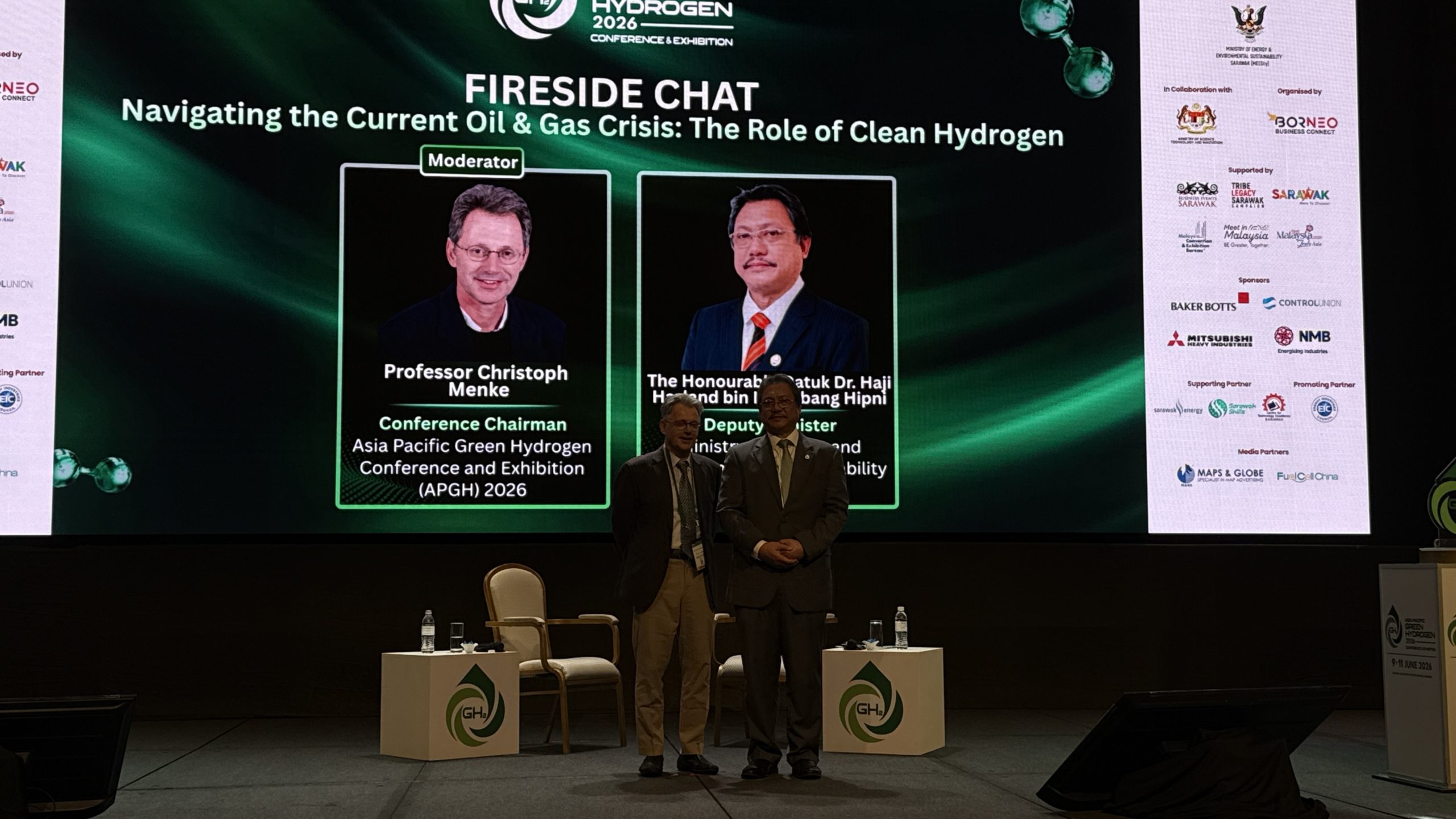
KUCHING: Sarawak is accelerating its development of a hydrogen-based economy by leveraging strong policy frameworks and expanding infrastructure to support clean energy growth, particularly in transport and industrial applications.
Deputy Minister of Energy and Environmental Sustainability Datuk Dr Hazland Hipni said the state has already begun implementing key components of its hydrogen roadmap, with early focus on domestic use, especially in mobility.
He said Sarawak’s hydrogen development journey has progressed from initial planning stages over the past few years to early implementation, particularly in public transport systems powered by hydrogen.
“We have the roadmap and we started with basic domestic requirements, especially on mobility. We have not only developed public transport powered by hydrogen, but also multi-fuel stations,” he said during the Fireside Chat titled “Navigating the Current Oil and Gas Crisis: The Role of Clean Hydrogen” held in conjunction with the Asia Pacific Green Hydrogen Conference and Exhibition (APGH) 2026 at the Borneo Convention Centre Kuching (BCCK) here Tuesday.
The session was moderated by Professor Christoph Menke, conference chairman of APGH 2026.
He said the multi-fuel stations being developed will integrate fossil fuel, electric charging and hydrogen refuelling capabilities under one system to support a gradual transition to cleaner energy.
“We are developing about five of those multi-fuel stations throughout Sarawak, and another 20 smaller stations in the next five years,” he added.
Hazland also highlighted ongoing development of the Autonomous Rapid Transit (ART) system, which forms part of Sarawak’s broader clean mobility agenda.
He said two major hydrogen production projects — H2biscus and H2ornbill, involving international partners from South Korea and Japan, are also part of the state’s long-term strategy, although they have been adjusted due to financial considerations.
“Even though we need to downscale a little bit because of financial constraints, after the war things can change. Investors can come,” he said.
The H2ornbill Project, led by SEDC Energy with Japan’s ENEOS and Sumitomo Corp, will build two hydrogen plants targeting 90,000 metric tonnes of clean hydrogen annually by 2030.
Meanwhile, the H2biscus Project partnering South Korea’s Samsung Engineering, Posco, and Lotte Chemical, aims to develop hydrogen derivative facilities with a 150,000 metric tonne per year capacity.
He added that global uncertainties have made Sarawak a more attractive destination for investors seeking stability and long-term opportunities in green energy.
“Investors are now looking at us and they know our huge potential, especially from our natural resources, leadership and very stable political situation in Sarawak and Malaysia,” he said.
Hazland said this positions Sarawak strongly for future expansion of its green hydrogen sector, supported by a combination of policy direction and resource advantage.
Sarawak’s hydrogen development is guided by several key frameworks, including the Post Covid-19 Development Strategy (PCDS) 2030, National Energy Transition Roadmap (NETR), Hydrogen Economy and Technology Roadmap, and the Sarawak Energy Transition Policy (SET-P).