KUCHING: Sarawak is strengthening its position in the semiconductor industry by investing in young talent and providing students with early exposure to integrated circuit (IC) design and advanced technology.
Minister for Education, Innovation and Talent Development Datuk Seri Roland Sagah Wee Inn said the strong participation of the SMD IC Design Sarawak State-Level Make-A-Thon reflected the growing interest among young Sarawakians in advanced technology industries.
“The enthusiasm shown by the students proves that our young people are curious, ambitious and ready to embrace opportunities in advanced technology when given the right platform,” he said when speaking at the showcase and closing ceremony of the SMD IC Design Sarawak State-Level Make-A-Thon at Swinburne University of Technology Sarawak Campus (Swinburne Sarawak) here yesterday (Jul 18).
Sagah described the Make-A-Thon as more than a competition, calling it a strategic talent development initiative that exposes students to real-world industry challenges.
“This programme provides early exposure to integrated circuit design, innovation and problem-solving, which are essential capabilities for future industries. We are connecting talent directly with industry and the economy,” he said.
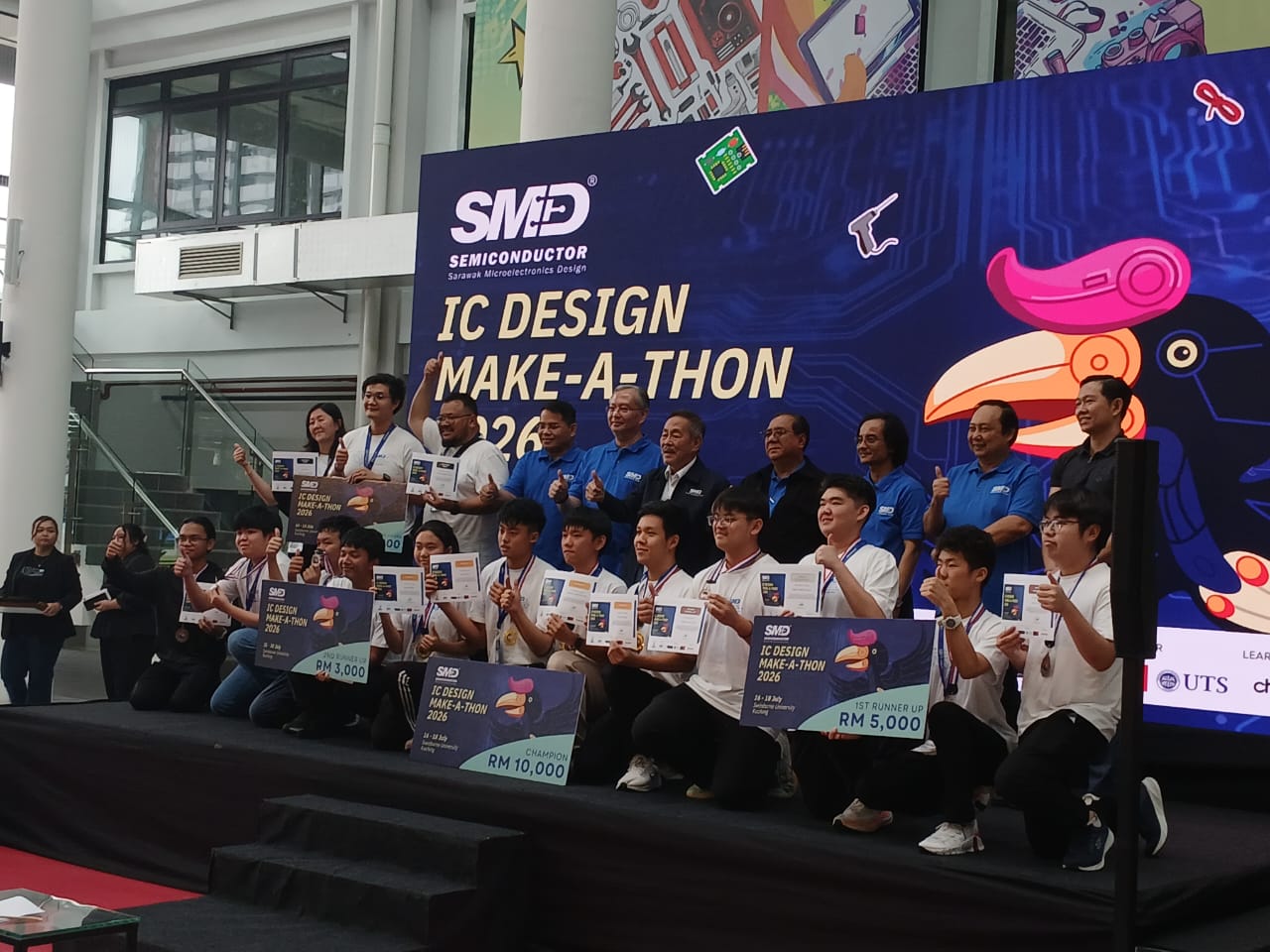
The SMD IC Design Sarawak State-Level Make-A-Thon, held at the Borneo Atrium, Swinburne Sarawak, brought together hundreds of secondary school and university students from across the state to showcase innovation, creativity and problem-solving skills in semiconductor design.
A total of 624 participants took part in the statewide programme, including 575 secondary school students and 59 university students from 64 educational institutions across Sarawak. After several rounds of competition, 15 finalist teams involving 51 participants from 23 institutions advanced to the state-level finals.
Organised by SMD Semiconductor with the support of the Ministry of Education, Innovation and Talent Development (MEITD), the programme is aimed at developing a pipeline of highly skilled local talent to support Sarawak’s growing semiconductor ecosystem.
Each finalist team comprised two secondary school students and two university students, a format designed to encourage cross-level collaboration, peer learning and knowledge sharing.
He also said initiatives such as the Make-A-Thon help move learning beyond classrooms and textbooks into practical applications.
“Students are encouraged to think critically, collaborate and innovate. This is not an examination. If they fail, they learn, improve and eventually become experts,” he said.
He added that Sarawak is actively developing strategic sectors such as semiconductors, aerospace, satellite technology, renewable energy, hydrogen and the digital economy, all of which rely heavily on advanced semiconductor technologies.
“Semiconductors are strategic enablers for many of the technologies shaping the future, including artificial intelligence, automation and smart systems. To succeed in these sectors, Sarawak must develop a highly skilled local workforce,” he said.
Sagah also stressed the importance of aligning education with industry needs as technology evolves rapidly.
“We must prepare our young people not only with technical competencies but also with adaptability, creativity and strategic thinking. Our education ecosystem must evolve together with industry,” he said.
He encouraged students not to limit themselves based on geography or background, reminding them that perseverance and a willingness to take on challenges are key to success.
“Young Sarawakians should believe that they can compete globally. Opportunities in advanced technology industries are growing rapidly, and we want our local talent to lead that growth,” he said.
The SMD IC Design Sarawak State-Level Make-A-Thon was organised by SMD Semiconductor in collaboration with strategic partners Swinburne Sarawak, Universiti Malaysia Sarawak (UNIMAS) and University of Technology Sarawak (UTS), reinforcing the strong partnership between government, academia and industry in developing Sarawak’s next generation of technology innovators.
Also speaking at the event, State Financial Secretary and chairman of SMD Semiconductor Datuk Seri Dr Wan Lizozman Wan Omar, said SMD Semiconductor is playing a pivotal role in shaping Sarawak’s future semiconductor ecosystem by nurturing local talent and encouraging more young people to pursue studies and careers in IC design and advanced technology.
He said talent development remains the cornerstone of Sarawak’s ambition to become a high-income, innovation-driven economy.
He said the semiconductor industry is no longer a niche sector, but one that powers technologies people use every day, from smartphones and laptops to artificial intelligence, smart systems and advanced electronics.
“As Sarawak progresses towards a knowledge and innovation-driven economy, investment in talent is just as important as investment in infrastructure and technology. We are proud to pioneer a dedicated IC design programme for secondary and tertiary students because we believe talent must be discovered early, nurtured early and supported consistently,” he said.
Wan Lizozman also said the overwhelming response to this year’s Make-A-Thon demonstrates that young Sarawakians are eager to embrace future technologies when given the right opportunities. He encouraged students, regardless of their background, to dream big and believe in their potential.
“Whether you come from the city, a small town or a longhouse, never limit yourself. Your background does not determine your future. Be the Bill Gates of Sarawak, the Steve Jobs of Sarawak or the Jensen Huang of Sarawak. Continue learning, stay curious and never be afraid of failure because the future of Sarawak’s semiconductor industry will be built by talent, courage and innovation,” he said.
Meanwhile, Swinburne Sarawak Board of Directors chairman Datuk Amar Jaul Samion said strong collaboration between academia, industry and the government is essential in preparing the next generation of talent to support Sarawak’s Semiconductor Roadmap 2030 and the state’s aspiration of becoming a high-income, innovation-driven economy.
He said semiconductor technology is now the backbone of many emerging industries, powering artificial intelligence, renewable energy, aerospace and advanced electronics.
“For our students, understanding semiconductor technology is no longer just an academic exercise. It is their gateway to participating in the future global economy. To successfully realise Sarawak’s aspirations, academia and industry must work hand in hand, and collaboration is the key to making that happen,” he said.
He commended SMD Semiconductor for bringing industry-level IC design challenges directly to students, allowing them to develop critical thinking, innovation and problem-solving skills beyond the classroom.
“True innovation does not come from textbooks alone. It comes from the courage to tackle unfamiliar challenges, learn through trial and error, and work collaboratively. Programmes like this provide the exposure needed to ignite students’ passion for technology and help transform them into industry-ready engineers, innovators and future leaders,” Jaul said.
Also present at the event were Sarawak Research Development Council (SRDC) general manager and SMD Semiconductor board member Dr Peter Morin Nissom, Salihin Chartered Accountants founder and managing partner and SMD Semiconductor board member Datuk Dr Salihin Abang, SMD Semiconductor chief executive officer Shariman Jamil and others.