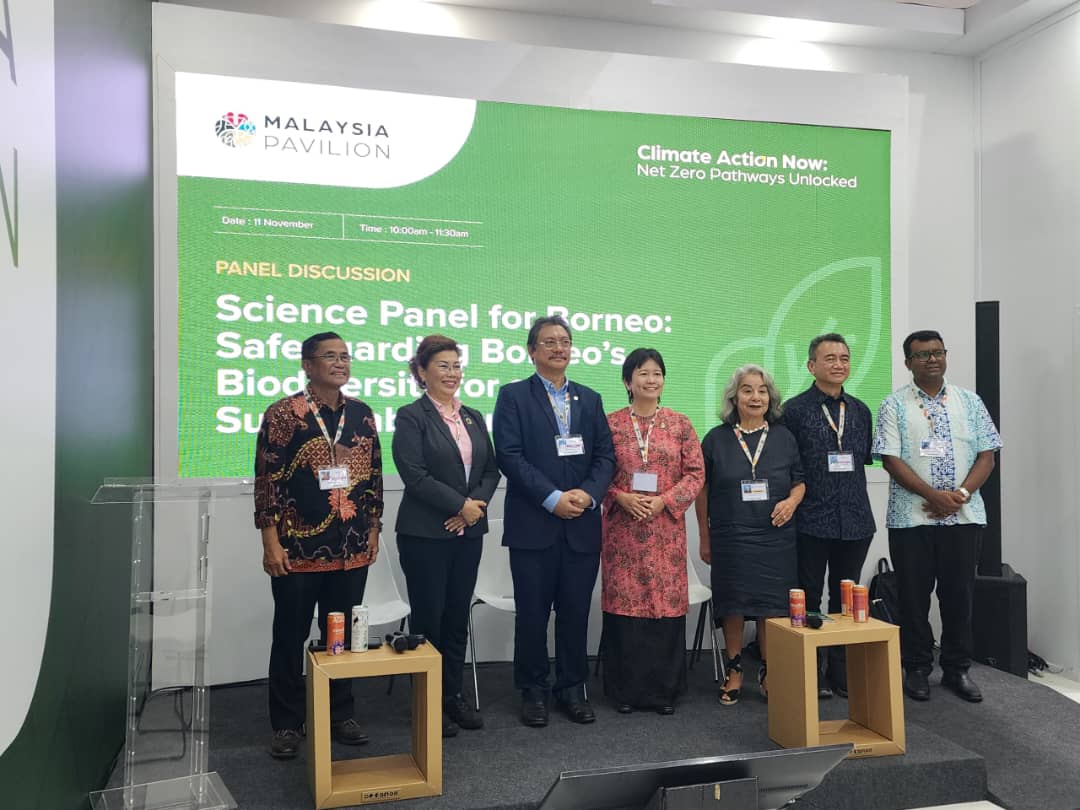
BELEM, Brazil: Sarawak reinforced its commitment to sustainability and regenerative agriculture at the COP30 ‘Science Panel for Borneo: Safeguarding Borneo’s Biodiversity for a Sustainable Future’ session held here.
Deputy Minister for Energy and Environmental Sustainability Sarawak, Datuk Dr Hazland Abang Hipni, took part in the panel discussion titled ‘The Borneo Sustainable Agriculture Assessment: A Pathway to Regenerative, Just, and Climate-Resilient Food Systems’.
The 40-minute dialogue explored governance levers, fiscal incentives, and land-use reforms needed to accelerate regenerative agriculture while supporting smallholders and protecting peatlands.
The session was moderated by Prof. Jatna of the UNSDSN, and featured other panelists, including Prof. Datuk Dr Mazlin Mokhtar, Emma Tores, Prof. Leong Yuen Yoong, and Datuk Dr Lulie Meling.
Dr Hazland highlighted that Sarawak has launched its Sustainability Blueprint 2030, outlining the region’s sustainable development vision, including tools addressing sustainable agriculture to accelerate regenerative practices and support smallholders.
“Transforming agriculture at scale requires targeted governance tools such as adoption incentives, financial support, value chain development, and skills investment,” he said.
He elaborated that adoption incentives should include financial support tied explicitly to regenerative farming practices such as cover cropping and reduced tillage, while public-private partnerships should mobilise capital for scaling these efforts.
He also emphasised the importance of creating sustainable markets that reward certified, fair-trade products and integrating indigenous knowledge systems into modern agricultural policy and education.
He further underscored that Sustainable Forest Management remains crucial for developing regions.
“Through the Sarawak Land-use Policy and Sustainability Blueprint 2030, targets have been set to expand Totally Protected Areas and Permanent Forests, including restoring 200,000 hectares of degraded sites by 2030 through reforestation and peatland restoration,” he said.
He also stressed the importance of blending indigenous knowledge with scientific research and policy innovation to redefine sustainable agriculture.
“Redefining sustainable agriculture for Borneo means inclusivity, preservation of cultural heritage, and leadership from empowered local communities,” he concluded.